

What if your accounts could do more than explain what’s already happened? If you’re asking “what does a business advisor do”, the practical answer is that they help turn business information into clearer decisions and useful next steps. That can mean looking beyond compliance to questions about cash flow, pricing, growth or day-to-day operations.
It’s understandable to want advice that fits your business, not a general list of ideas. An adviser can help you make sense of the numbers and weigh up your options, while accounting work may focus more on reporting and tax obligations. The roles can overlap, so it helps to be clear about the agreed scope and which decisions remain yours.
This guide explains what a business adviser can help with, when their perspective may be useful and how the role differs from accounting or project-based consulting. You’ll also learn what to prepare for a productive conversation, so you can bring your current challenges and goals into focus. For Australian small and medium-sized businesses, a structured discussion can help turn uncertainty into practical action.
Key Takeaways
- Learn what does a business advisor do, and how their guidance can help you assess choices while keeping decisions in your hands.
- See how advisory support can bring clarity to business priorities, from financial questions to operational decisions.
- Understand the typical differences between an adviser, an accountant and a consultant, while recognising where their work may overlap.
- Prepare for a focused conversation by identifying your concern, gathering relevant information and clarifying what you want to achieve.
- Explore how Stewart Private Accounting brings business advisory together with accounting, taxation, bookkeeping and expert tax planning.
What does a business advisor do for a small business?
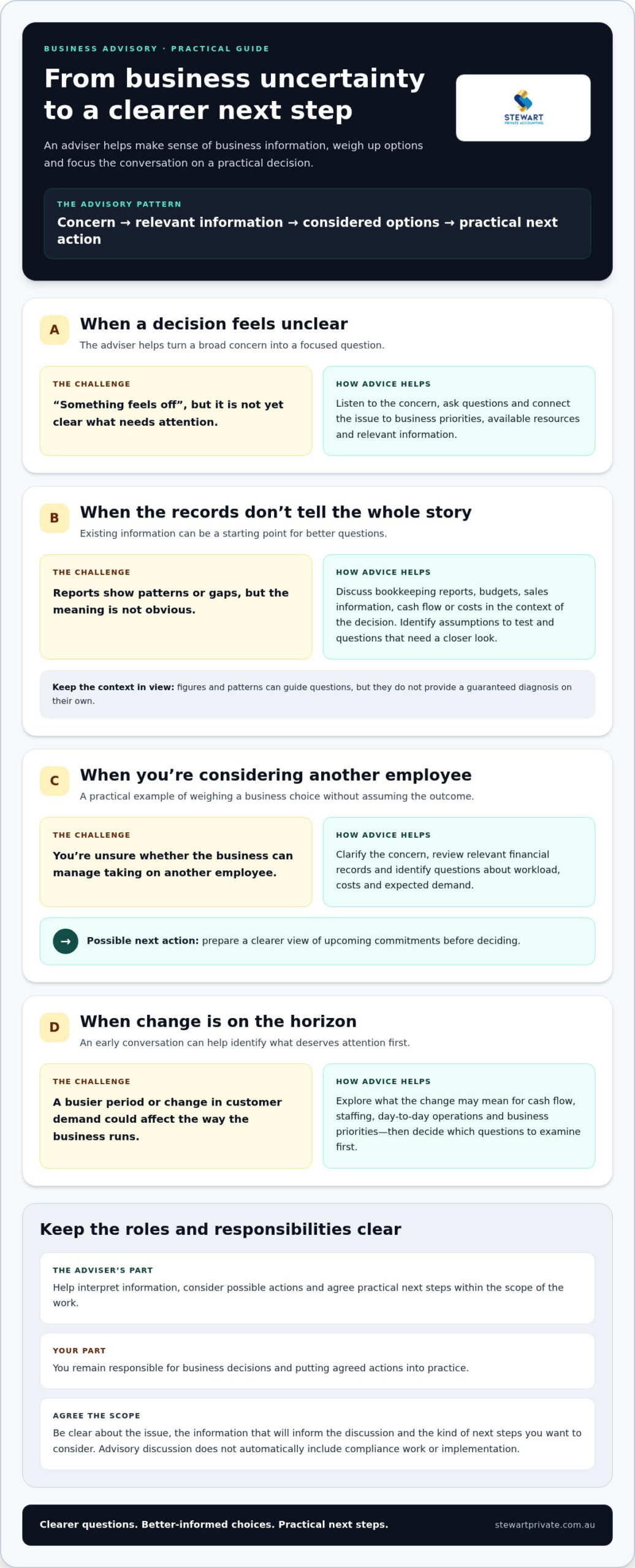
A business adviser helps you understand the choices in front of you and plan practical next steps. They can interpret information such as cash flow, sales patterns, costs and business priorities, then help you consider what those details may mean for a decision. The aim is to bring structure to a question that feels unclear, not to take control of your business.
So, what does a business advisor do in a working relationship? They listen to your concerns, ask questions and help you weigh possible actions against your goals and available resources. This is related to the broader field of management consulting, but the specific scope depends on your business, your priorities and what you agree to work on together. You remain responsible for decisions and for putting agreed actions into practice.
What does business advice look like in practice?
Say you’re unsure whether your small business can manage another employee. An adviser might help clarify the concern, review relevant financial records and identify questions about workload, costs and expected demand. You could then agree on a practical next action, such as preparing a clearer view of upcoming commitments before deciding. The discussion helps you assess the decision, without promising a particular result.
Existing records are a useful starting point, even if they don’t answer everything. Bookkeeping reports, budgets or sales information may highlight patterns to explore, gaps to resolve or assumptions worth testing. The adviser connects those details to the decision at hand, so the conversation moves from “something feels off” to a focused question and a practical next step.
Which businesses might use an advisor?
A sole trader may want a second perspective when weighing a change in workload, pricing or business direction. A small or medium-sized business might seek advice as it grows, takes on more complex responsibilities or needs to make better use of its financial information. The right discussion depends on the business and the owner’s priorities, rather than a standard checklist that applies to everyone.
You don’t need to wait until a problem becomes a crisis. Advice can help you think through a decision while you still have time to consider options and plan. For instance, an owner anticipating a busier period could discuss what the change may mean for cash flow, staffing or day-to-day operations. The value lies in examining relevant questions early and deciding what deserves attention first.
A useful advisory relationship should have a clear scope. Agree on the issue to address, the information that will inform the discussion and the kind of next steps you want to consider. This keeps the guidance connected to your circumstances, rather than leaving you with broad ideas that are difficult to act on.
What areas can a business advisor help you understand?
Business advice can cover several parts of running a business, but the focus should reflect your circumstances and the scope you agree with your adviser. If you’re asking what does a business advisor do beyond discussing accounts, they can help connect business information with choices about priorities, performance, operations or planning. The adviser’s role is to interpret and discuss information, not automatically complete every compliance task or put each decision into action.
Useful advice links your business context to a clear next step. For instance, a change in customer demand might prompt a conversation about which goals to prioritise, what information would help you assess the situation and what to explore next. Figures and patterns can guide questions, but they don’t provide a guaranteed diagnosis on their own.
Planning, performance and business priorities
An adviser can help you organise your goals and decide what deserves attention first. Performance information, such as sales patterns or changes in costs, can provide a starting point. Rather than treating one figure as a complete explanation, look at what else is happening in the business and identify which questions need a closer look.
- Planning: clarify which business goals matter most and what decisions could support them.
- Performance: use available information to identify patterns or questions, then consider what context may explain them.
- Operations: discuss whether existing ways of working fit your current priorities and responsibilities.
The specific topics depend on the advisory relationship. For a wider view of the kinds of support that may sit under this umbrella, RSM Australia’s Business Advisory services outlines a range of business advisory areas. It’s a useful reminder that the term can cover different needs, rather than one fixed service for every business.
Accounting, tax and operational context
Bookkeeping and accounting information can help frame broader business discussions. Records may show what has happened, while an advisory conversation can help you consider what those details mean for a decision about priorities or future plans. Reviewing information together doesn’t necessarily mean the adviser is completing a separate compliance task or implementing a change. Those responsibilities depend on the agreed work.
Tax planning may also form part of a wider conversation, particularly when you’re considering how a business decision fits with your tax position. Individual circumstances matter, so general discussion shouldn’t be treated as personal tax instructions. For more context, read this Perth tax planning guide.
Stewart Private Accounting provides business advisory alongside accounting and tax support. Explore business advisory support to see how these services can fit together.
Business advisor, accountant or consultant: what is the difference?
The roles can overlap, but they usually begin with different questions. An accountant may help you understand financial records, reporting and tax matters. A business adviser helps you consider what those details mean for your priorities and direction. A consultant is often engaged to examine a defined issue or support a specific piece of analysis or implementation.
These are typical purposes, not strict boundaries. The right professional depends on the question you need to resolve and the agreed scope of work. If you’re wondering what does a business advisor do compared with an accountant, think of the adviser as helping connect business information to choices, while accounting work can provide important financial context for that discussion.
| Professional | Typical focus | A question they may help address |
|---|---|---|
| Accountant | Financial records, reporting and tax matters | What do the records show, and what accounting or tax work is needed? |
| Business adviser | Options, priorities and business direction | Given the information available, what should we consider next? |
| Consultant | A defined specialist analysis or implementation task | How can we assess or deliver this particular project? |
How does business advice differ from accounting?
Accounting information can help answer what has happened in your business; an advisory discussion can help you consider how that information relates to a decision ahead. For example, records might show a shift in sales across different parts of the business. An accountant can support the relevant financial reporting, while an adviser may help you explore questions about priorities or direction. The work can complement each other and may sit within a connected relationship.
The scope still matters. Reviewing figures as part of a discussion doesn’t automatically mean an adviser is preparing accounts or completing a tax obligation. If you’re considering how the service arrangement itself is structured, this fixed-fee accountant guide explains how agreed support can be made clearer.
When might a business need specialist advice?
Some questions call for expertise beyond general business guidance. A legal issue may need a lawyer; a decision about a financial product may require an appropriately qualified specialist; and a lending matter may need to be discussed with a lender. A business adviser can help you clarify the business question and consider how it relates to your priorities, but shouldn’t be treated as a substitute for specialist advice.
Start with the decision you need to make, then match the support to the nature of that question. The professional’s role and agreed scope should be clear, especially where compliance, legal interpretation or regulated services are involved. Accounting and advisory support can work alongside specialist input, with each professional contributing within their own area.
How to prepare for a useful business advisory conversation
A little preparation can help you use the conversation well, especially if you’re juggling several business concerns. You don’t need a perfect set of answers. Bring the issue you want to discuss, relevant context and a sense of what you hope to clarify. If you’re asking, “what does a business advisor do with the information I bring?”, they use it to understand your situation and shape a focused discussion, not to make decisions on your behalf.
- Define the concern. Write down the decision or difficulty you want to discuss. For example, you may be weighing a change in direction or trying to understand why a business priority has become harder to manage.
- Gather context. Bring relevant financial information, recent business records and details of upcoming decisions. Choose material related to the question rather than trying to assemble every document you have.
- Discuss options. Explain what you’ve already considered, what constraints you’re working with and what matters most to the business. Clear questions help keep the discussion practical and show where further information may be useful.
- Agree next steps. Before wrapping up, summarise what needs attention, who will take responsibility and when you’ll revisit the matter. Keep the actions proportionate to your priorities and available resources.
What information should you bring?
The useful material depends on the topic. A conversation about business direction may call for a summary of current priorities and an upcoming decision, while a discussion involving financial context may benefit from relevant bookkeeping or accounting records. Bring a concise outline of what’s concerning you, what’s changed and what you’d like to understand. There’s no universal document list for every advisory discussion.
It also helps to note any assumptions you’re working with. If you’re considering a significant change, describe what you currently expect and what information is still uncertain. That gives the adviser a clearer starting point and helps distinguish known facts from questions that need further attention.
How to turn advice into manageable action
Preparation connects your question to the information and priorities that matter. After discussing possible approaches, consider each action in light of its relevance, timing and the people or resources available to carry it out. You may decide to start with one practical step rather than trying to address every issue at once.
Record the agreed actions, who is responsible and any follow-up points to revisit. This creates a shared reference for the next conversation and helps prevent useful discussion from becoming a list of intentions with no clear owner. If circumstances change, adjust the priorities rather than treating the original plan as fixed.
If you’re ready to bring a business question into focus, explore business advisory services in Perth. You can also start a conversation about business advisory support with Stewart Private Accounting.
What business advisory support can look like at Stewart Private Accounting
Stewart Private Accounting is a Perth-based accounting and advisory practice supporting small and medium-sized businesses. Business advisory sits alongside accounting and taxation, bookkeeping and expert tax planning, helping you consider a business decision with relevant financial context in view. The focus is on understanding your circumstances and priorities, then shaping the discussion around the questions that matter to your business.
This connection can be useful when you want more than a record of past activity. For example, financial information may form part of a conversation about business priorities, while tax planning may be relevant when considering a future decision. The discussion should stay grounded in your needs and the agreed scope of support, with you retaining responsibility for your business decisions.
A hands-on approach shaped around your business
Good support starts with your actual situation, not a standard set of recommendations. Your current pressures, goals and available information help shape the conversation, so you can work through what deserves attention and what a practical next step might involve. As your circumstances change, the priorities you bring to an advisory discussion can change too.
Bradley Stewart leads the practice. He is a Chartered Tax Adviser and Registered Tax Agent, with more than 15 years of public accounting and consulting experience. That background brings accounting and tax understanding into advisory conversations, while keeping the discussion centred on your business context and the decisions you need to consider.
Tailored fixed-fee packages provide clarity about the services agreed. Knowing the scope of the arrangement helps you understand what support is covered and how it relates to your priorities, without assuming that every business needs the same work. The support is shaped around the agreed services and your circumstances.
A clear next step for Perth business owners
You can make an initial discussion more focused by identifying the decision, pressure point or uncertainty you want to explore. Bring a brief outline of what’s happening, why it matters now and what you’d like to understand better. The conversation can begin with your business context and the issue you want to address, rather than jumping straight to a solution.
You don’t need to have everything mapped out before raising a question. A clear starting point helps you and your adviser consider what information is relevant and what next steps may suit your priorities. If you’re ready to discuss your business advisory needs with Stewart Private Accounting, get in touch to discuss your business and possible next steps.
Take the next step with greater clarity
The practical answer to “what does a business advisor do” depends on the decision you’re facing. Advice is most useful when it gives you space to pause, examine the situation and choose a sensible direction, while keeping ownership of the decision in your hands. You don’t need to have every detail resolved before starting that conversation.
As your business changes, the questions you need to consider may change too. Identify the pressure point taking up most of your attention and decide what clarity would help you move forward. That gives an advisory discussion a clear purpose, without requiring you to solve everything at once.
Stewart Private Accounting works with small and medium-sized businesses in Perth, with tailored fixed-fee packages that clarify the agreed services. If you’re ready to explore your options, discuss your business advisory needs with Stewart Private Accounting. A thoughtful conversation can help you approach the next decision with a steadier sense of direction.
Frequently Asked Questions
When should I speak to a business advisor?
Consider speaking with an adviser when you face a significant choice, your priorities are shifting or you’re unsure what deserves attention first. A business owner preparing to take on new responsibilities, for instance, might want to think through the decision before committing. You don’t have to wait until a challenge is urgent. Whether advice is useful depends on your circumstances and goals, and not every business needs ongoing support.
Can a business advisor help improve profitability?
An adviser can help you examine factors that may affect profitability, such as whether a product’s selling price reflects its costs or whether demand has shifted. They can help organise relevant information and discuss possible responses, but outcomes depend on your decisions, business conditions and other factors. A conversation isn’t a promise of higher profit. Any accounting, tax or operational work needed may have a separate scope.
Is a business advisor the same as an accountant?
No, the roles often have different purposes, although they can overlap. An accountant commonly helps maintain financial records, prepare reporting and address tax matters. An advisory discussion may use that information to explore a choice, such as which business priority to focus on next. Some practices provide both types of support. The work you receive depends on the services and scope agreed for your circumstances.
What should I discuss with a business advisor?
Start with the decision, concern or goal that prompted you to seek a conversation. Explain what’s happening in the business, any relevant deadlines and what you’ve already considered. If the issue involves a planned change, note when you need to decide and what information you’re still missing. Bring records that relate to the topic, then agree which priorities and follow-up actions make sense.
How often should a business meet with an advisor?
There’s no universal meeting schedule for business advisory. You might seek guidance around a particular decision, or arrange regular discussions if that suits your needs and agreed relationship. Timing can depend on upcoming business choices, changing priorities and the support you’ve arranged. Rather than meeting to follow an arbitrary timetable, consider whether the conversation helps address relevant questions and gives you enough time to act on agreed steps.
How are business advisory fees structured in Australia?
Business advisory fees and arrangements vary according to the work involved and the agreed scope. Some practices offer fixed-fee packages for defined services, while other arrangements may differ. There’s no single model that suits every business, and fees shouldn’t be assumed without understanding what’s covered. Stewart Private Accounting offers tailored fixed-fee packages designed to give clients clarity about agreed services, including support for small and medium-sized businesses in Western Australia.