

A tax payment that arrives before you’ve planned for it can put pressure on cash flow and distract from running your business. With tax planning Perth business owners can connect tax obligations with decisions about spending, growth and major changes, rather than leaving every consideration until lodgement time.
Deadlines and record keeping can feel like another job on an already full schedule. Routine compliance helps you meet reporting obligations; proactive tax planning looks ahead. It helps you consider the tax implications of business decisions before acting and include expected payments in cash-flow forecasts.
This guide explains which decisions may benefit from tax advice, how organised records can support planning, and what to consider when choosing professional support with clear fee expectations. Stewart Private Accounting is a Perth-based practice led by Bradley Stewart, a Chartered Tax Adviser and Registered Tax Agent. It supports businesses with taxation, bookkeeping and business advice, connecting current responsibilities with longer-term business goals.
Key Takeaways
- Plan ahead to connect tax obligations with cash-flow forecasts and business decisions, rather than leaving every consideration until tax time.
- Review records, forecasts and relevant obligations throughout the year so advice can inform decisions before you act.
- Use tax planning Perth guidance to explore how your business structure and circumstances shape the questions worth discussing with a tax adviser.
- Follow a practical process: organise records, note business changes, identify upcoming decisions, seek advice and record next steps.
- Look for support with relevant credentials, clear communication and a well-defined scope and fee approach that suits your needs.
Why tax planning in Perth matters before tax time
Tax decisions are easier to manage when you consider them before a deadline or major business change. A forward-looking review can help you understand how expected income, expenses and obligations may affect available cash, while leaving time to organise records and seek advice. Perth businesses follow the same national tax rules as other Australian businesses, but may also need to account for Western Australian requirements that apply to their circumstances.
Compliant tax planning is the lawful, forward-looking consideration of a business’s circumstances and current tax rules to inform decisions, meet obligations and plan for their financial effects. It is not a way to avoid tax unlawfully. A general overview of the concept is available in Tax planning; advice for an Australian business should be based on applicable Australian rules.
What does business tax planning involve?
A review may consider expected income and expenses, cash-flow forecasts, current obligations and decisions on the horizon. Before committing to new equipment, hiring staff or changing how the business operates, for example, consider how the decision’s timing and structure may affect tax and the cash available for other costs. The aim is an informed business decision, not a tax outcome in isolation.
Planning complements bookkeeping, tax return preparation and routine compliance. Bookkeeping keeps financial records organised; compliance work helps meet reporting and payment responsibilities; return preparation reports relevant information for a period. Planning uses that information to look ahead. Each has a distinct role, and reliable records make forward-looking advice more useful.
Why Perth businesses benefit from a forward-looking approach
Business owners balance customer demand, supplier costs, wages and investment while keeping up with administration. Reviewing the likely timing of income and expenses can make cash-flow forecasts more useful and help you prepare for tax payments instead of treating them as an unexpected draw on funds. It also gives you time to gather missing information and resolve questions before they become last-minute tasks.
Western Australian businesses may need to consider Australian obligations, such as GST or PAYG instalments where applicable, as well as state obligations that apply to their circumstances. Payroll tax, for example, may be relevant to some employers depending on their taxable wages and current rules. Requirements can change, so check current official guidance or obtain advice before relying on a threshold, deadline or tax treatment.
Planning priorities depend on how your business operates. A sole trader’s income and record-keeping considerations may differ from those of a company. A growing small or medium-sized business may need to account for payroll, changing cash-flow demands or planned expansion. No structure is right for every owner. Tax planning Perth businesses can use effectively starts with their actual structure, income patterns, obligations and future plans. That context keeps advice practical, compliant and connected to the decisions you need to make.
What a tax planning review should cover throughout the year
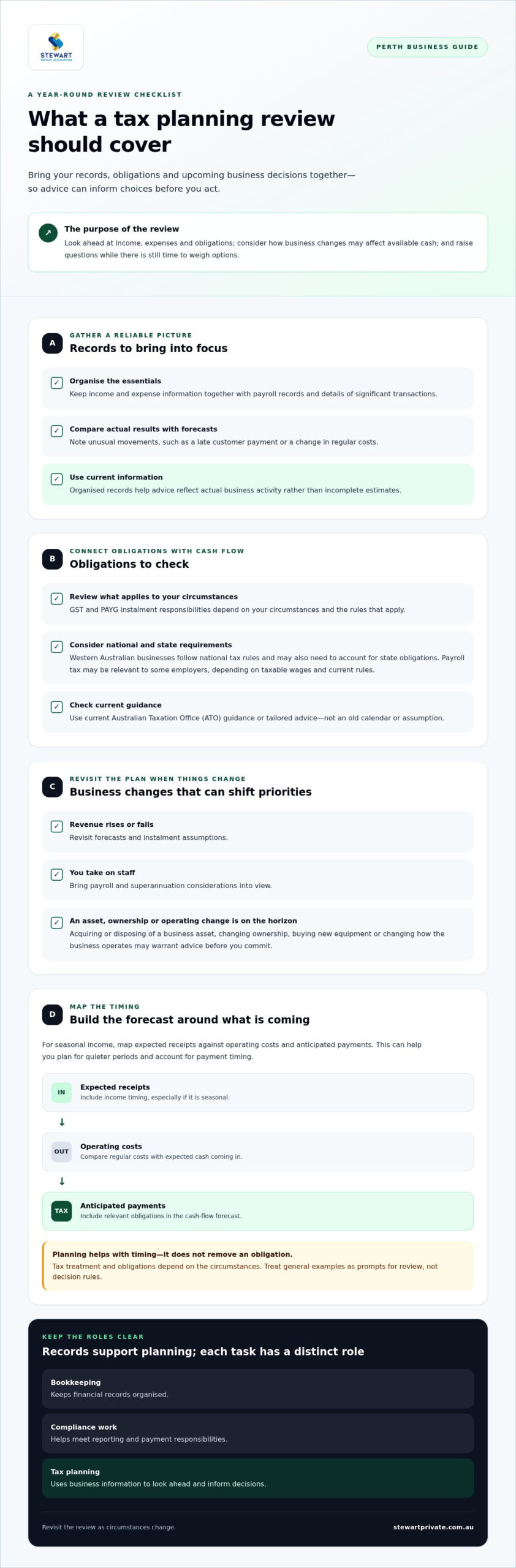
A useful review turns current records and your business outlook into decisions you can act on. It can help you spot upcoming tax obligations, consider how changes may affect available cash and raise questions while there’s still time to weigh your options. Revisit the review as circumstances change rather than treating it as a once-a-year task.
Records and obligations that inform tax advice
Accurate records give an adviser a clearer picture of how the business is tracking. Keep income and expense information organised alongside payroll records and details of significant transactions. Compare actual results with forecasts, and note unusual movements, such as a late customer payment or a change in regular costs. This helps distinguish a temporary cash-flow shift from a change that may need a longer-term response.
Current, organised records make a tax review more relevant because advice can be based on actual business activity, not incomplete estimates. They also help identify obligations that need attention. GST and PAYG instalment responsibilities depend on your circumstances and the rules that apply, so check current Australian Taxation Office (ATO) guidance rather than relying on an old calendar or assumption.
A review can connect obligations with your cash-flow forecast. If income is seasonal, mapping expected receipts against operating costs and anticipated payments can help you plan for quieter periods. It won’t remove an obligation, but it can make its timing easier to account for.
How business changes can affect planning priorities
Business changes are useful prompts to revisit the plan. A rise or fall in revenue may affect forecasts and instalment assumptions. Taking on staff can bring payroll and superannuation considerations into view, while acquiring or disposing of a business asset may warrant advice before you commit. Changes in ownership can also raise new questions. Tax treatment and obligations depend on the circumstances, so don’t use a general example as a decision rule.
For a Western Australian business, relevant considerations may include national tax obligations and state requirements, such as payroll tax where applicable. A review can identify which areas need attention and whether current official guidance or tailored advice is needed. It can also account for personal goals connected to business decisions, such as how much income you plan to draw or whether you’re preparing for a future change in ownership.
Keep a short record of decisions, open questions and the next review point. This gives you a reference when forecasts or plans shift, rather than requiring you to reconstruct the reasoning later. Regular bookkeeping maintains the information this process relies on. For support connecting your records with tax and business decisions, explore tailored accounting support.
How tax planning priorities differ by business and decision
There’s no single checklist that suits every business. Start with how you operate now and what you’re considering next. A sole trader reviewing income patterns may have different questions from a company owner considering a change in ownership. A growing small or medium-sized business may need to consider staffing, investment and cash flow together. The aim is to identify relevant questions, not apply a generic shortcut.
Match planning questions to your business circumstances
For a sole trader, separating business transactions from personal spending can make income, expenses and obligations easier to understand. A company may need advice on transactions between the company and its directors or shareholders, including whether Division 7A is relevant. A growing SME might review how new staff, planned asset purchases or changing revenue affect its forecasts and obligations. These are prompts for tailored advice, not automatic reasons to change structure or act in a particular way.
Compare tax considerations before acting
Before committing to a decision, set out what is changing, what information supports it and what you need to understand. The questions below can help you prepare a focused discussion with a tax adviser. Answers depend on the business’s facts, eligibility and current legislation.
| Decision | Tax question | Records needed | Adviser discussion |
|---|---|---|---|
| Buying a business asset | What tax and cash-flow factors may affect the timing or cost of the purchase? | Quotes, expected purchase date, cash-flow forecast and business-use details | Consider the relevant tax treatment before committing; don’t assume every asset is treated alike. |
| Changing ownership | Could the proposed change affect tax obligations or reporting? | Current ownership details, proposed terms and relevant business records | Identify the implications of the specific arrangement before it proceeds. |
| Taking on staff | Which payroll, superannuation or state obligations may apply? | Staffing plans, payroll information and wage forecasts | Check which requirements apply to the business and how they affect forecasts. |
| Company transactions with a director or shareholder | Could Division 7A or another company-specific issue be relevant? | Company accounts and records of payments, loans or other transactions | Seek current, situation-specific advice rather than relying on a general rule. |
A change in cash flow can affect the urgency or order of these discussions. For instance, a purchase planned during a strong trading period may need to be reconsidered if revenue falls or customer payments are delayed. Ownership and staffing plans can also change which records and obligations deserve attention first.
For tax planning Perth businesses can rely on, start with the decision in front of you, accurate information and advice grounded in current rules. A table like this helps organise the discussion, but it can’t determine eligibility or predict a tax outcome on its own.
A practical tax planning process for Perth business owners
A clear process makes planning easier to maintain when business demands compete for your attention. Instead of relying on one end-of-financial-year discussion, build short reviews into the year and revisit the plan when circumstances or priorities change. This keeps advice connected to the decisions you’re making, not just the figures at a particular date.
- Gather your records. Bring together current financial reports, bookkeeping information and relevant records for income, expenses, payroll and significant transactions. Include cash-flow forecasts if you have them.
- Review what has changed. Note changes in revenue, staffing, ownership, assets or expected costs since your last review. A change in customer payment timing, for example, may affect the cash available for upcoming commitments.
- Identify decisions ahead. List choices you expect to make, such as investing in equipment, taking on staff or changing how the business operates. Record when you expect to decide and what information is still uncertain.
- Obtain advice before acting. Discuss the relevant facts and potential tax effects with a qualified tax adviser before finalising decisions that could materially affect the business. Any specific tax-saving strategy must suit your circumstances and current rules.
- Record next actions. Write down the agreed steps, who is responsible for each one and when you’ll review progress. Keep supporting documents with your business records.
Prepare for a useful tax planning conversation
Complete information helps an adviser understand how a decision fits your wider business position. Bring financial reports, relevant records, forecasts and details of planned changes. You don’t need to resolve every question beforehand. Note what you’re unsure about, which decision is approaching and what matters to the business, such as preserving working cash or planning an investment. That gives the discussion a practical starting point.
For a Perth business, fixed-fee accounting support in Perth can make the scope and fees clearer when you’re considering ongoing accounting and advice.
Turn advice into recorded next steps
Advice is most useful when it leads to clear action. After a review, record what you’ve agreed to do, who will handle each task and when you’ll revisit the decision or information. This gives you and your team a simple reference point and helps keep follow-up from getting lost in day-to-day work.
Revisit the plan when new decisions arise or your business circumstances shift. Not every change requires a full review, but it’s worth checking whether earlier assumptions still apply before relying on them. For a broader discussion of how clear fees can support planning, explore accounting support tailored to your business.
Choosing tax planning support in Perth that fits your business
The right level of support depends on the decisions you’re facing and how often they arise. If you need guidance on a specific transaction or change, a one-off discussion may help you understand the tax considerations before proceeding. If staffing, investment, cash flow or growth decisions come up throughout the year, ongoing support can keep advice connected to your business as it changes.
Consider whether an adviser explains obligations in plain language, understands your business context and makes the scope of their work clear. Relevant credentials matter, as does the quality of the conversation: you should understand the options, the information behind the advice and the practical steps that follow. Clear expectations around fees and scope also make it easier to plan for professional support.
What to expect from a collaborative tax adviser
A useful adviser works with the information available, asks about decisions ahead and explains how current rules may apply to your circumstances. Rather than offering a generic answer, they can clarify which issues need attention, what records would help and what to consider before acting. You should come away with a clearer understanding of your choices, not a list of unexplained technical terms.
Stewart Private Accounting is a Perth-based accounting and advisory practice led by Bradley Stewart, a Chartered Tax Adviser and Registered Tax Agent. Its credentials are relevant trust signals, alongside an approach that connects tax considerations with business decisions and cash-flow visibility. The aim is to make the advice clear and practically relevant to your business.
How Stewart Private Accounting supports Perth businesses
Accounting, taxation and business advisory can inform one another. Organised financial information provides context for tax advice, while an understanding of your business plans keeps discussions focused on decisions that matter to you. Stewart Private Accounting supports individuals and small and medium-sized businesses in Perth and across Western Australia with accounting and taxation, bookkeeping, business advice and expert tax planning.
Tailored fixed-fee packages make fees clearer and help avoid surprise bills. The scope is tailored to the relevant service, so you can understand what the arrangement covers without assuming every business needs the same support. If you’re considering ongoing advice, clear scope helps you assess how it fits your priorities and budget.
For tax planning Perth business owners can connect to their circumstances and goals, a considered conversation is a practical starting point. Discuss tax planning support with Stewart Private Accounting to explore how its accounting and advisory services can support your business.
Make your next business decision with greater clarity
Choose one upcoming decision that could affect your cash flow or business direction, then gather the records and questions you’ll need to assess it. Taking that step before committing can make tax considerations part of sound business planning, rather than an afterthought. The right approach depends on your circumstances and the rules that apply, so tailored advice can help you move forward with confidence.
Stewart Private Accounting is a Perth-based practice serving Western Australian clients. Led by Bradley Stewart, a Chartered Tax Adviser and Registered Tax Agent, the practice offers tailored fixed-fee packages designed to provide fee clarity. Its accounting, taxation and advisory services can support you with the decisions ahead.
Discuss tax planning support with Stewart Private Accounting and take a considered next step with tax planning Perth support shaped around your business. A clearer view of what lies ahead can make it easier to focus on building the business you want.
Frequently Asked Questions
Is tax planning different from preparing a business tax return?
Yes. Preparing a tax return reports relevant information for a completed period, while planning considers the tax implications of decisions you may make next. Before entering a new contract, for example, you might want to understand how its timing could affect income forecasts and cash available for expenses. Tax return preparation remains essential, but it doesn’t necessarily answer forward-looking questions about a proposed business decision.
Can tax planning help if my business has had a difficult year?
Yes. A difficult trading period can make it especially useful to review your current position and upcoming commitments. An adviser can help assess the records behind your forecasts, identify questions about tax obligations and consider how changes in income or customer payments affect cash flow. A downturn doesn’t automatically remove reporting or payment responsibilities, so don’t assume an obligation no longer applies without checking your circumstances.
What should I bring to a tax planning meeting?
Bring information that explains what has happened and what you’re considering next. This might include recent financial reports, cash-flow forecasts, relevant ATO correspondence, payroll summaries, asset purchase documents and details of proposed changes to ownership or operations. A short list of questions is useful too. If some records are incomplete, note what’s missing and why, so the discussion can account for that limitation.
How much does tax planning cost in Perth?
The cost depends on the scope of support and the information or decisions involved, so a single figure wouldn’t accurately describe every engagement. Stewart Private Accounting offers tailored fixed-fee packages designed to make fees clearer and avoid surprise bills. The scope and fee are set for the relevant services, rather than assuming every business needs the same arrangement. This gives you a clearer basis for deciding what support fits your needs.
Can I change my business structure just to reduce tax?
A lower tax bill shouldn’t be the only reason to change your business structure. A change may also affect administration, reporting, ownership arrangements and how business decisions are managed. The practical implications depend on your circumstances and current rules, so review the proposed change before acting. Tax planning Perth advice can help you weigh broader effects alongside tax considerations, rather than relying on a general claim that one structure always saves more.
Do Perth businesses have different tax planning rules from businesses elsewhere in Australia?
Perth businesses generally work within the same Australian federal tax framework as businesses elsewhere in the country. However, a business operating in Western Australia may also need to consider state obligations that apply to its circumstances, such as payroll tax. The relevant requirements depend on factors including business activity and taxable wages. Location alone doesn’t determine every obligation, so check the current rules that apply to your business.