

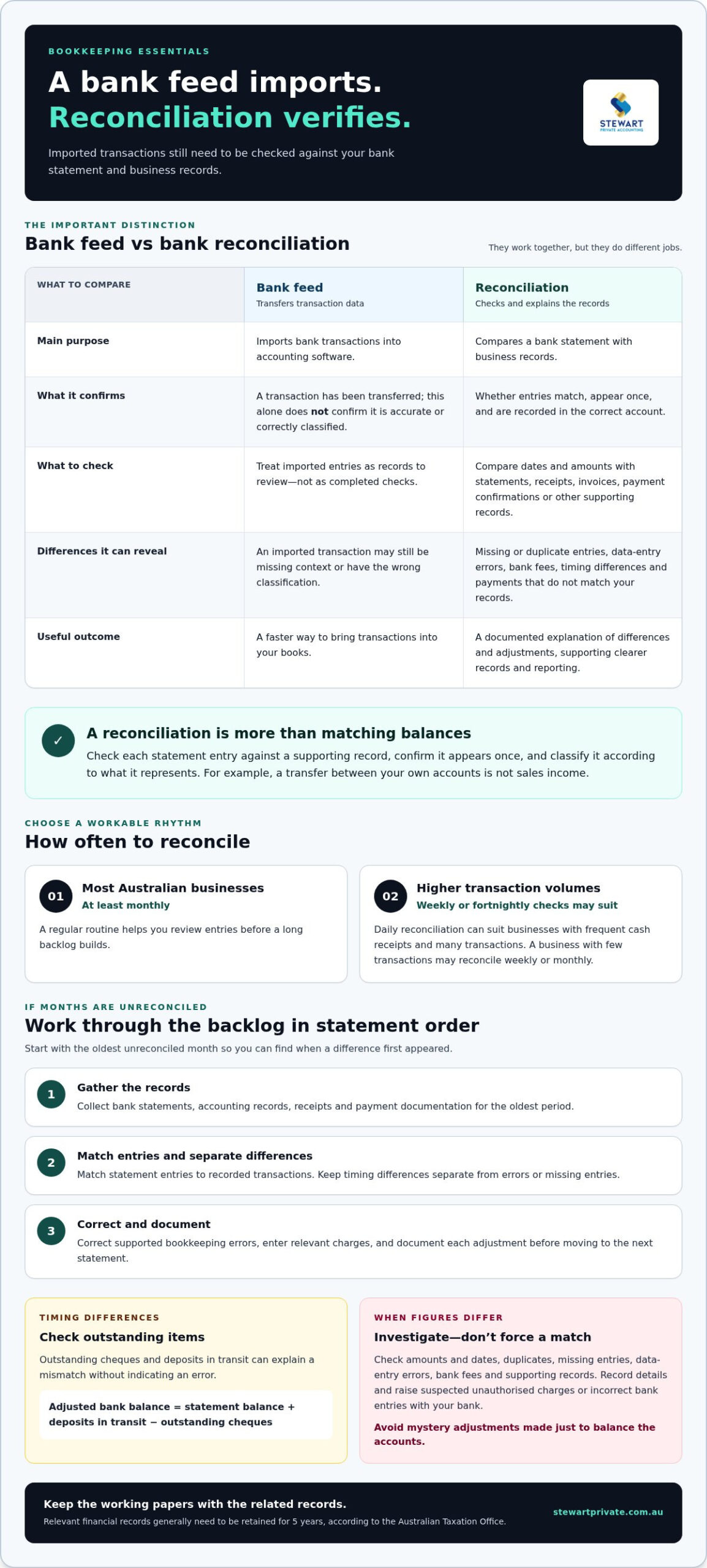
A bank feed isn’t a completed bank reconciliation. Reconciliation means matching your bank statement against your business records to identify missing, duplicated or incorrectly recorded transactions. Most Australian businesses should reconcile their accounts at least monthly, while businesses with high transaction volumes may need to do so more often.
It’s easy to assume imported transactions have already been checked, especially when they appear automatically in your accounting software. But a bank feed transfers transactions; it doesn’t confirm that each one is accurate or correctly classified. That distinction affects how clearly you can see your cash position and how reliably you can prepare business reports.
This guide explains what bank reconciliation involves, how often to reconcile and where bank feeds fit in the process. You’ll also learn how to work through months of unreconciled transactions, investigate balances that don’t match, and use bank reconciliation services to support accurate, organised bookkeeping. The goal is a clear routine that helps you understand your records and make decisions with greater confidence.
Key Takeaways
- Compare each bank statement with your business records so you can spot missing, duplicated or misclassified transactions.
- Most Australian businesses should reconcile accounts at least monthly; higher transaction volumes may call for a more frequent routine.
- A bank feed imports transactions, but you still need to check their accuracy and classification.
- When catching up on unreconciled months, investigate outstanding cheques, deposits in transit and bank charges rather than forcing a balance.
- Keep a clear record of discrepancies and adjustments to support reliable bookkeeping and business reporting.
What if there are months of unreconciled transactions?
Work through the backlog in statement order, starting with the oldest unreconciled month. This helps pinpoint when a difference first appeared and prevents an unexplained balance from carrying forward.
The cost of bank reconciliation services in Australia depends on transaction volume, backlog complexity, the number of accounts and the quality of your records. A quote request establishes the price.
Outstanding items and bank charges
For each statement, identify outstanding cheques that haven’t cleared and deposits in transit that appear in your records but not on the statement. These timing differences can explain a balance mismatch without indicating an error. Add deposits in transit to the statement balance, then subtract outstanding cheques to calculate the adjusted bank balance. Record bank service charges in the correct account rather than leaving them unexplained.
Regular checks and transaction control
Reconciliation is a transaction-control step, not simply a way to make two balances agree. A weekly review can help you spot an unfamiliar payment, a repeated supplier charge or a subscription your business no longer uses. Compare each statement entry with a receipt, invoice or payment record, and check that it appears once in the correct account. This routine can also reveal personal spending in a business account.
Resolving discrepancies and bank errors
For each difference, compare the transaction’s amount and date with the bank statement and your supporting records. Look for duplicate or missing entries, data-entry errors, bank fees and payments that don’t match your records. If a charge seems unauthorised or a bank entry looks incorrect, record the details and raise the issue with your bank. Don’t use a mystery adjustment just to force the accounts to balance.
Use a consistent catch-up process for every month:
- Gather bank statements, accounting records, receipts and payment documentation for the oldest unreconciled period.
- Match statement entries to recorded transactions, then mark timing differences separately from errors or missing entries.
- Correct supported bookkeeping errors, enter relevant charges, and document each adjustment before moving to the next statement.
Keep the working papers with the related records. According to the Australian Taxation Office, businesses generally need to retain relevant financial records for 5 years. An unreconciled file can also make a BAS statement an estimate rather than a reliable summary. For example, a loan drawdown recorded as sales income can overstate revenue, while a supplier invoice paid twice may still appear to reconcile. Review classifications as well as balances before relying on the accounts for reporting or compliance.
What is Bank Reconciliation?
Bank reconciliation compares your bank statements with internal financial records, matching transactions and identifying differences. Bank reconciliation services typically involve matching transactions, investigating exceptions and documenting adjustments. Choose a provider who explains the process and keeps clear records.
Gather the relevant bank statements, accounting records and supporting receipts or payment documents before matching entries. These records give you a practical starting point for checking the accounts properly.
Matching bank statements and business records
Start with the statement’s opening balance and compare it with the opening balance in your business books. Then match statement deposits and withdrawals against recorded transactions, checking dates and amounts. For example, a customer payment should appear once in both sets of records, with a description that helps identify its purpose.
Check bank, savings and credit-card accounts separately. For each transaction, look for a corresponding receipt, invoice, deposit record or payment log. A proper reconciliation confirms that entries appear once and are classified according to what they represent. A transfer between your own accounts, for example, isn’t sales income.
Reconciliation timing and purpose
A reconciliation statement records the comparison, outstanding differences and adjustments made. It explains why the book balance and statement balance differ, rather than simply showing that the figures match. Keep the explanation with the relevant records so you can trace an adjustment later and review the accounts with greater confidence.
Most Australian businesses should reconcile accounts at least monthly. A business with few transactions may reconcile weekly or monthly, while high transaction volumes may call for weekly or fortnightly checks. Daily reconciliation can suit a business with frequent cash receipts and many transactions. Choose a rhythm that lets you review entries before a long backlog builds.
Documents and bank data needed
Bring together the bank statement for the period, the matching accounting ledger and supporting transaction documents. Useful records include sales receipts, supplier invoices, payment confirmations, deposit slips and cash receipts. For credit-card reconciliations, include the card provider’s records. Organising these items by statement period and account name makes each match easier to follow.
To choose a provider, look for a clear method for matching entries, investigating differences and recording adjustments. Ask how the work will help you keep transaction records complete and useful for reporting. If preparing those records takes time away from running your business, bookkeeping services can help organise routine financial records and reconciliations.
Reconciliation frequency for trade and small businesses
Most Australian businesses should reconcile accounts at least monthly. High transaction volumes may call for weekly or fortnightly checks, while frequent cash receipts can make daily reviews useful.
Reconciliation timing for small businesses
Bank reconciliation compares bank activity with bookkeeping records, helping you identify missing entries and understand cash flow. Set a routine based on transaction volume, payment frequency and how quickly you need current figures. A small trade business with a handful of monthly invoices may reconcile monthly; a busy retailer receiving daily sales may need weekly or daily checks.
For a trade business, regular reviews bring supplier payments, customer deposits and operating costs into view. If you reconcile only at month-end, a missing payment or incorrectly recorded expense may go unnoticed until then. Weekly checks can make the workload more manageable when transactions arrive steadily, while monthly reconciliation suits businesses with fewer entries.
Keep personal and business spending separate wherever possible by using a dedicated business bank account. If you pay for a personal item from that account, record it distinctly rather than classifying it as a business expense. This keeps the books accurate and gives you a clearer view of business costs. A consistent process in your bookkeeping software can make these entries easier to review.
- Set a recurring day for reconciliation and gather statements for the same period.
- Match deposits and payments, then follow up missing records or unexplained entries.
- Record personal transactions separately from business expenses.
Adjust your routine when business activity changes. A seasonal rise in customer deposits or supplier payments may make monthly checks too infrequent to keep records current.
Reconciliation for Western Australian businesses
A Western Australian business can set its reconciliation schedule around transaction volume and the timing of receipts and payments. A tradie receiving customer payments throughout the week may prefer weekly checks, while a business with few monthly transactions may reconcile monthly.
Keep business transactions distinct from personal spending, even if an owner occasionally uses the same account. Record the purpose of each payment and retain its supporting receipt or invoice. If a personal purchase appears among business costs, identify it clearly rather than treating it as an operating expense. This keeps reports easier to interpret.
Use accounting software to organise transaction records, then review entries against the statement on your chosen schedule. Automatic imports can simplify data entry, but they don’t replace checking that each transaction is present and correctly classified. If your business has several accounts, apply the same review routine to each so missing activity doesn’t remain hidden in a secondary account.
Reconciliation findings can also help you plan upcoming payments. Comparing recorded customer receipts with supplier costs helps clarify the cash available for the next trading period. Keep the routine consistent, and adjust it when transaction volume or cash receipts change.
Reconciliation frequency
Most Australian businesses should reconcile accounts at least monthly. Set the timing according to transaction volume, cash receipts and how quickly you need accurate balances for reporting. A routine that fits your activity helps you detect differences while recent transactions are easier to trace.
Choose a practical rhythm for each account rather than relying on one calendar rule. A business with few transactions may reconcile weekly or monthly. High transaction volumes may call for daily or weekly checks, while weekly or fortnightly reviews can suit other busy businesses. Frequent cash receipts can make daily reviews useful because the records stay close to the activity being checked.
Accounting software can hold transaction information entered daily, weekly or monthly. Whatever entry schedule you use, set a separate reconciliation routine and assign someone to complete it. For example, if your team enters bank-account data each Friday, schedule a review against the available statement information. Record the period checked and note outstanding items for the next review.
Use a repeatable sequence to keep each review focused:
- Set the period and gather the matching statement and accounting records.
- Compare the statement balance and transactions with the recorded balances.
- Investigate entries that are missing, duplicated or difficult to identify.
- Document any supported corrections and the items that remain outstanding.
The last step matters because a balanced figure alone doesn’t show whether transactions were classified correctly. For example, a payment recorded in the wrong expense account can leave the bank balance matching while distorting reporting. Review the transaction description and account category as part of each scheduled check, then keep a note explaining any change.
Review your schedule when business activity changes. A quiet period with few transactions may be manageable with monthly checks, while a rise in customer payments can justify weekly reviews. A seasonal business can adjust its routine as activity builds or slows, then return to its usual pattern when transaction levels settle. Let the volume and timing of transactions guide your decision.
Regular reconciliation also gives owners a more current view for business decisions. Monthly reviews let you assess receipts and payments for the completed period, while more frequent checks provide a closer view of cash activity between reporting periods. Keep the chosen schedule consistent so each review covers a clear period and leaves a useful record of what was checked.
Bank feeds versus reconciliation
Accounting software, in-house bookkeeping and outsourced bank reconciliation services have different roles. Software imports bank transactions and may suggest matches, but it doesn’t verify their accuracy. In-house staff or an outsourced bookkeeper still need to review records, resolve discrepancies and confirm classifications.
A bank feed transfers transaction data from an account into accounting software. This can reduce manual entry, but it doesn’t prove that every payment is correct or complete. A suggested match might link a supplier payment to the wrong invoice, or an imported transaction might be coded to the wrong account.
Reconciliation adds a review step. Compare imported transactions with the bank statement and supporting business records, then investigate anything unmatched or unusual. For example, a payment may appear in the feed without a matching invoice. That calls for investigation, not automatic approval.
Feeds can also leave gaps. If a transaction fails to carry across, there may be no suggested match to prompt a review. Compare the statement’s transaction list with the software records for the same period. Check dates, amounts and descriptions, including transfers between your own accounts.
Use this workflow to make the most of your bank feed without treating it as proof:
- Review each imported transaction and confirm its date, amount and business purpose.
- Match payments to invoices, receipts or other supporting records.
- Check for missing entries and duplicate transactions before finalising the period.
- Investigate unexplained differences and document any correction you make.
An account can reconcile even when a transaction is classified incorrectly. For instance, recording a loan drawdown as sales income may leave the bank balance matching while overstating revenue. Check both the balance and account category. Matching totals alone won’t catch every bookkeeping error.
In-house bookkeeping gives your team direct control over routine reviews, but staff still need time and a consistent process. Accounting software supports data entry and matching, but doesn’t replace judgement. Outsourcing shifts reconciliation work to a bookkeeper, freeing up your time while keeping human review of exceptions. The right arrangement depends on transaction volume, internal capacity and how much oversight you want.
For clearer records, decide who reviews imported transactions, how exceptions are recorded and when each period is reconciled. If you want help maintaining those checks, explore bookkeeping support for your business records.
Stewart Private Accounting: Accounting & Taxation Services
Stewart Private Accounting’s Bookkeeping Services can help organise transaction records. If unreconciled accounts are affecting your records or reporting, bookkeeping support can help you organise entries and document adjustments. Accounting & Taxation Services can support the wider financial work that relies on clear, accurate bookkeeping. Business Advisory Services and Expert Tax Planning can also help business owners consider cash flow, costs and next steps.
Consider support when reconciliation is falling behind, exceptions are difficult to resolve or routine bookkeeping is taking time away from running your business. Clear records give you a more useful basis for financial discussions and decisions. Contact Stewart Private Accounting to discuss your bookkeeping and accounting needs.
Build a clearer foundation for your next decision
Use your bookkeeping routine as a starting point for stronger financial stewardship. Bank reconciliation services do more than organise transactions: dependable records give you a sounder basis for planning, allocating resources and deciding what deserves attention next.
Stewart Private Accounting offers Bookkeeping Services to help keep financial records organised, alongside Accounting & Taxation Services and Business Advisory Services for broader business needs. Together, these services support a more connected view of day-to-day records and the decisions you make from them.
If you’re ready to bring more structure to your bookkeeping or discuss the support your business needs, contact Stewart Private Accounting. A clear next step can make financial administration feel more manageable and leave you better placed to focus on running your business.
Frequently Asked Questions
Can you handle multiple bank accounts or complex transactions?
Yes, reconciliations can cover several accounts, with each statement matched to its corresponding records. For a Western Australian business with operating, savings and credit-card accounts, keep records for each account distinct before comparing overall balances. Treat transfers between your own accounts carefully so they aren’t mistaken for income or expenses. Detailed transaction descriptions and supporting documents make complex entries easier to trace and explain.
How do reconciliations help with compliance and audits?
Reconciliations create a documented trail showing how recorded transactions compare with bank activity. This can help you explain balances, adjustments and outstanding items during financial reviews. For example, retaining the receipt for a business purchase makes its purpose easier to identify later. Reconciliation supports well-organised records, but it isn’t an audit or assurance service and doesn’t replace supporting documents.
How often should it be done?
Most Australian businesses should reconcile their accounts at least monthly. A business with high transaction volumes or frequent cash receipts may benefit from weekly, fortnightly or daily checks. Consider how quickly you need current figures and how easily you can trace older transactions. For a Western Australian business with seasonal trading, review the schedule when transaction activity rises or falls.
If the bank feed does it automatically, why pay for this?
A bank feed imports transactions, but it doesn’t confirm that each entry is accurate, complete or correctly classified. Bank reconciliation services add a review of imported transactions to identify missing entries and investigate exceptions. For example, a system may import a supplier payment without flagging that the invoice was already paid. Human oversight can help catch the issue before you rely on the records.
How do bank reconciliation services work in Australia?
In Australia, this work involves comparing business bookkeeping records with bank statements, investigating differences and documenting relevant adjustments. Provide the records for the accounts and period being reviewed, such as statements, receipts and payment details. The reviewer traces unmatched transactions to supporting information, then records how they were resolved. The result is a clearer set of accounts for routine business reporting and financial decisions.
What steps are involved in reconciling a business bank account?
Start by selecting the statement period and gathering the matching business records. Compare opening balances, then match deposits and payments by date, amount and description. Separate timing differences from missing or duplicated entries, and trace exceptions to invoices, receipts or payment confirmations. Record supported corrections and keep a note explaining them. Before closing the period, check that transactions are classified consistently with their business purpose.
What Australian tax, BAS and record-keeping rules apply to bank reconciliations?
Reconciled accounts help you prepare reliable business information, but duplicated or incorrectly recorded transactions can affect BAS reporting. The Australian Taxation Office generally requires businesses to retain relevant financial records for 5 years. Keep statements, supporting documents and reconciliation notes together so you can follow how reported amounts relate to recorded transactions. Your records should clearly explain adjustments instead of relying on unexplained balancing entries. For related obligations, learn about superannuation compliance mistakes that can affect SMSFs and employers.
What are common bank reconciliation errors and risks, including fraud?
Common issues include missing or duplicated transactions, incorrect dates, data-entry mistakes and unrecorded charges. Regular reviews can also bring unusual or unauthorised payments to your attention for investigation. A successful match doesn’t rule out every costly error: a supplier invoice paid twice can still reconcile while leaving your business out of pocket. Check transaction details against supporting records, not just the final balance.