

What if the financial information you already have could help you make decisions before cash flow or compliance becomes a pressing concern? The value of business advisory services Perth business owners rely on isn’t just in preparing accounts or tax returns. It’s in turning financial information into practical choices throughout the year.
It’s understandable if advisory feels hard to distinguish from accounting and tax support. When reports arrive late or daily demands leave little room to plan, it can be difficult to see which actions deserve attention first. An adviser can bring your financial information, operational pressures and growth plans into one clearer conversation.
This guide explains what business advisory can help you manage, how to assess the support that suits your needs, and what an ongoing relationship with a Perth adviser can look like. You’ll learn how accounting, bookkeeping and tax information can inform cash flow and performance decisions, what to prepare for discussions, and how tailored fixed-fee packages can provide greater clarity about fees. At Stewart Private Accounting, Bradley Stewart brings more than 15 years of public accounting and consulting experience to personalised support for small and medium-sized businesses.
Key Takeaways
- Business advisory can turn accounting and bookkeeping information into clearer decisions about cash flow, performance and growth priorities.
- The focus of business advisory services Perth businesses use should reflect their circumstances, goals and the decisions they need to make.
- Free public advice and ongoing private advisory differ in access, continuity and how closely guidance can connect with your financial records.
- Prepare for an advisory discussion by defining the decision ahead, gathering current accounts and cash flow information, and noting your key questions.
- Stewart Private Accounting brings advisory together with accounting, bookkeeping and tax planning, with tailored fixed-fee packages for fee clarity.
When do Perth businesses need business advisory services?
Limited time, uncertain cash flow and competing growth priorities can make it difficult to step back and see what your business needs next. You may be meeting day-to-day commitments while trying to understand why margins have changed, whether a new opportunity is affordable or which task deserves attention first. Business advisory provides structured guidance to help you interpret business information and make considered decisions. It can be useful when decisions feel reactive, results are hard to explain or plans keep shifting because the financial picture isn’t clear.
Bookkeeping and compliance work help organise and report financial information; advisory uses that information to support decisions. The work is connected: accurate records give you a stronger basis for discussing performance, cash flow and priorities. The general role of a business consultant can include helping organisations assess challenges and consider ways forward. For a small business, useful advice should relate to its actual circumstances and goals.
What does business advisory mean for a small business?
An adviser helps translate financial and operational information into practical priorities. Rather than looking at a result in isolation, you can discuss what may be driving it and what choices are available. The focus should reflect your goals, stage of business and constraints. For example, before committing to additional staff or equipment, review the expected costs alongside available cash and likely demand, then weigh the decision against other priorities.
The discussion doesn’t need to produce a complex plan. Its value may be in clarifying the decision, identifying information you still need and agreeing what to monitor. The right level of support depends on the question in front of you, not a standard schedule imposed on every business.
Which Perth business challenges can prompt an advisory conversation?
A conversation may help when you’re preparing to grow, adjusting to changing cash flow needs or struggling to understand what your results mean. Consider whether any of these situations sound familiar:
- Sales are changing, but you’re unsure how that affects cash available for upcoming commitments.
- Costs or margins have shifted, and the reasons aren’t clear from the figures alone.
- You’re weighing a growth opportunity against the people, time or funds needed to pursue it.
- Compliance responsibilities are taking up time you also need for operational and strategic decisions.
These aren’t signs that something has gone wrong. They can simply indicate a decision point where a clearer view would help. For business advisory services Perth owners can access, the useful question is whether the support connects financial information to the choices they actually need to make.
Not every business needs ongoing advice, and the frequency can vary as circumstances change. You might seek guidance around a particular decision, then revisit priorities as new information becomes available. If you’re repeatedly making choices without understanding their likely effect on cash flow or performance, structured support can bring the facts, trade-offs and next steps into one practical discussion.
What can business advisory services help you manage?
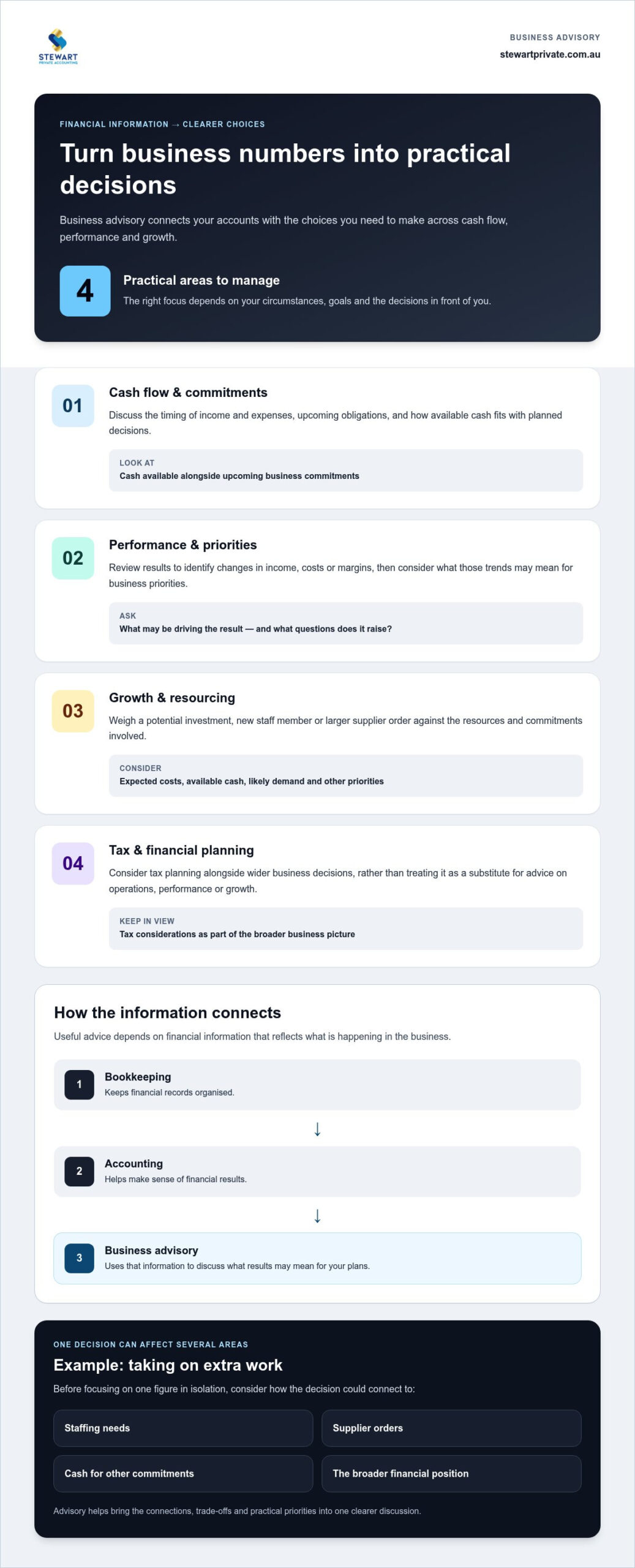
Business advisory connects the numbers in your accounts with the choices you need to make across the business. Bookkeeping helps keep records organised, accounting helps make sense of financial results, and advisory uses that information to discuss what those results may mean for your plans. The work is related, not separate: useful advice depends on financial information that reflects what’s happening in the business.
The right focus depends on your circumstances. A Perth business managing a busy seasonal period may need to think about staffing and supplier commitments differently from one preparing to expand or seeing changes in customer demand. Business advisory services Perth owners use can bring those considerations into a practical discussion without assuming every business needs the same support.
- Cash flow and commitments: Use financial records to discuss the timing of income and expenses, upcoming obligations and how available cash fits with planned decisions.
- Performance and priorities: Review results to identify changes in income, costs or margins, then consider what questions those trends raise about business priorities.
- Growth and resourcing: Weigh a potential investment, new staff member or increased supplier order against the resources and commitments involved.
- Tax and financial planning: Consider tax planning alongside wider business decisions, rather than treating it as a substitute for advice on operations, performance or growth.
These areas can overlap. Taking on extra work, for instance, might affect staffing needs, supplier orders, cash available for other commitments and the broader financial position. Advisory helps you consider those connections before focusing on one figure or decision in isolation.
How can financial information support better business decisions?
Timely bookkeeping and accounting records help you see income, expenses and the cash available to meet business commitments. Comparing results over time can prompt useful questions: have costs changed, are margins moving, or is a particular part of the business contributing differently than expected? The aim is to understand what may be behind the numbers and decide which issues warrant attention, rather than react to a single result.
This perspective can be valuable for businesses balancing seasonal trading with staffing and supplier demands. Keep the discussion focused on the decision at hand, such as whether a change in costs affects your ability to meet upcoming commitments or pursue a planned opportunity.
How can advice connect business goals with tax and personal wealth?
Business choices can have tax and personal financial considerations as well as operational ones. Planning an investment, changing how the business is run or reviewing future goals may call for a broader conversation about how business decisions relate to your circumstances and personal wealth. Tax planning is one part of that picture, not a replacement for advice about the business as a whole.
For a clearer view of how the parts fit together, Stewart Private Accounting’s business advisory support sits alongside accounting, bookkeeping and tax planning. Discussions can focus on the information you have, the goals you’re working towards and the priorities that matter now.
Free business advice or private advisory support: what is the difference?
In Western Australia, free public business advice can be a useful place to start. The Small Business Development Corporation (SBDC) provides information and advice for small business owners, including guidance on common business topics. Private advisory support offers a different kind of relationship: it can be shaped around your business’s own financial information and revisited as your decisions and circumstances change. Neither option is automatically better. The right fit depends on what you need help with.
Start with the question you want to resolve. If you need general information or guidance on a defined issue, a public service may be a practical first step. If your question involves interpreting your business’s accounts, weighing connected financial decisions or working through priorities over time, a private adviser may offer a closer fit. The comparison below highlights common differences, rather than suggesting public advice is inadequate.
| Consideration | Public business advice | Private advisory support |
|---|---|---|
| Access | May provide free information and advice, subject to the service’s current arrangements. | Provided through a paid professional relationship, with arrangements shaped around the agreed support. |
| Focus | Useful for general guidance, business information and a clearly defined question. | Can be tailored to your business goals, circumstances and financial information. |
| Continuity | Can help address a particular need or point you towards relevant information. | May suit owners who want to revisit performance and priorities as the business changes. |
| Financial context | Guidance can help you understand a topic, but may not be based on an ongoing review of your accounts. | Advice can connect with accounting and bookkeeping information when that context is relevant. |
When can a government advisory service be a useful first step?
The SBDC can be a helpful starting point if you’re seeking general business information, considering a familiar issue or trying to clarify what question to address next. Its guidance may help you organise your thinking before deciding whether you need more tailored, ongoing support. For current details about the SBDC’s advice, access and scope, visit the Small Business Development Corporation website, as service information can change.
When might a private business adviser be a better fit?
Private support may suit you if your decisions depend on your own accounts, cash position or business goals, and you value continuity as those priorities evolve. An adviser can connect financial information with the wider context, rather than discussing a question in isolation. Business advisory services Perth owners choose can also sit alongside accounting, bookkeeping and tax planning, so relevant information informs the discussion.
Stewart Private Accounting provides tailored fixed-fee packages to give clients clarity about fees, alongside personalised support for small and medium-sized businesses. This can suit owners who want ongoing advice connected to their financial information and priorities.
How to prepare for business advisory services in Perth
A useful advisory discussion starts with a clear question, not a perfect set of reports. You might be weighing a new expense, trying to understand a change in results or deciding which business priority should come first. A little preparation helps keep the conversation grounded in your circumstances and focused on decisions you can act on.
Before meeting an adviser, work through these steps:
- Define the decision. Write down what you need to decide and by when. If there are several issues, note which one feels most pressing.
- Gather relevant records. Bring current accounts, bookkeeping reports and any cash flow information you have. Use the latest available records, even if they’re not perfectly presented.
- Identify constraints. Note known deadlines, staffing or supplier pressures, and any recent changes that affect the decision.
- Agree priorities. Discuss what needs attention first, what can wait and how you’ll review progress or follow up.
What should you bring to an initial advisory discussion?
Bring recent financial records, a short outline of your business goals and the questions you need help working through. Include relevant deadlines, operational constraints and changes such as a shift in demand, costs or staffing. These details help an adviser understand the context behind the figures and support a more grounded discussion. They don’t guarantee a particular outcome or mean every uncertainty will be resolved in one meeting.
If a report is missing or you’re unsure which figures matter, note that too. Preparation should make the conversation more useful, not create extra work or delay a decision until every document is polished. For business advisory services Perth business owners can use effectively, clear context is often more helpful than a large bundle of unexplained paperwork.
How should you define useful advisory priorities?
Separate immediate pressures from longer-term aims. An upcoming commitment may need attention now, while improving profitability or planning for growth may require a series of considered steps. Explain what progress would look like for your business, then agree what information to review and when to revisit the priorities. This gives you and your adviser a shared point of reference as circumstances develop.
It can also help to understand how ongoing accounting support is organised, including how fees are communicated. Stewart Private Accounting offers tailored fixed-fee packages intended to provide fee clarity, with support shaped for small and medium-sized businesses. Information about business advisory support for your business can help you consider how it fits with the decision you’re facing and the information you have so far.
How Stewart Private Accounting works with Perth business owners
Stewart Private Accounting is a Perth practice supporting small and medium-sized businesses with personalised accounting, bookkeeping, business advisory and tax planning. Bringing these services together connects financial records and tax considerations with the decisions you’re making across the business. The focus is practical support shaped around your circumstances, rather than advice treated as separate from day-to-day operations.
What does a collaborative adviser relationship look like?
Good collaboration starts with understanding your business priorities. You might want to assess a growth opportunity, make sense of changing results or bring more structure to financial decisions. Your adviser can use relevant accounting and bookkeeping information to inform the discussion, then consider how the options relate to your goals and constraints. As your circumstances develop, you can revisit priorities rather than assume the same approach will always fit.
Bradley Stewart leads the practice. He is a Chartered Tax Adviser and Registered Tax Agent, with more than 15 years of experience in public accounting and consulting. That background informs a considered approach to business and tax matters, while personalised, hands-on support keeps the conversation connected to the realities of running a small or medium-sized business.
Business decisions can also affect personal financial priorities. A collaborative relationship can take both the business context and personal wealth into account when discussing goals, without treating one decision as right for every owner. Tailored fixed-fee packages are intended to give clients greater clarity about fees. With a tailored package, you can understand the agreed support and its cost without relying on an hourly-rate arrangement.
How can you take the next step with a Perth business adviser?
Start by outlining your business context, the priorities you’re managing and the questions you want to work through. Identify any decision you need to make, relevant records you already have and what you’d like the advisory relationship to help clarify. You don’t need to arrive with every answer. A clear account of what’s happening gives the discussion a useful starting point.
If you’re comparing ongoing support, include fee clarity in your considerations. A fixed-fee arrangement can make agreed fees more predictable, while the scope should reflect the support your business needs. Stewart Private Accounting’s business advisory services Perth owners draw on connect with its accounting, bookkeeping and tax planning support, giving financial information a practical role in business discussions.
To discuss how this approach could fit your business, discuss business advisory support with Stewart Private Accounting. Share your current priorities and questions to begin a conversation about support suited to your circumstances.
Give your next decision a clearer starting point
Business advisory works best as part of how you lead, not simply something you turn to when a problem becomes difficult to manage. As your business changes, the questions you need to answer will change too. Making space to consider those questions can help you move from reacting to each new pressure towards choosing your next steps with purpose.
Start with one decision that’s occupying your attention. Consider what you need to understand, what information could help and which priorities you want to protect as you move forward. You don’t need every answer before beginning a conversation. A clear question is enough to create a practical starting point for business advisory services Perth owners can shape around their circumstances.
Stewart Private Accounting provides personalised support for business owners who want to connect financial information with thoughtful decisions. If you’re ready to discuss what matters most in your business, talk with Stewart Private Accounting about your business priorities. Start with the decision you’re facing and the information you already have.
Frequently Asked Questions
What do business advisory services include?
Business advisory services can cover planning, financial performance, cash flow, growth choices and tax planning, depending on what your business needs. For example, an owner considering a new sales channel might discuss its costs, resources and fit with business goals. An adviser helps you assess relevant information and options, rather than applying the same plan to every business. The scope should reflect your circumstances and the decisions ahead.
Is business advice from the Small Business Development Corporation free?
Yes. The Small Business Development Corporation (SBDC), a Western Australian Government agency, provides free and confidential business advice to current and aspiring business owners in WA. It can be a useful source of general guidance, such as information for starting a business or managing a particular issue. Service arrangements and advice topics can change, so check the SBDC’s official website for current access details and scope.
When should a small business hire a business adviser?
Consider an adviser when a decision has several financial or operational factors and you’d value help weighing them before committing. For instance, before entering a new market, you might assess the resources required alongside your business goals and current obligations. You don’t need to wait for a crisis. Advisory can be useful when you’re preparing for a change and want a structured way to examine the options.
Can an accountant provide business advisory services?
Yes, an accountant can provide business advisory services if it forms part of their professional work and experience. Accounting knowledge can connect business discussions with financial information, while advisory focuses on applying that context to decisions and goals. Stewart Private Accounting provides accounting, bookkeeping, tax planning and business advisory support. The relevant mix depends on the owner’s needs, because accounting and advice are related but distinct tasks.
How can a business adviser help with cash flow?
A business adviser can help you interpret cash flow information and consider how planned decisions may affect funds available to meet commitments. For example, a retailer preparing for a quieter trading period could review expected income alongside stock, staffing and supplier commitments. This discussion can help identify which assumptions need closer attention. It supports informed planning, but can’t remove uncertainty or guarantee that future cash will match expectations.
What should I prepare before meeting a business adviser?
Bring the information that relates to the decision you want to discuss. This might include a recent profit and loss statement, current cash position, relevant sales or cost details, and upcoming commitments. Note the outcome you’re aiming for and what’s making the decision difficult. If records are incomplete, explain that openly. A useful first conversation can begin with a clear question and the information you have available.
Are business advisory services suitable for small businesses in Perth?
Yes, business advisory services Perth small businesses use can be shaped to suit their stage, goals and immediate questions. A local café considering staffing changes for a busy period may need a different discussion from a professional services firm planning to take on more clients. Start with the decision or challenge at hand. The level and timing of support can reflect that need, rather than a standard schedule.
How do fixed-fee accounting packages relate to business advisory?
Fixed-fee packages set agreed fees for tailored accounting, tax or advisory services, which can make the cost of an ongoing professional relationship clearer. At Stewart Private Accounting, packages can cover work ranging from compliance and bookkeeping to strategic business advice. The services included depend on the package agreed for your needs, so fixed fees don’t mean every business receives an identical set of services.