

Payroll compliance is part of every pay run. Payroll help for a small business in Perth can make it easier to manage PAYG withholding, payslips and leave while keeping reporting organised. Australian employers must report payroll information to the ATO through Single Touch Payroll each time they process payroll.
When you’re managing a small team, pay rates, entitlements and reporting can take time away from running the business. Outsourcing can bring these recurring tasks into a consistent process, with clearer records and fewer administrative steps for you to manage.
This article explains what outsourced payroll can cover, how PAYG withholding and Single Touch Payroll work, and what to consider when arranging support. It also outlines how pay rates, leave, superannuation and reporting fit together, so you can identify which tasks would benefit from a more consistent process.
Key Takeaways
- Outsourced payroll can help organise pay runs, payslips, leave records and PAYG withholding into a consistent process.
- In Western Australia, the payroll tax threshold is A$1 million in annual taxable wages, according to RevenueWA, Department of Finance, Western Australia.
- The Australian Taxation Office states that Australia’s Superannuation Guarantee rate is 12%.
- Employers report payroll information to the ATO through Single Touch Payroll each time they process payroll, so reporting needs to fit the pay cycle.
- Clear payroll records can make it easier to manage compliance obligations and understand when accounting, bookkeeping or business advisory support may help.
Outsourced payroll services for Perth small businesses
Perth small businesses can access free, confidential advice from the Small Business Development Corporation on financial management and tax. Outsourced payroll can also organise recurring pay and reporting tasks as your team’s needs change.
Service coverage for Perth businesses
Payroll services can prepare wages, apply employee pay details, issue payslips and manage payroll records. For an Australian business, the process should reflect its pay arrangements and where employees work. A Perth southern suburbs business can map each employee’s role, work location and agreed pay cycle before setting up outsourced payroll. Western Australia’s payroll tax threshold is A$1 million in annual taxable wages, according to RevenueWA, Department of Finance, Western Australia.
Before changing your payroll arrangements, list the tasks you want covered, such as wage calculations, leave records and reporting. This gives you a clear scope for a payroll arrangement in Perth.
Pricing and onboarding
Costs depend on the work involved, including employee numbers, pay complexity and which tasks are included. For example, a business with changing hours may need different payroll preparation from one with consistent salaries. Compare the tasks covered, not just the service description, so the arrangement suits your payroll needs.
A practical handover starts with gathering employee details, pay arrangements, existing payroll records and reporting information. Agree who provides updates, who prepares each pay run and how records are reviewed. A clear schedule helps prevent missing details when the first outsourced pay run is prepared.
Scalable payroll support
Payroll requirements can change as a business hires employees, changes work patterns or expands into new locations. A scalable process should make it straightforward to update employee records and adjust the work involved, rather than rebuilding the workflow each time. For example, before a part-time employee’s first pay run, record their pay arrangement and relevant details.
Review the workflow when your team structure changes. Confirm who sends hours and leave updates, how payroll changes are recorded and which reports you need. These steps help keep payroll organised as a small Australian business grows, even when employees have different pay patterns.
Free payroll and employer advice
The Small Business Development Corporation provides free, confidential advice to current and aspiring small business owners in Western Australia. Its advisers can discuss financial management and tax, helping you understand employer responsibilities and identify questions about your payroll process. Contact the service on 133 140, or access advice by phone, Microsoft Teams video call or live chat.
Use that conversation to clarify the issue first, such as payroll tax, employee records or the information needed for pay runs. Then organise your records and identify any tasks requiring ongoing support. This gives you a practical starting point, whether you’re preparing to employ staff or reviewing an existing payroll process.
Fair Work pay rates, payslips and leave obligations
Pay runs bring together employee rates, payslips, leave records, superannuation and reporting. A consistent process helps you manage these obligations alongside the day-to-day work of running your business.
Pay rates and payslip requirements
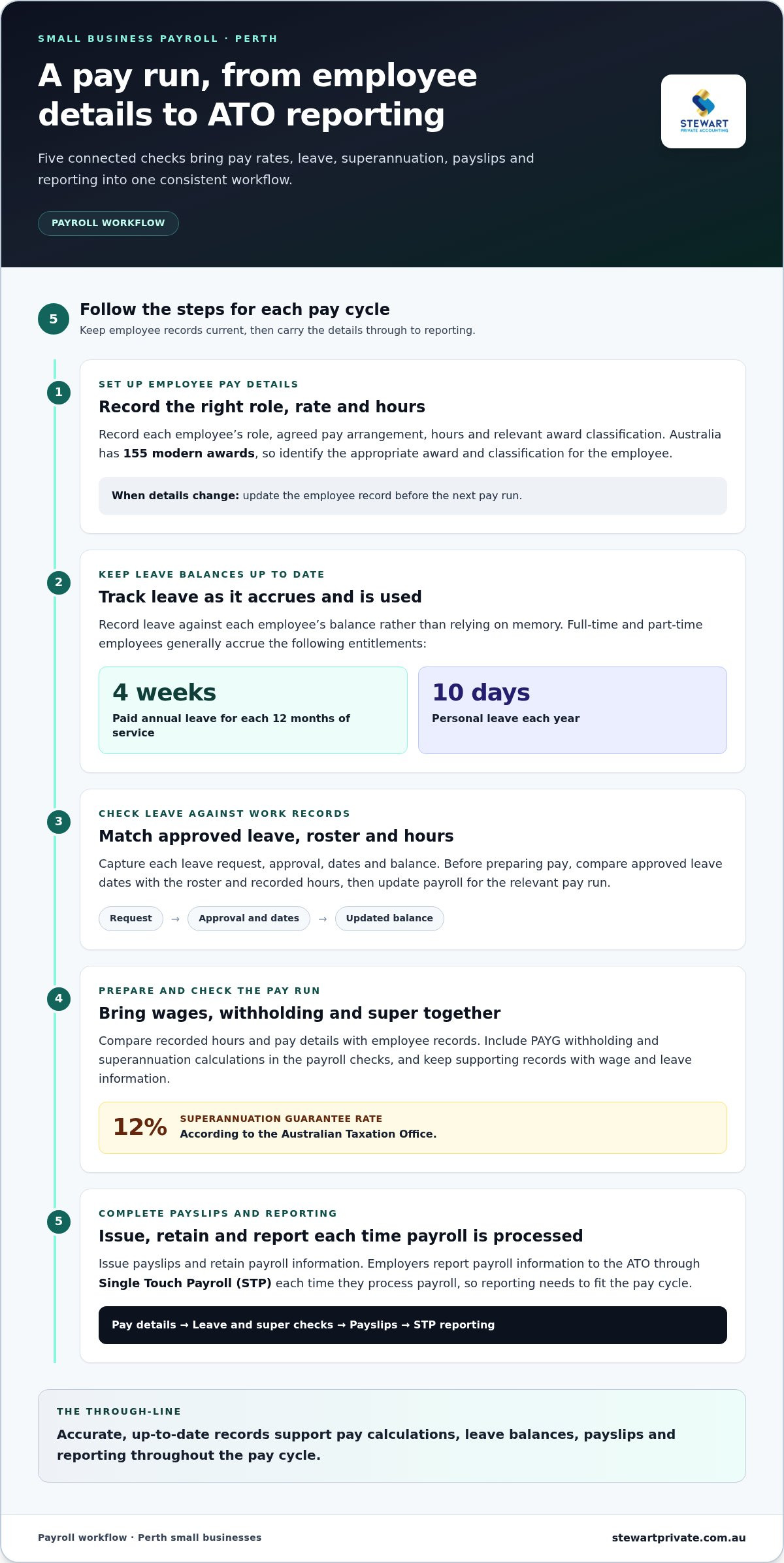
Start by recording each employee’s role, agreed pay arrangement, hours and any relevant award classification. Australia has 155 modern awards, so identifying the right award and classification helps you prepare payroll using appropriate pay details. For a change in duties or working patterns, update the employee record before the next pay run.
For each pay run, compare recorded hours and pay details with employee records, then issue payslips and retain payroll information. Australian employers must report payroll information to the ATO through Single Touch Payroll each time they process payroll. Accurate, up-to-date records support both payslips and reporting.
Leave tracking and management
Record leave as it accrues and is used, rather than relying on memory when an employee requests time off. Capture the request, approval, dates and leave balance, then update payroll before the relevant pay run. For example, compare approved leave dates with the roster and recorded hours before preparing pay.
Superannuation also belongs in the payroll workflow. The Superannuation Guarantee rate is 12%, according to the Australian Taxation Office. Include superannuation calculations in your payroll checks, and keep supporting records alongside wage and leave information. This helps you review the full pay run in one place, rather than treating each obligation as a separate task.
Annual and personal leave entitlements
Australian full-time and part-time employees generally accrue four weeks of paid leave for each 12 months of service, according to the Fair Work Ombudsman. Employees are also entitled to 10 days of personal leave each year. Record accruals and leave taken against each employee’s balance so payroll reflects their current position.
When an employee takes leave, check the approved dates against their balance and pay records before processing wages. Keep the calculation consistent with their employment arrangement and recorded service. A clear leave history also helps when you review a balance, correct an entry or prepare for a later pay run.
Accounting support can help you organise payroll records alongside your wider business accounts. If you want to review how those records fit together, explore accounting and taxation support.
Why Choose Outsourced Payroll Services in Perth?
Outsourced payroll can provide structured support for changing requirements, records and pay processes. Payroll support can help organise compliance tasks and connect payroll records with your accounting workflow.
Compliance knowledge and assurance
Payroll compliance involves more than entering hours and preparing wages. A sound process checks employee details, pay information, reporting steps and relevant requirement changes. Clarify how procedures are kept current and how missing or inconsistent information is identified before a pay run is completed.
Software can streamline calculations and reporting, but accurate inputs still matter. For example, a change to an employee’s hours needs to appear in the payroll record and the next pay run. Set out who supplies and reviews changes and how errors are corrected. This creates a clear workflow without assuming outsourced support prevents every compliance issue.
Payroll records and record-keeping
Organised records help you explain how a pay result was prepared. Keep employee details, hours, pay calculations, payslips, leave information and payroll reports together in a consistent system. A payroll provider can help structure this information and establish a routine for recording updates, rather than relying on scattered files or memory.
Agree on a practical review process before payroll begins. For each pay run, check that approved hours and employee changes match the information used to calculate wages. Retain the resulting records in an accessible format. If payroll software integrates with accounting software, compare payroll totals with the corresponding business entries.
Payroll tax support
Payroll tax is a state tax on wages employers pay to employees. Businesses may be exempt when their total wages fall below the threshold set by their state or territory. Support can help organise wage information, prepare payroll tax calculations and identify which employees’ work locations matter when obligations span jurisdictions.
Payroll tax is calculated on wages paid each month and collected in the state where the employee is based. Keep employee work locations and wage records current, especially when staff work across state borders. A regular monthly review helps you prepare the figures and keep payroll tax tasks distinct from ordinary wage processing.
There are financial consequences for missed obligations. Unpaid superannuation penalties may be as high as 200% of the amount originally owed. Fair Work civil penalties for small businesses can reach A$93,900 per standard contravention, or A$469,500 for serious contraventions involving knowing or reckless conduct. These figures show why clear processes matter. Set a regular review point for employee records, pay calculations, superannuation and reporting, and document how exceptions are handled.
General payroll processing and reporting
A reliable payroll cycle moves from recorded hours to wage calculations, payments and reporting. Outsourcing can organise these steps around your business’s pay frequency and record-keeping process.
Timesheet and wage processing
Australian businesses can process payroll weekly, fortnightly or monthly, depending on what suits the business and its staff. Set a cut-off for timesheets and approved changes before each pay run. For example, confirm rostered hours, leave taken and updated employee details before calculating wages.
Payroll processing can include calculating wages, withholding PAYG tax and issuing payslips. A consistent sequence helps you spot missing hours before preparing pay. Keep a record of corrections, such as an amended timesheet, so the change is clear during the next payroll review.
Managed payroll processing
Managed processing can bring wage calculations, payslips and termination pays into one workflow. Agree who provides timesheets, who approves changes and who prepares each pay run. Clear responsibilities help prevent a missing approval or late update from disrupting payroll.
Payroll software can support the workflow, while a person reviews the information entered and the resulting figures. Xero and MYOB are commonly used cloud-based payroll and accounting systems in Australia. If you use either system, define how employee details and payroll reports flow into your accounting records.
Superannuation processing
Include superannuation as a defined step in payroll processing. Employers can use SuperStream-compliant payroll software to make superannuation payments electronically. Check employee details and payment information for accuracy before processing, then retain the relevant records with the pay run.
A clear routine also helps reconcile payroll information with business accounts. Compare the superannuation amounts recorded in payroll with the entries in your accounting records. If a correction is needed, document what changed and keep the note with the related payroll information.
Payroll reporting
Reporting is part of the payroll cycle, not just a year-end task. Australian employers must report payroll information to the ATO through Single Touch Payroll each time they process payroll. At the end of each income year, employers must lodge an STP finalisation report with the ATO.
Payroll management can also include preparing end-of-year payroll summaries and payroll tax calculations. Organise reports by pay run and make sure employee records match the information used for reporting. Regular reviews can help identify missing details before you prepare year-end information or respond to an accounting query.
PAYG withholding and Single Touch Payroll reporting
PAYG withholding and Single Touch Payroll (STP) reporting connect each pay run with information reported to the ATO. A reliable process checks payroll inputs, withholding calculations and reporting details together, rather than treating each as separate paperwork.
PAYG withholding refers to amounts collected from payments to employees, contractors and businesses that don’t state their ABN. For each pay run, identify the payment type, check the recorded details and calculate any withholding through your payroll process. Keep supporting information with the employee or payee record so you can explain how the amount was prepared.
Use a consistent sequence to manage the reporting side:
- Collect approved hours, pay changes and employee details before processing.
- Calculate wages and PAYG withholding, then review the figures against source records.
- Issue payslips and report payroll information through STP for that pay run.
- Keep the resulting reports and records together for later reconciliation.
Australian employers must report payroll information to the ATO through STP each time they process payroll. Reporting therefore follows the pay cycle, whether wages are processed weekly, fortnightly or monthly. Before submitting, compare employee details and amounts in the payroll software with the information used to prepare that pay run. Correct mismatches in the underlying records, then process the updated information consistently.
STP also includes an end-of-year step. Employers must lodge an STP finalisation report with the ATO after the end of each income year. Keep pay run reports, employee records and withholding information organised throughout the year. This makes it easier to review figures before finalising, rather than reconstructing records from separate files.
Outsourced payroll can help coordinate these steps, especially when one person handles timesheets and another manages accounting records. Agree who supplies employee changes, who reviews withholding and who checks reporting outputs. Establish how corrections are recorded, too, so a changed detail can be traced from its source through the payslip and report.
For a practical review, compare the payroll register with payslips and accounting entries after processing. Look for differences in gross pay, withholding or employee details, then record each correction and its reason. Regular reconciliation gives you a clear audit trail and helps keep reporting aligned with payments made.
If your payroll reporting and business accounts need a more coordinated approach, discuss accounting and taxation support for your records and reporting process.
Stewart Private Accounting: Accounting & Taxation Services
Stewart Private Accounting can help organise payroll-related records through its Accounting & Taxation Services and Bookkeeping Services. This support can be useful when wage records, business accounts and tax information need to work together, or when you’re reviewing how payroll fits into the wider running of your business.
For broader planning, Business Advisory Services and Expert Tax Planning can help you consider financial information alongside business decisions. Clear, organised records provide a more useful basis for those discussions and connect payroll reporting with your overall accounts.
If you’d like to discuss your accounting or bookkeeping needs, contact Stewart Private Accounting.
Set up a clearer next step for your payroll
Decide which payroll tasks you want to keep in-house and how payroll records connect with your accounts. Note who supplies employee changes, who reviews the figures and where supporting records are kept. This workflow map gives you a practical starting point and helps identify where a clearer handover could make daily administration easier.
If you’re considering payroll help for a small business in Perth, think about how payroll information fits into your bookkeeping and wider financial decisions. Stewart Private Accounting offers Accounting & Taxation Services, Bookkeeping Services and Business Advisory Services to support the financial administration of your business.
Bring your priorities and current workflow into the conversation, then contact Stewart Private Accounting to discuss the support that suits your needs. A considered next step can help you bring more order to the way your business manages its finances.
Frequently Asked Questions
How does payroll outsourcing help with compliance and legal obligations?
Outsourcing can make compliance tasks more consistent by assigning payroll preparation, reporting and record management within a defined workflow. For example, set a cut-off for employee changes, review payroll inputs, then reconcile the results after processing. A payroll specialist can also help keep procedures aligned with payroll reforms and regulatory requirements. Your business remains responsible for providing accurate employee and pay information for each run.
Which payroll systems or software are commonly used in Australia?
Xero and MYOB are commonly used cloud-based payroll and accounting systems in Australia. Their payroll functions can help organise payslips, superannuation and reporting in a digital workflow. When selecting a system, consider how it handles employee records, pay arrangements and reporting needs. Also consider whether payroll information integrates with your accounting process, so wage figures can be reconciled against business records.
How frequently should payroll be processed?
Australian businesses can process payroll weekly, fortnightly or monthly, depending on what suits the business and its staff. Choose a cycle you can maintain consistently, then set timesheet cut-offs and approval steps around it. For example, a fortnightly cycle needs a reliable routine for collecting hours and approved leave before each run. Make sure employees understand when their pay period closes and when payslips are issued.
Why should I outsource payroll instead of doing it in-house?
Outsourcing can reduce the payroll administration your team handles internally and provide support with payroll changes and obligations. It may suit a business where the person preparing wages also manages bookkeeping or customer work. Keeping payroll in-house can make sense when you have the time, skills and established process to manage it. Compare the workload, review responsibilities and reporting needs before deciding.
What payroll services are available for small businesses in Perth?
Outsourced payroll can cover wage calculations, PAYG withholding, payslips, employee leave records, superannuation processing and payroll reporting. The scope depends on the tasks you need handled and how your records are organised. If you need payroll help for a small business in Perth, map your current pay process first. Stewart Private Accounting’s bookkeeping and accounting support can help organise related financial records and reporting.
How much does outsourced payroll cost for a small business in Perth?
The price depends on the case and is given after a quote request. Factors include the number of employees, pay frequency, complexity of pay arrangements, and which tasks are included. A business needing only payroll processing has a different scope from one needing records, reporting and payroll tax calculations organised together. Set out your requirements clearly so the proposed service can reflect the work involved.
What are the Australian payroll and PAYG withholding obligations for small businesses?
Employers need to calculate wages, withhold PAYG tax where required, provide payslips and report payroll information through Single Touch Payroll each time payroll is processed. PAYG withholding covers amounts collected from payments to employees, contractors and businesses that don’t state their ABN. Keep pay and employee records organised, and lodge an STP finalisation report with the ATO after the end of each income year.
What are the current Superannuation Guarantee rates and payment deadlines in Australia?
The Superannuation Guarantee rate is 12%, according to the Australian Taxation Office. Payday Super was scheduled to arrive in Australia in July 2026. Build superannuation calculations and payments into your payroll workflow, linking contribution records to the relevant pay run. Keep employee and payment details accurate, then reconcile superannuation records with your accounting entries so you can trace contributions through your business records.