

When comparing a fixed fee accountant Perth businesses can work with, it’s natural to want predictable costs and clarity about what happens after you agree. The challenge is that accounting packages can use similar labels while covering very different services. The clearest sign of a suitable arrangement is a written scope that explains what’s included and how additional work will be handled.
A fixed fee can make accounting support easier to plan, but the arrangement needs to match your circumstances. Before engaging an accountant, clarify what’s included, how you’ll communicate and how the scope and fee will be reviewed if your needs change.
This guide explains what a fixed fee may cover, how to compare proposals based on scope, communication and review processes, and what to ask about work outside the agreed arrangement. You’ll also learn how to consider compliance, bookkeeping and advisory needs together where relevant, so you can choose support that brings clarity now and can adapt as your business or personal finances evolve.
Key Takeaways
- A fixed fee applies to an agreed scope of work, so distinguish ongoing services from one-off or additional tasks.
- When comparing a fixed fee accountant Perth proposal, look beyond the fee label and assess deliverables, communication, turnaround expectations and review arrangements.
- Prepare for a useful discussion by outlining your needs, sharing relevant records and clarifying responsibilities, including GST or BAS matters where relevant.
- Ask how the agreed support can be reviewed if your circumstances or business needs change.
- Stewart Private Accounting offers accounting and taxation, bookkeeping, business advisory and expert tax planning, with tailored support discussed before engagement.
Why consider a fixed fee accountant in Perth for ongoing clarity?
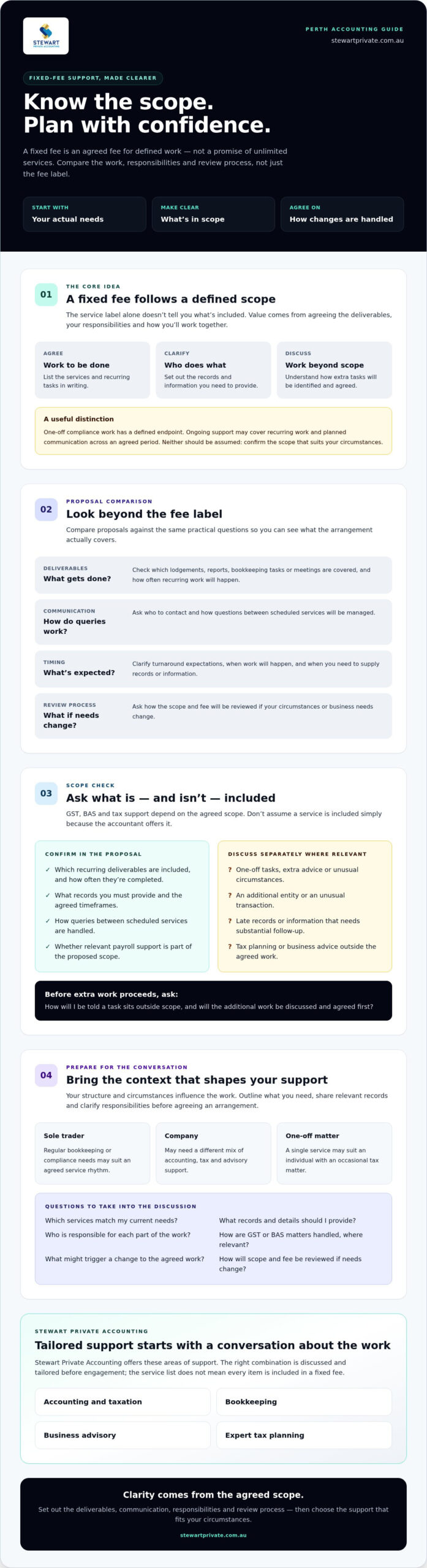
A fixed fee can make accounting costs easier to plan, but the label alone doesn’t tell you what support you’ll receive. It’s an agreed fee for a defined scope of work, not a promise of unlimited services. The value comes from setting out deliverables, responsibilities and how you’ll work together. That gives you a clear starting point and reduces the chance of surprises about what sits outside the arrangement.
Predictable billing can help business owners plan administrative commitments alongside other operating costs. Ongoing support may also make it easier to deal with questions as they arise, rather than seeking help only when a lodgement is due. But not every business needs a continuing arrangement. A single compliance task may be enough if your accounting needs are occasional. The right option depends on your circumstances and the inclusions you agree with your accountant.
What does a fixed-fee accountant arrangement mean?
The fee model doesn’t establish which services are included. Ask for the agreed work and your own responsibilities to be written down, including how often work will happen and what may be treated as additional. Pricing may reflect the value of the agreed service to you, an idea explored in this value-based pricing model, but clarity still depends on the scope.
For example, a hypothetical sole trader might agree to recurring bookkeeping and specified tax compliance work, while discussing business advice or an unusual transaction separately. That isn’t a standard package. It shows why you should confirm what the fee covers before you engage.
Who may benefit from a fixed-fee arrangement in Perth?
A sole trader with regular bookkeeping or compliance needs may value an agreed service rhythm, while a company may need a different mix of accounting, tax and advisory support. An individual with a one-off tax matter may prefer a single service instead of ongoing accounting. Your structure and circumstances shape the work, so a fixed fee should follow a discussion about your actual needs.
Consider the difference between one-off compliance work and continuing support. A one-off task has a defined endpoint; an ongoing arrangement may cover recurring work and planned communication across an agreed period. If your needs change, ask how the scope and fee will be reviewed rather than assuming new work is automatically included. When comparing a fixed fee accountant Perth option, look for this clarity alongside the fee itself.
What should fixed-fee accounting services include for your needs?
A useful proposal turns a broad service label into a clear working agreement. Ask for a written list of deliverables, what you’re responsible for providing and how recurring work will be handled. GST, BAS and tax support depend on the agreed scope, so don’t assume they’re included simply because an accountant offers them. A fixed fee accountant Perth proposal should make it clear what you’re engaging the accountant to do and what may need a separate discussion.
How to check the inclusions in an accounting package
Match the proposed services to the work your situation actually requires. Ask which lodgements, reports, bookkeeping tasks or meetings are covered, and how often they’ll happen. If payroll support is relevant to your business, ask whether it is part of the proposed scope. Then clarify which records you must supply and by when. Set expectations for questions between scheduled services too: who should you contact, and how will queries be handled? ASIC’s MoneySmart guide offers useful questions to ask an accountant as you compare options.
- Which recurring deliverables are included, and how often are they completed?
- What information must you provide, and what are the agreed timeframes?
- How are queries between scheduled services managed?
These details help both sides keep work organised and reduce misunderstandings about what’s due or who is responsible.
What may sit outside the agreed scope?
Separate regular work from one-off tasks, extra advice and work prompted by unusual circumstances. Ask how the engagement would address an additional entity, an unusual transaction or records that arrive late or need substantial follow-up. If you need tax planning in Perth or business advice, clarify how that work will be identified, agreed and reflected in the engagement before it begins.
- Which events or requests could change the agreed work?
- How will you be told if a task falls outside the scope?
- Will additional work be discussed and agreed before it proceeds?
A service list describes what an accountant may offer, not necessarily what your arrangement includes. Read the engagement details against your needs, including client responsibilities and any process for reviewing the scope as circumstances change. If you’d like to discuss the support your business needs, explore tailored accounting support with Stewart Private Accounting.
How to compare fixed-fee accountants in Perth beyond the fee label
A fixed fee can make an arrangement easier to understand, but it doesn’t tell you whether the service suits your business. Compare proposals against the same needs and responsibilities, not just their labels or headline fees. A fixed fee also doesn’t mean unlimited advice: check what’s included and how additional work is raised before it proceeds.
A fair comparison considers the work delivered, your responsibilities, how you can reach the accountant and how the arrangement will be reviewed as your needs change.
| What to compare | Questions to ask |
|---|---|
| Scope | Which services and deliverables are included, and what remains your responsibility? |
| Contact access | Who handles day-to-day questions, and what communication channels are available? |
| Turnaround expectations | What response or completion timeframes should you expect for routine work? |
| Review arrangements | When will you revisit the scope if your business or accounting needs change? |
Use the same questions with each practice. A proposal with a lower fee may cover fewer deliverables or require you to take on more tasks. A higher fee can’t be judged in isolation either. Compare the service list, expected communication and client responsibilities before deciding whether the difference is worthwhile.
Fixed fee versus hourly billing: compare the arrangement, not assumptions
Billing models explain fees differently. A fixed-fee proposal sets out an agreed fee for defined work, while hourly billing ties charges to time spent. Neither approach automatically costs less or suits every business. Focus on how clearly the work, communication and any additional charges are explained. A separate comparison of fixed-fee and hourly arrangements can help you consider which structure fits your preferences.
Which questions reveal whether the service is a good fit?
Ask who will handle routine queries and how the practice will keep you informed. Check how often the accountant reviews your service needs, particularly if you expect changes to your business structure, activity or record-keeping. A review process helps keep the arrangement relevant instead of relying on an old scope that no longer reflects the work required.
Compare relevant qualifications and experience for the work you need, and confirm current credential details directly. Credentials can help you assess professional background, but they don’t guarantee a particular service experience. If you’re considering a fixed fee accountant Perth businesses can work with over time, weigh qualifications alongside scope, communication and review practices.
What to ask before engaging a fixed-fee accountant in Perth
A productive first discussion starts with a clear picture of your needs, not just a request for a fee. Work through the steps in order: outline what you need, share the records you have, confirm the proposed scope, clarify communication and read the engagement terms before work begins. This gives you and the accountant a practical basis for deciding whether the arrangement fits.
Prepare for a first conversation with a Perth accountant
Before speaking with a fixed fee accountant Perth practice, note your business structure, the entities involved and the regular accounting or compliance tasks you need help with. Where relevant, raise GST and BAS responsibilities, as these depend on your circumstances and the agreed engagement. Bring recent records if available, and be upfront about gaps or information that still needs organising.
Separate immediate requirements from future goals. For example, you might need help with current tax compliance while also wanting to discuss longer-term tax planning or business advice. Making that distinction helps the accountant identify which needs belong in the initial scope and which require a separate conversation.
- List your entities, recurring obligations and bookkeeping needs.
- Gather recent records, or identify what is incomplete.
- Write down unresolved questions and longer-term priorities.
Confirm the agreement before work begins
Once you’ve discussed your needs, check that the written engagement describes the deliverables, your responsibilities, exclusions and communication arrangements. Confirm how often services will be provided, who to contact with routine questions and when the arrangement will be reviewed. If you’re already considering a change of accountant, plan for the transition and make sure responsibilities for current work and records are clear.
Ask how the accountant will handle work outside the agreed scope. Will they explain why it’s additional, outline any change to the engagement and seek your agreement before proceeding? Also clarify how either party can raise changes if your business structure or requirements shift. Clear terms make it easier to address changes calmly, rather than discovering a difference in expectations after work has started.
Use this sequence to compare proposals on more than the fee: needs, records, scope, communication and terms. If you’d like to discuss the accounting support your business requires, discuss your business’s accounting needs with Stewart Private Accounting.
How Stewart Private Accounting approaches tailored fixed-fee support
Stewart Private Accounting is a Perth-based practice led by Bradley Stewart. It offers tailored fixed-fee support across accounting and taxation, bookkeeping, business advisory and expert tax planning. You can discuss the work you need and clarify the proposed scope before deciding whether the arrangement is right for you.
Bradley Stewart is a Chartered Tax Adviser and Registered Tax Agent, with more than 15 years of public accounting and consulting experience. You can check current credential details and discuss the practice’s engagement terms directly. Qualifications and experience can help you understand an accountant’s background, while a clear conversation will establish whether the services fit your circumstances.
A tailored scope for accounting, tax and business needs
Your priorities should guide the conversation. You might need bookkeeping alongside accounting and taxation support, or want to discuss expert tax planning and business advisory needs as well. These are services the practice offers, but that doesn’t mean every service is included in every fixed-fee arrangement. Ask which deliverables are proposed for you, what information you’ll need to provide and how any work outside the agreed scope will be discussed.
Stewart Private Accounting also offers a Trusted Concierge service. Ask the practice what this involves and whether it’s relevant to your needs. Before engaging, make sure responsibilities, inclusions and any exclusions are agreed in writing. That gives you a practical reference point if your needs change.
What to expect from the next conversation
You don’t need to have every detail resolved before starting a discussion. It can help to outline what your business does, how your accounting is currently managed and where you’d value support. Mention recurring work, immediate priorities and questions you’d like to address. This gives the practice useful context without assuming that a particular service or package will suit you.
Then explore the proposed scope, how communication will work and when you might review the arrangement. A considered conversation can help you judge whether a fixed fee accountant Perth business relationship suits your current requirements and could adapt as they evolve. You can ask for time to consider the terms before making a decision.
If you’d like to discuss whether the practice’s support is a good fit, Talk with Stewart Private Accounting.
Choose accounting support with clarity and confidence
A suitable fixed-fee arrangement starts with a clearly agreed scope, not the fee label alone. Before engaging, confirm which services and deliverables are included, what you’re responsible for and how the accountant will communicate about additional work. Compare proposals on those details, alongside turnaround expectations and how the arrangement will be reviewed if your needs change.
For a business seeking a fixed fee accountant Perth practice, these conversations can turn uncertainty into a more considered choice. Stewart Private Accounting is based in Perth and led by Bradley Stewart, a Chartered Tax Adviser and Registered Tax Agent with over 15 years of public accounting and consulting experience. Discuss the engagement details directly before proceeding.
If you’re ready to explore whether its accounting and taxation, bookkeeping or advisory support suits your needs, Discuss your accounting needs with Stewart Private Accounting. A clear conversation is a sensible first step towards an accounting relationship that feels organised, appropriate and able to adapt as your circumstances evolve.
Frequently Asked Questions
What does a fixed-fee accountant in Perth usually include?
Inclusions depend on the written engagement, not the fixed-fee label. The agreement may cover a one-off compliance task or ongoing support, and the scope varies between accountants. Check the deliverables, your responsibilities, any lodgements, communication arrangements and exclusions before agreeing. A fixed fee accountant Perth businesses choose should match their actual needs, as should support for individuals. Don’t assume a standard list of services applies to every engagement.
Is a fixed-fee accountant cheaper than an hourly accountant?
The billing model alone can’t show which arrangement will cost less. Compare the work included, your needs and how additional tasks are identified and approved. Ask each accountant for a written scope covering equivalent deliverables and responsibilities, then check how changes may affect charges. A fixed fee can make agreed costs easier to plan, while hourly billing links charges to time, but neither model is always more affordable. For a closer look, see this fixed fee vs hourly accountant guide. Compare the arrangements, not just their labels.
How much does a fixed-fee accountant in Perth cost?
There’s no single fee that applies to all Perth clients. The amount depends on the services required, your business structure, the state of your records and the responsibilities agreed between you and the accountant. Request a tailored written quote that sets out inclusions, exclusions and how additional work will be discussed and approved. For broader cost considerations, consult a guide to how much an accountant costs in Perth, then assess any quote against your circumstances.
Can a fixed-fee accountant help with bookkeeping, tax and business advice?
Some practices provide several types of support, but a fixed fee doesn’t automatically bundle them together. Confirm which services are available, what the engagement includes and whether the work is ongoing or agreed separately. Stewart Private Accounting offers accounting and taxation, bookkeeping, business advisory and expert tax planning. If you’re in Perth or elsewhere in Western Australia, discuss your priorities directly and ask how any proposed scope would address them.
What happens if my business needs change after I agree to a fixed fee?
A change in your business can affect the work required, so check how the engagement handles scope reviews and additional work. Contact your accountant if your structure, transaction volume or support needs shift. Ask how they’ll explain work outside the existing scope and seek your agreement before proceeding. Don’t assume the original fee will stay unchanged or that extra tasks are automatically included. Clear communication gives you a chance to review the arrangement together.
How can I check that an accountant is appropriately qualified in Australia?
Check relevant credentials and use the Tax Practitioners Board’s public register to confirm tax-agent registration. For a professional designation such as Chartered Tax Adviser, confirm its current status with the issuing professional body. These checks help you understand an accountant’s qualifications, but they don’t guarantee a particular result. Also assess relevant experience, service scope and communication. Bradley Stewart is a Chartered Tax Adviser and Registered Tax Agent; check current details directly when making your choice.