

For an entity with an ABN other than a sole trader, the key online step is yours: nominate a new registered tax agent through the ATO’s client-to-agent linking process. Individuals and sole traders currently follow different onboarding arrangements; ask your agent which process applies. After nomination, the agent has 28 days to add your business as a client. They can’t complete the nomination on your behalf.
It’s understandable to want ATO correspondence, tax obligations and follow-up handled in an orderly way, especially while running a business. The nomination process lets you decide who can act for your business and which authorisations they hold.
This guide explains how to prepare your business access, nominate an agent through the ATO’s online services and choose appropriate authorisations. It also covers responding to an audit, compliance review or tax debt, and keeping communication and follow-up organised. A clear process gives your accountant the authority they need while keeping you informed about decisions and deadlines.
Key Takeaways
- Nominate your registered tax agent yourself; once nominated, they have 28 days to add your business as a client.
- Agree the required tax accounts and scope with your agent. A later expansion of their authorisation can require a fresh nomination.
- Keep ATO audit or compliance review records organised so your responses are clear, complete and supported by relevant business information.
- Track ATO messages, agreed actions and follow-up dates to keep tax matters moving and identify when you may need to discuss payment arrangements.
- For a tax dispute, organise the notices and records involved so the issue and the basis for your position are clear.
Authorising a registered tax agent to represent a business with the ATO
1. Identify the right professional. “Accountant” describes a profession, not by itself an ATO registration or permission to represent your business. A registered tax agent can legally represent clients in ATO dealings, including audits, objections and debt negotiations. A BAS agent is also a registered agent, but the title alone doesn’t establish authority for every tax matter. Confirm the registration and the work you need covered.
2. Get the agent’s Registered Agent Number. Ask the agent for their RAN, then use it to identify them during the nomination process. Check that the details match the person or practice you intend to authorise. This reduces the risk of nominating the wrong agent, particularly when several professionals have similar names.
3. Prepare your business access. The business representative needs Standard Identity Strength on myID for the remaining linking steps. The principal authority, the person ultimately responsible for the business, must link the business’s ABN in Relationship Authorisation Manager (RAM) first. A person can link online when their name is listed in the ABR and they have strong myID identity strength. Otherwise, they must contact the ATO directly to link their myID to the ABN.
4. Nominate the agent through ATO online services. The business must complete its nomination itself; the agent can’t do it on your behalf. The ATO’s client-to-agent linking process for Australian businesses came into effect on November 13th, 2023. The requirement applies to entities with an ABN other than sole traders when engaging a new agent or changing the authorisation of an existing agent. Businesses already linked to an agent don’t need to act under the process.
5. Agree the authorisation scope carefully. Tell the agent which tax accounts and responsibilities they should link after nomination. A later change to their authorisations can require a fresh nomination; do not confuse agent nomination with the separate RAM permissions used for your staff. An accountant can handle authorised ATO dealings within the access granted, but your business should still review messages and decisions. The main risks are granting the wrong access or assuming nomination removes your need to oversee tax matters.
6. Confirm the agent accepts the nomination. A nominated agent has 28 days to add the business as a client. If the nomination is nearing expiry, the extension feature becomes available the next calendar day after submission. An extension adds 28 calendar days from when the request is submitted. Act promptly, and confirm the agent has completed the link.
Online services for agents is the secure system for registered tax and BAS agents and their authorised staff. To log in, users need myID, a Digital ID credential, and Relationship Authorisation Manager (RAM); each user needs their own Digital ID. Users must also meet minimum security and computer requirements. Use RAM to authorise or remove contacts who need online access to business records, and review access as roles change.
The ATO’s agent-client linking process is designed to make interaction between tax agents and businesses secure and streamlined. Agree the intended authorisation scope with your agent at the outset. Nominate the correct agent using their registered agent number, complete the declaration and tell them when you have submitted it. See the ATO’s agent nomination guide.
Steps for engaging an ATO liaison service
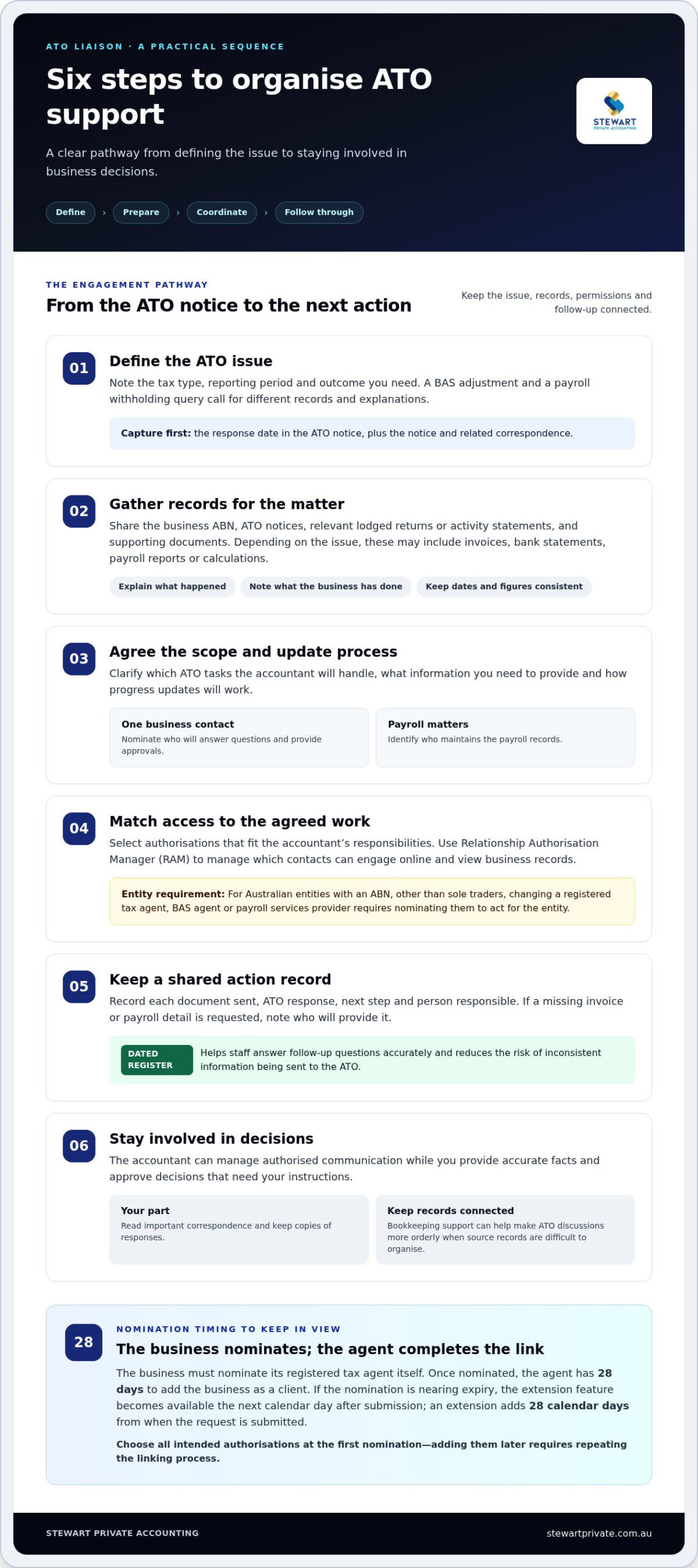
- Define the ATO issue before choosing support. Note the tax type, reporting period and outcome you need. A BAS adjustment and a payroll withholding query, for example, require different records and explanations. Record any response date in the ATO notice, then share the notice and related correspondence. This gives an accountant to liaise with the ATO for your business a clear starting point.
- Gather records relevant to the matter. Provide the business ABN, ATO notices, relevant lodged returns or activity statements, and supporting documents. Depending on the issue, these may include invoices, bank statements, payroll reports or calculations. Explain what happened, what the business has already done and who handled the transaction. Keep dates and figures consistent across your records.
- Agree on the scope of assistance and how updates will work. Clarify which ATO tasks the accountant will handle, what information you need to provide and how you’ll receive progress updates. Nominate one business contact for questions and approvals. For payroll matters, identify who maintains the payroll records. This helps connect the ATO response with the business’s accounting information.
- Review access and permissions against the agreed work. Select authorisations that match the accountant’s responsibilities. Use Relationship Authorisation Manager (RAM) to manage which contacts can engage online and view business records. For Australian entities with an ABN, other than sole traders, changing a registered tax agent, BAS agent or payroll services provider requires nominating the agent or provider to act for the entity.
- Keep a shared record of actions. Note each document sent, ATO response, next step and person responsible. If the accountant requests a missing invoice or payroll detail, record who will provide it. A dated file or register helps staff answer follow-up questions accurately and reduces the risk of sending inconsistent information to the ATO.
- Stay involved in business decisions. An accountant to liaise with the ATO for your business can manage authorised communication, while you provide accurate facts and approve decisions requiring your instructions. Read important correspondence and keep copies of responses. If organising source records is part of the challenge, business bookkeeping support can help make ATO discussions more orderly.
If the agreed work involves Online services for agents, confirm access arrangements before expecting the accountant to complete an online task. Users must meet minimum security and computer requirements to secure their transactions. They also need myID, a Digital ID credential, and Relationship Authorisation Manager (RAM), an authorisation service, to log in. Treat these as separate access requirements: having an authorisation in place does not replace the login requirements. If access is not ready, raise this early and agree how documents and decisions will be handled meanwhile. The Tax agent online services guide lists the queries and functions available through the service. Match the task to that list, then confirm with the accountant that it falls within the agreed scope.
ATO audits and compliance reviews
- Read the ATO notice and identify its scope. Note the tax type, reporting periods, records requested and contact details. An audit may examine specific transactions, while a compliance review may ask how the business reported its obligations. Keep the notice with earlier ATO correspondence. For a sole trader, separate business records from personal records where relevant.
- Record the response date in the ATO notice and plan around it. List the requested items, such as invoices, bank statements, activity statements or payroll records, and assign each to the person who can locate it. If a document is missing, note what happened and gather other records that explain the transaction. This gives your registered tax agent a clear evidence trail.
- Reconcile records before sending them. Compare the figures in the notice with your accounting records, lodged returns and source documents. If the ATO asks about a sales amount, for example, trace it from invoices through bank deposits to the relevant tax reporting. Flag differences and explain their cause. An indexed, consistent set of records helps the agent respond on your behalf clearly.
- Agree on who will prepare and approve the response. A registered tax agent can legally represent clients in ATO dealings, including audits. Give the agent the authority needed for the matter and provide accurate business context. You remain responsible for explaining decisions, transactions and records only you know. Review factual statements before they go to the ATO, particularly when the response covers several reporting periods.
- If you find an error, discuss whether a voluntary disclosure is appropriate. Through your registered tax agent, disclose the relevant facts rather than leaving an identified issue unexplained. A voluntary disclosure may reduce penalties, depending on its timing, completeness and the applicable rules; using an agent does not itself guarantee preferential treatment or a reduction. Provide the agent with the affected records and explain how the error arose so any disclosure accurately reflects the circumstances.
- Keep a dated record of each submission, ATO request and response. Audit and review timing varies with the scope, records and issues; do not assume a standard completion period. Timing depends on the records, issues and follow-up involved. Save materials in one secure business file and note outstanding questions after each ATO contact. This makes it easier to respond consistently if the review continues or further information is requested.
Business communication and follow-up with the ATO
If the ATO contacts your business directly, keep the message and note its response date. Forward it promptly to your registered agent, then agree who will prepare the reply and provide supporting records.
- Use one clear channel for ATO correspondence. Keep letters, online messages and call notes together in a dated business file. Record the officer’s details, the topic discussed and any requested action. If a phone call raises a new issue, summarise it for your agent. An accountant to liaise with the ATO for your business can then work from one consistent record instead of separate accounts from different staff.
- Track every open ATO action. In a simple register, record the matter, responsible person, next step and relevant date. List a request for payroll summaries separately from a question about a lodged tax return, for example. Mark an action complete only after saving the submitted material or ATO response. This keeps follow-up organised when different staff handle separate tasks.
- Make sure your registered agent can access the information needed. Business contacts must be authorised in Relationship Authorisation Manager to engage online and view business records. Review permissions when staff roles change. If you change agents, nominate the new registered agent through the linking process. Your business must still provide relevant records and make its own business decisions.
- Respond carefully if the ATO contacts you directly. Send your accountant the original notice, attachments and call notes. If the ATO asks a factual question, answer accurately and keep a copy. Don’t guess figures or alter records to fit an explanation. If you disagree with the accountant’s advice, ask them to explain the reasoning against the ATO issue and source documents.
- Clarify any disagreement before a response goes to the ATO. Identify the ATO’s position, the records supporting your view and the next step being considered. Separate a factual correction, such as a duplicated payment, from a disagreement about tax treatment. Agree who will draft the reply and who will approve business facts. An accountant to liaise with the ATO for your business can explain the technical reasoning, while you confirm the facts.
- Discuss tax debt early if payment becomes difficult. Discuss debt recovery and payment arrangements with the ATO or your agent promptly. A dispute or payment-plan request does not automatically stop recovery or interest. An ATO payment plan lets a taxpayer pay tax debt in instalments rather than as a lump sum. Give your agent current cash-flow information and details of existing commitments. Record agreed payment dates and monitor them alongside lodgement and follow-up tasks.
GST, income tax, PAYG and FBT disputes
A registered tax agent can represent your business in ATO objections and debt negotiations. They can discuss a payment plan and help present a request about interest or penalties, supported by facts and records relevant to your case.
- Identify the tax type and decision in dispute. For GST, check the relevant activity statement and transaction records. For income tax, identify the return, calculation or adjustment at issue. PAYG matters may involve withholding or instalments, while FBT disputes concern how benefits were treated. Record the ATO’s stated position and the period involved.
- Gather evidence directly related to the disputed treatment. A GST issue may require invoices and sales records; an income tax matter may need expense documents and calculations. For PAYG, collate payroll reports and payment records. For FBT, organise records describing the benefit and its business context. Give the agent complete documents, not selected pages alone.
- Compare the ATO’s figures with your business records. Trace each amount from its original source through bookkeeping entries to the lodged return or activity statement. Note any mismatch and its cause, such as a duplicated entry or missing document. Ask the agent to distinguish verified facts from assumptions before preparing the business’s position.
- Agree on the response and decision process with your agent. Registered tax agents can represent clients in ATO dealings, including objections and debt negotiations. Share the commercial context, confirm factual statements and approve material responses before submission. If you disagree with advice, ask which records and tax treatment support it, then discuss the reasoning and alternatives.
- Discuss payment separately from the dispute. An ATO payment plan allows tax debt to be paid in instalments rather than as a lump sum. Give your agent current cash-flow details and explain what the business can manage. For interest or penalties, provide the timeline, relevant correspondence and details of the circumstances, so a remission request can present the supporting facts.
- Keep a record of what was lodged and what happens next. Save the objection, supporting documents, payment-plan details and ATO correspondence together. Track requested information and who is responsible for each action. If the ATO responds with a different calculation, compare it with the original dispute and your evidence before deciding what to do next. This keeps agents and business staff working from the same record.
For structured help with the records and tax issues behind a dispute, discuss accounting and taxation support.
Stewart Private Accounting: Accounting & Taxation Services
Stewart Private Accounting helps bring structure to business tax and accounting matters. Its Accounting & Taxation Services support regular obligations, while Bookkeeping Services help keep financial records organised for returns and ATO discussions.
Consider support if you need clearer tax records, want to plan for how to structure a business for tax in Australia or need advice on the financial decisions surrounding an ATO matter. Business Advisory Services and Expert Tax Planning can connect tax considerations with wider business decisions. As a registered tax agent, Bradley Stewart can represent clients in ATO dealings within the authorisations granted.
For a considered conversation about your business accounting and tax needs, contact Stewart Private Accounting.
Build a steadier approach to ATO matters
Choosing an accountant to liaise with the ATO for your business is also an opportunity to improve how you manage financial decisions. Clear records, consistent reporting and informed advice can support better day-to-day choices, not just responses to an ATO enquiry. Consider what would make tax administration easier for your team over the coming year, such as clearer bookkeeping processes or earlier planning for business obligations.
Stewart Private Accounting offers Accounting & Taxation Services, Bookkeeping Services and Business Advisory Services. These services connect financial records with practical business decisions, helping you manage ongoing tax responsibilities with greater clarity. Take the next step by discussing your business’s priorities and the support that would be useful.
Arrange a conversation with Stewart Private Accounting about your accounting and tax needs. With a clear plan and steady oversight, you can approach the next business decision with greater confidence.
Frequently Asked Questions
What ATO authorisations does a business need to appoint an accountant as its registered agent?
An entity with an ABN other than a sole trader generally needs to nominate a new registered agent in ATO Online services for business. Sole traders should confirm the separate onboarding process with their agent. Choose access that matches the accountant’s responsibilities, such as handling relevant tax matters, rather than granting broader permissions by default. Manage staff access to business records separately through Relationship Authorisation Manager (RAM). The business representative also needs the required myID identity strength to complete the online process.