

A fixed fee can make your accounting costs easier to plan, but it doesn’t automatically mean every task or question is included. When weighing up a fixed fee vs hourly accountant, match the fee structure to the work you need and the scope you agree.
When comparing proposals, it can be difficult to see what each fee covers. Hourly charges may make routine advice less predictable, while a fixed fee can raise questions about what happens when your business needs change. Address those questions before you engage an accountant, not after additional work arises.
This guide explains how fixed-fee and hourly billing work, where cost uncertainty sits, and what to check in an engagement agreement, including how out-of-scope work is handled. It also shows how to compare your workload, cash flow and need for ongoing advice. Stewart Private Accounting offers tailored packages at predetermined fixed fees, with the scope shaped around client needs.
Key Takeaways
- Use the fixed fee vs hourly accountant comparison to weigh predictable budgeting against charges that vary with time worked.
- Check what the agreed fee covers, including deliverables, assumptions, exclusions and how additional work is handled.
- Separate recurring tasks such as BAS, bookkeeping and annual tax work from requests that may change as your business develops.
- Compare proposals by scope and terms, not just by billing method or headline fee.
- Stewart Private Accounting offers tailored services at predetermined fixed fees across accounting and taxation, bookkeeping, business advisory and expert tax planning.
Fixed fee vs hourly accountant: what are you actually paying for?
To compare accounting costs, first understand how the charge is calculated, then check which work the agreement covers. This matters when you need a quick answer, your workload changes or you ask for help beyond routine tasks.
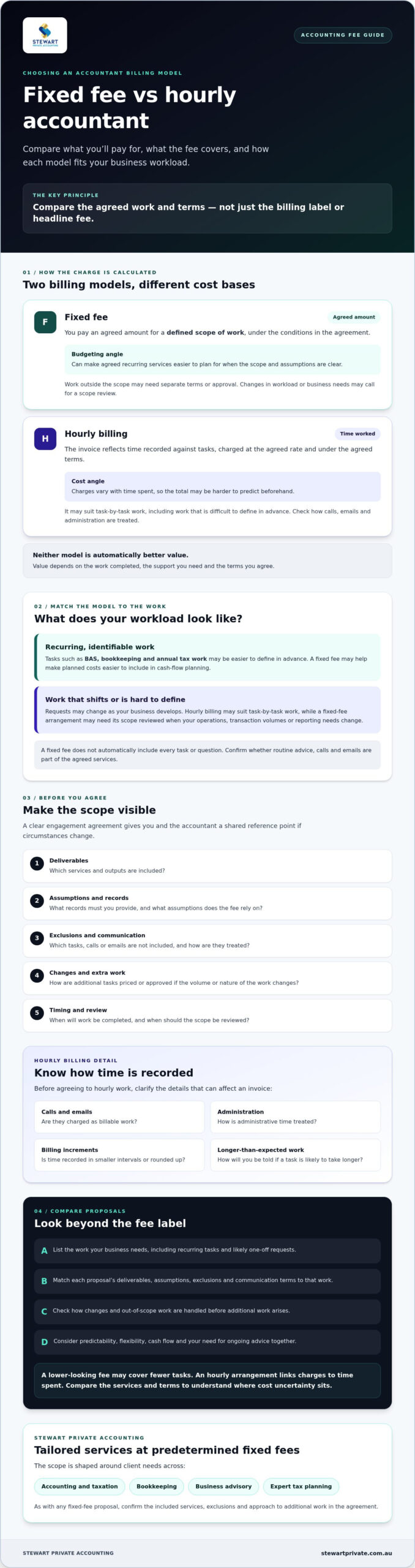
Hourly billing charges for time worked; fixed-fee billing charges an agreed amount for a defined scope of work. Neither method automatically offers better value. The important questions are whether the scope, communication expectations and fee terms fit the support your business needs.
A fixed fee is a form of flat rate pricing, but the label alone doesn’t tell you what an accountant has agreed to do. Read the engagement terms to understand the boundaries of the work and how changes are handled.
How does an hourly accountant charge for work?
With hourly billing, an invoice reflects time recorded against tasks, charged under the agreed rate and terms. Tasks might include preparing bookkeeping records, answering a bookkeeping question or providing one-off advice. Whether a call or email is charged, and how much time is recorded, depends on the engagement terms.
Before agreeing, ask how the accountant treats calls, emails, administration and minimum billing increments. Check whether time is recorded in smaller intervals or rounded up, and how you’ll be told if work is likely to take longer than expected. These details help you understand how ordinary requests may affect the invoice.
What does a fixed-fee accountant agree to provide?
A fixed fee applies to specified services and the conditions set out in the agreement. Depending on the arrangement, the scope could include bookkeeping, tax work or business advisory support. Don’t assume these services are included simply because a proposal calls the fee fixed.
Ask for the deliverables, exclusions, timing and review arrangements in writing. Clarify what records you need to provide, what happens if the volume or nature of the work changes, and how additional tasks are priced or approved. A clear scope gives you and the accountant a shared reference point if circumstances shift.
When comparing proposals, remember that a lower-looking fee may cover fewer tasks, while an hourly arrangement may suit work that is difficult to define in advance. Compare the services and terms, not just the billing label, to see what support you’ll receive and where cost uncertainty sits.
Fixed fee vs hourly accountant: compare certainty, flexibility and advice access
The right arrangement depends on how regularly you need support and how clearly the work can be defined in advance. A fixed fee can make agreed recurring services easier to budget for. Hourly billing links charges to time spent, which may be less predictable. Neither model is automatically cheaper: value depends on the work completed and the terms you agree.
| Consideration | Fixed fee | Hourly billing |
|---|---|---|
| Predictability | Can support budgeting when services and assumptions are clearly agreed. | Total charges depend on time spent, so ask how time is tracked and reported. |
| Scope flexibility | Work outside the agreed scope may need separate terms or approval. | May suit task-by-task work, subject to the agreed rate and terms. |
| Workload changes | A change in volume or business needs may call for a scope review. | Charges can reflect additional time, but the total may be harder to predict beforehand. |
| Routine advice | Confirm whether questions or advice are included in the defined services. | Ask whether time spent on calls and emails is recorded as billable work. |
Billing certainty and service value are related, but they’re not the same: a clear fee matters only when the agreed work meets your needs. For a broader perspective on accountant billing methods, consider how the structure shapes both the professional’s work and your expectations as a client.
When can a fixed-fee arrangement suit a small business?
If your business has recurring bookkeeping, tax or compliance work that can be clearly identified, a fixed fee may make planned costs easier to include in cash-flow planning. That doesn’t guarantee a saving or mean every request is covered. Review the agreement when your operations, transaction volumes or reporting needs change, and ask whether the scope or fee should be revisited.
When might hourly billing be a reasonable option?
Hourly billing can be practical for an isolated question, an unusual project or work whose extent is difficult to establish upfront. Charges follow the time spent on that task, which may suit a business looking for flexibility rather than a recurring arrangement. Agree the rate, how time will be recorded and whether you’ll approve work before it proceeds. To understand how a Perth practice offering tailored fixed-fee services works, explore Stewart Private Accounting’s approach.
What to check before choosing a fixed-fee or hourly accountant
A useful proposal explains what work you’re engaging the accountant to do, what information they’ll need from you and how charges are set. When comparing a fixed fee vs hourly accountant, assess equivalent scopes rather than choosing by the headline fee alone. A lower quote may cover fewer services or rely on different assumptions.
Ask for the deliverables, assumptions and exclusions in writing. Check the billing frequency, whether GST is included or added, payment terms and how additional work is approved. These details make it easier to compare the full arrangement and understand what to expect if your needs change.
Which questions clarify the scope and any extra work?
Use practical questions to check whether the proposed scope matches your workload:
- Which recurring services are included, and which need a separate agreement?
- How will you be told about work beyond scope, and will you approve it before it proceeds?
- How might changes in transaction volume, staff numbers or business structure affect the work or fee?
- How are urgent requests handled, and could they involve different terms?
For example, hiring staff or changing your business structure may mean you need support beyond your previous routine. Ask what prompts a review, how a revised scope will be documented and whether the accountant will discuss the change with you before doing extra work.
How should you assess communication and professional standing?
Agree who your day-to-day contact will be and how advice requests are managed. Ask how to raise a question, what response arrangements to expect and whether calls or emails affect the fee. Clear expectations make it easier to seek support without guessing how communication will be treated.
Check that the person handling your work has credentials relevant to the services you need. If you’re engaging someone for tax agent services, verify their current registration details through the Tax Practitioners Board’s public register. For other professional credentials, use the relevant Australian professional body’s register where available.
Before signing, compare proposals line by line: services, assumptions, exclusions, GST treatment, payment terms, approval for additional work and review arrangements. This is a more reliable basis for deciding whether an arrangement fits than comparing fee labels alone. Ask for any unclear wording to be clarified in the written agreement.
Which accountant billing model fits your business in Western Australia?
Choose based on how your business operates, not on an assumption that one fee model suits every Perth or Western Australian business. BAS work, bookkeeping and annual tax work may recur, but whether they’re included depends on the agreed scope. Use these steps to compare options against your actual workload.
- 1. Map recurring work. List regular needs such as bookkeeping, BAS preparation or annual tax work, and note how often they arise. Treat these as tasks to discuss, not automatic inclusions.
- 2. Identify variable tasks. Separate predictable work from unusual projects, changes in business structure and irregular advice requests. Consider whether you want ongoing access to advice for business decisions.
- 3. Compare equivalent scopes. Check that each proposal covers comparable work, responsibilities and assumptions. A fee is difficult to assess fairly if one option includes different tasks from another.
- 4. Clarify the terms. Confirm how routine and additional work are handled, what triggers a scope review, and how changes or extra work are discussed and approved.
How can you match the billing model to your workload?
If most of your accounting needs recur and can be clearly described, a fixed-fee proposal may help you plan around an agreed scope. If your work is irregular or difficult to predict, hourly billing may be worth considering for particular tasks. Your fixed fee vs hourly accountant decision also depends on how you want to manage advice: check whether routine questions are covered or charged separately, then choose the proposal that makes responsibilities clear.
A small business’s needs can change over time. Adding staff can affect bookkeeping and reporting tasks; higher transaction volumes may change the work involved; and new advisory needs may call for a broader discussion. Clarify how each proposal responds to these changes rather than assuming the original terms will continue to fit.
What changes should prompt a review of the arrangement?
Revisit the scope when your business structure, transaction volume or reporting needs change, or when the work you’re requesting no longer matches the agreement. Raise the change early, before expectations diverge or an invoice prompts questions. You can also agree on a suitable point to review the arrangement, without assuming that one review schedule suits every business.
Stewart Private Accounting is a Perth-based practice offering tailored accounting, tax, bookkeeping and advisory packages at predetermined fixed fees. If you want to discuss how recurring work and changing needs could shape an arrangement, discuss your business accounting needs with the practice.
How Stewart Private Accounting approaches fixed-fee accounting
After comparing billing models, look for an arrangement that reflects the work you need. Stewart Private Accounting is a Perth-based practice offering tailored accounting, tax, bookkeeping and advisory packages at predetermined fixed fees. Services and proposed scope are shaped around client needs, so a fixed fee shouldn’t be taken to mean every task or future request is automatically included.
For your fixed fee vs hourly accountant decision, focus on whether the proposed work matches the way your business operates. Regular compliance needs may sit alongside questions about tax planning or business decisions, but the services and terms need to be agreed. A useful proposal should show what support is planned and when you may need to discuss a change.
What should you discuss when requesting a fixed-fee proposal?
Give the accountant a practical picture of your business and the work you need. Describe your current accounting tasks, how your operations are changing and where you’d value support. For example, explain whether you’re seeking help with bookkeeping, taxation, business advisory or expert tax planning. Stewart Private Accounting provides these services, but the exact work included depends on the proposed arrangement.
Before deciding, ask for the deliverables, exclusions and process for agreeing to additional work. Check that the written scope reflects your discussion, then compare it with other proposals based on equivalent services and assumptions. The lowest headline fee may not be the best fit if the scope differs or leaves important questions unanswered.
How can an ongoing accounting relationship support your business?
As your business develops, compliance, bookkeeping and advisory needs may connect. A clear view of your records, for instance, may inform questions you bring to a discussion about business decisions or tax planning. How those services work together depends on what you engage the practice to provide, so confirm the scope rather than assuming one fee covers every area.
Stewart Private Accounting is led by Bradley Stewart, a Chartered Tax Adviser and Registered Tax Agent. His credentials are relevant context as you assess who will support your accounting and taxation needs. The right choice still comes down to service fit, agreed responsibilities and clear communication about work beyond the proposed scope.
To outline the support your business needs, discuss your accounting needs with Stewart Private Accounting.
Choose an accounting arrangement that fits the way you work
The right fixed fee vs hourly accountant choice depends on your workload, how predictable your needs are and how clearly the agreement defines the work. A fixed fee may support budgeting when its scope and assumptions are clear; hourly billing can suit isolated or less predictable tasks. Neither model guarantees better value, so compare equivalent services and clarify how extra work is handled.
For a business in Western Australia, Stewart Private Accounting offers tailored accounting, tax and advisory packages at predetermined fixed fees. The Perth-based practice is led by Bradley Stewart, a Chartered Tax Adviser and Registered Tax Agent. Discuss and confirm any proposed services and scope to ensure they suit your needs.
When you’re ready to compare your options, discuss your accounting needs with Stewart Private Accounting. Clear expectations and a suitable arrangement can help you plan your business finances with greater confidence.
Frequently Asked Questions
Is a fixed-fee accountant cheaper than an hourly accountant?
Not necessarily. The fixed fee vs hourly accountant comparison depends on the work completed, the agreed scope and how extra tasks are charged. A fixed fee may make specified services easier to budget for, while hourly billing links charges to time worked. Compare proposals covering equivalent services, and consider whether the arrangement suits your workload and advice needs rather than judging value by the billing method alone.
What is usually included in a fixed-fee accounting arrangement?
There’s no standard set of inclusions for every fixed-fee arrangement. The agreement should specify the services covered, which could include accounting, tax, bookkeeping or advisory work, depending on the proposal. Check the deliverables, assumptions, exclusions, timing and any limits on the work. Ask how changes to your circumstances or extra requests are treated, and get the scope confirmed in writing before engaging the accountant.
What happens if work falls outside a fixed-fee agreement?
Work outside the agreed scope may need separate terms or a separate fee, so check the engagement agreement rather than assuming it’s included. Ask the accountant to explain what counts as additional work, how they’ll tell you about it and whether they’ll seek approval before proceeding. If your transaction volume, business structure or reporting needs change, raise it early and confirm any revised scope and fee arrangements in writing.
When does hourly billing make sense for an accountant?
Hourly billing may suit an isolated question, an unusual project or work whose extent is difficult to establish in advance. You pay according to the time recorded under the agreed rate and terms, so ask how calls, emails, administration and minimum billing increments are handled. It can offer task-by-task flexibility, but request updates or approval arrangements so you can follow the work and manage uncertainty about the final charge.
Can you ask an accountant to change from hourly billing to a fixed fee?
Yes, you can ask whether a fixed-fee arrangement is possible for clearly defined work, but the accountant needs to agree to the change. Describe the tasks you need, how often they arise and any variable parts of the workload. Ask for a written proposal outlining services, assumptions, exclusions and how additional work would be handled. If the work is difficult to predict, a fixed fee may require a carefully defined scope.
What should a Perth business check before choosing an accountant’s fee model?
Compare proposals for the same services and check deliverables, exclusions, billing frequency, GST treatment, payment terms and approval of additional work. Consider recurring needs such as bookkeeping, BAS or annual tax work, without assuming they’re automatically included. For tax agent services, check current registration details with the Tax Practitioners Board. A Perth-based practice such as Stewart Private Accounting can discuss tailored fixed-fee services with Western Australian clients.