

Could your business meet one tax deadline while another obligation quietly slips through? Tax compliance for small business WA involves more than lodging an annual return. Your structure, activities and staffing can bring different federal and state responsibilities. Since 1 July 2026, employers must pay superannuation guarantee contributions on payday, making coordination between payroll, bookkeeping and tax administration especially important.
It’s understandable if the rules feel difficult to keep straight while you’re running the business. A reliable routine can organise records, reporting and due dates, and help you see which obligations apply to your circumstances.
This guide covers key federal and Western Australian responsibilities, then shows how to build a repeatable compliance system. You’ll also learn how coordinated bookkeeping and tax support can ease the administrative load. For Perth businesses, Stewart Private Accounting provides accounting, taxation and bookkeeping support, alongside business advisory and expert tax planning. Tailored fixed-fee packages provide clarity about fees and consistent oversight.
Key Takeaways
- Tax compliance for small business WA depends on your business structure, activities, turnover and whether you employ staff.
- Identify which ATO obligations apply to you, including GST, BAS, income tax and PAYG withholding. Don’t assume every business has the same reporting duties.
- Check whether your business activities or workforce bring separate Western Australian tax responsibilities into play.
- Use a consistent routine to capture records, reconcile accounts, review obligations and prepare for upcoming lodgements and payments.
- When transactions or payroll become harder to manage, coordinated bookkeeping and tax support can give you clearer oversight.
Tax compliance for small business WA: what it covers and why it matters
Tax compliance for a small business in WA means meeting the tax registration, record-keeping, reporting and payment responsibilities that apply to its structure and activities. Requirements differ between businesses. Start by identifying which obligations apply to yours, then build your record-keeping and deadlines around that list.
Your business structure, turnover, income sources and workforce all help determine what you need to manage. A sole trader, for example, reports business income through their individual tax affairs, while a company has its own income tax responsibilities. Partnerships and trusts also have distinct reporting arrangements. These are broad differences, not a complete checklist. Selling particular goods or services, employing staff or holding property can bring additional obligations into view.
Compliance involves more than lodging forms. You may need to register for relevant taxes, keep supporting records, report information to the right authority and pay amounts by the applicable due dates. Accurate, up-to-date records connect these steps. Organise invoices, receipts, bank transactions and payroll information as you go, so you can prepare reports from a clear picture of business activity. Regular checks can also uncover missing documents or inconsistent entries before they create extra administration.
Which businesses need to manage tax compliance in Western Australia?
Sole traders, companies, partnerships and trusts can all have tax responsibilities, but the details depend on their legal structure and operations. Keep business records separate from personal spending, even if you’re a sole trader and business income is included in your individual tax return. A company’s tax administration is separate from its owners’ personal tax affairs. Employing staff can add payroll reporting and payment tasks, but not every business needs the same registrations or lodgement schedule.
Federal tax responsibilities and WA-specific requirements
The Australian Taxation Office (ATO) is the main source of information about federal business tax, including income tax and other obligations that may apply. For a broader overview of how Australia’s tax system is organised, see Taxation in Australia. Western Australian businesses may also need to consider state-administered responsibilities, such as payroll tax for some employers.
Federal responsibilities and state obligations are related but not interchangeable. ATO reporting doesn’t replace applicable state requirements, and state obligations don’t replace federal ones. In WA, income tax is administered federally rather than as a separate state income tax. Map responsibilities by authority and keep the relevant records and due dates visible in one place. Coordinated bookkeeping and accounting support can help bring business information and reporting needs together.
Core ATO obligations: GST, BAS, income tax and PAYG withholding
For tax compliance for small business WA, start by identifying which federal obligations apply to your business. GST, Business Activity Statements (BAS), income tax and PAYG withholding are separate responsibilities, and each depends on your circumstances. The Australian Taxation Office (ATO) provides current guidance on eligibility, reporting frequency, due dates and payment instructions.
When might GST registration and BAS reporting apply?
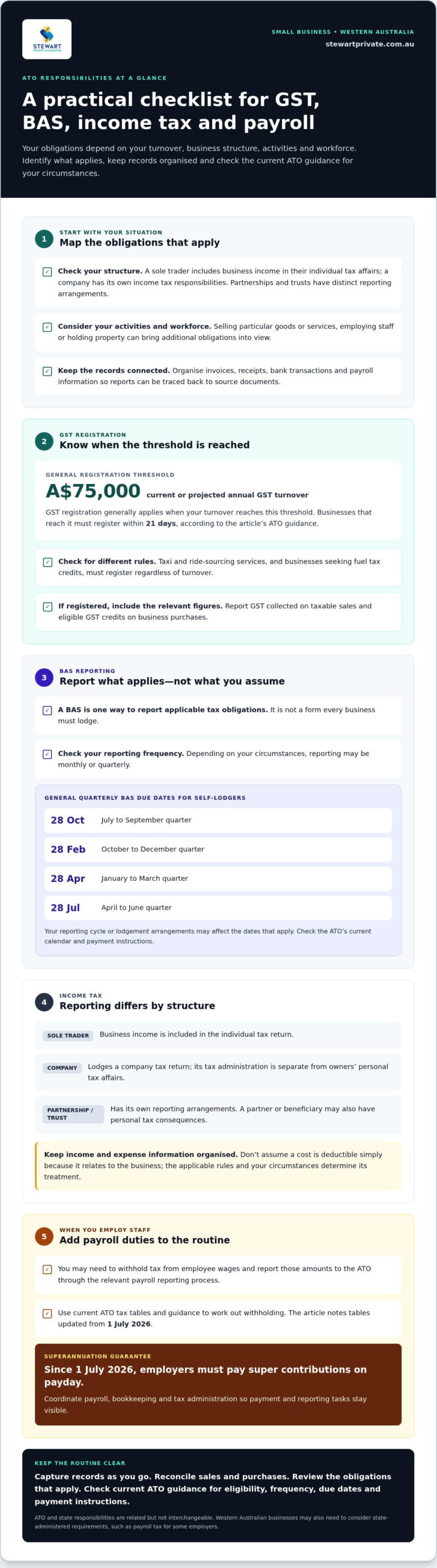
GST registration generally applies when your current or projected annual GST turnover reaches A$75,000. Some activities have different rules: taxi and ride-sourcing services, and businesses seeking fuel tax credits, must register regardless of turnover. The ATO says businesses that reach the threshold must register within 21 days. Check its current guidance for your situation, including applicable exceptions.
If registered, you generally include GST collected on taxable sales and eligible GST credits on business purchases in your reporting. A BAS is one way to report applicable tax obligations, not a form every business must lodge. Depending on your circumstances, reporting may be monthly or quarterly. Reconcile sales and purchase records so reported figures can be traced back to source documents.
For self-lodgers, the ATO’s general quarterly BAS due dates include 28 October for the July to September quarter, 28 February for October to December, 28 April for January to March, and 28 July for April to June. Your reporting cycle or lodgement arrangements may affect the dates that apply. Use the ATO’s current calendar and payment instructions rather than relying on a general list.
Income tax reporting also varies by structure. A sole trader includes business income in their individual tax return, while a company lodges a company tax return. Partnerships and trusts have their own reporting arrangements, and a partner or beneficiary may also have personal tax consequences. Keep business income and expense information organised, but don’t assume a cost is deductible simply because it relates to the business. The applicable rules and your circumstances determine the correct treatment.
What changes when a small business employs staff?
If you pay employees, you may need to withhold tax from their wages and report those amounts to the ATO through the relevant payroll reporting process. Use the current ATO tax tables and guidance to work out withholding, including tables updated from 1 July 2026. Whether withholding applies to other workers depends on the payment and working arrangement, so check the ATO’s rules for the specific case.
Tax reporting is only one part of employing staff. Workplace relations responsibilities and superannuation obligations are separate matters that need their own processes. From 1 July 2026, superannuation guarantee contributions must be paid on payday. Keep payroll data, withholding reports and super payment records aligned. For related practical guidance, see this payroll help for small business guide.
When payroll and tax reporting become difficult to coordinate, accounting, taxation and bookkeeping support can bring the records and reporting workflow together. Stewart Private Accounting offers tailored fixed-fee packages for clarity about service fees and consistent oversight. Explore accounting and taxation support as part of a more manageable compliance routine.
WA tax compliance: when state obligations may apply to your business
Operating in Western Australia doesn’t automatically mean you have a state tax bill. State obligations depend on your activities, workforce and assets, and sit alongside any applicable federal reporting. A clear tax compliance for small business WA plan separates responsibilities by authority, so you can track the right rules without treating one lodgement as a substitute for another.
Could WA payroll tax apply to your business?
Payroll tax is a state-level consideration for some employers, based on taxable wages and current WA rules. For 2026, the rate is 5.5%, with a threshold where total Australian taxable wages exceed A$1 million a year and a diminishing threshold for wages between A$1 million and A$7.5 million. Check current WA Treasury guidance for thresholds, exemptions and how the rules apply to your circumstances.
Other state obligations may be relevant too. For example, land tax may need consideration if your business owns land, subject to applicable valuation rules and exemptions. The Government of Western Australia is a starting point for state information. Use current Treasury or RevenueWA guidance to verify the specific requirements, rates and dates that apply.
| Obligation | Administering body | When it may apply | Where to verify |
|---|---|---|---|
| GST | ATO | If your business is required to register or chooses to register | Current ATO GST guidance |
| BAS reporting | ATO | If you have applicable obligations to report, such as GST | ATO lodgement and payment guidance |
| Income tax | ATO | According to your business structure and reporting responsibilities | ATO business income tax guidance |
| Payroll tax | WA state revenue authority | If your employer circumstances meet current WA rules | WA Treasury or RevenueWA payroll tax guidance |
| Land tax | WA state revenue authority | If you own land that is taxable under WA rules | Current WA land tax guidance |
How to distinguish ATO and WA responsibilities
The ATO administers federal obligations such as GST, BAS and income tax where they apply. WA state authorities administer separate state taxes, including payroll tax and land tax in relevant circumstances. Check each obligation with the authority responsible for it, and record its due dates separately. This keeps federal reporting visible while making room for state requirements that may depend on your workforce or property.
Your business’s location alone does not determine every tax obligation; its structure, activities, wages and assets matter too. Review those details against current guidance rather than relying on a generic checklist. Coordinated bookkeeping and accounting support can help keep the records behind federal and state reporting organised. Stewart Private Accounting provides tailored accounting and taxation support to help create clearer oversight.
A practical tax compliance routine for WA small businesses
A steady routine turns tax administration into manageable checks, rather than a scramble before each lodgement. For tax compliance for small business WA, keep the process simple: capture records, reconcile accounts, review applicable obligations, then prepare and lodge the required reports. Consistent bookkeeping helps you spot gaps early and gives BAS and year-end reporting a more reliable starting point.
Records to organise throughout the financial year
Keep business records in a consistent digital or paper-based system. Organise sales invoices, purchase invoices, receipts, bank records and supporting documents so reported figures can be traced to their source. If you employ staff, include relevant payroll records. A clear filing structure makes it easier to find evidence, explain transactions and resolve questions during preparation.
Build the habit when each transaction happens. For example, file a supplier invoice with the purchase record rather than leaving it in an inbox to sort out later. Keep business and personal transactions distinguishable, and follow current ATO guidance on record-keeping requirements, including how long specific records must be kept.
Monthly and quarterly checks that help prevent last-minute pressure
Set aside regular time to match bank activity against your bookkeeping, review uncategorised transactions and look for missing invoices or duplicate entries. Then compare upcoming tasks with your registrations and reporting arrangements. A business that isn’t registered for a particular obligation won’t have the same lodgement schedule as one that is, so make your calendar specific to your circumstances.
Use one calendar for applicable reporting dates, payment dates and internal preparation milestones. Set a reminder to gather records before a lodgement is due, not just on the final date. Check official guidance when due dates or arrangements change, then update the calendar so the next cycle starts with accurate information.
Use this numbered routine as a starting point:
- Capture sales, purchases, receipts, invoices, bank activity and relevant payroll documents as they arise.
- Reconcile business accounts regularly, following up unmatched transactions and missing source records.
- Review registrations, reporting responsibilities and upcoming due dates against your business’s current activities.
- Prepare reports from reconciled records and resolve unclear items before lodgement.
- Lodge applicable reports and arrange payments by the relevant dates, then save confirmation with your records.
Compliance and tax planning serve different purposes. Compliance keeps records and reporting in order, while forward planning helps you consider tax implications as business decisions develop. A Perth tax planning guide can help you think ahead without replacing regular compliance checks.
If bookkeeping or deadline coordination is taking time away from running the business, Stewart Private Accounting can bring bookkeeping, accounting and taxation support together. Explore accounting and bookkeeping support to build a clearer, more consistent compliance routine.
When accounting support can make WA tax compliance easier
Handling compliance yourself can work while transactions and reporting needs remain manageable. Missed deadlines, growing transaction volumes or payroll tasks that are harder to coordinate can be signs that extra support would help. The aim isn’t simply to hand over paperwork. It’s to create a clear view of applicable responsibilities, the records behind them and the tasks that need attention next.
Consider whether any of these situations sound familiar:
- You’re regularly searching for receipts or invoices when a report is due.
- Bookkeeping is falling behind, leaving transactions unreconciled or unclear.
- You’re unsure which registrations or reporting arrangements apply as the business changes.
- Payroll, withholding and other tax administration are becoming difficult to manage alongside daily work.
- You’ve missed a lodgement or payment date, or don’t have a dependable calendar for upcoming obligations.
One issue may be manageable with a better process. Several recurring gaps, or uncertainty about what needs to be reported, may point to a need for more consistent oversight. For tax compliance for small business WA, coordinated support connects bookkeeping records with tax preparation and business advice, helping you understand how routine administration fits together. It can also give you a clearer basis for planning workloads and preparing for upcoming responsibilities.
What to expect from coordinated accounting and tax support
Support can bring accounting, taxation, bookkeeping and business advisory into a more connected process. Organised records inform reporting, while regular communication helps you understand outstanding information and upcoming tasks. Stewart Private Accounting is led by Bradley Stewart, a Chartered Tax Adviser and Registered Tax Agent. Tailored fixed-fee packages provide clarity about service fees, with support shaped to the business’s needs and circumstances.
Clear communication matters. You should be able to see which records are needed, what reporting tasks are approaching and where a bookkeeping issue needs attention. That shared understanding helps you stay involved in decisions without carrying every administrative detail alone. It also gives your adviser a more useful picture of the business when tax or operational questions arise.
A clear next step for your business
Before seeking support, gather a snapshot of your current position: list your registrations, reporting and payment dates, and any bookkeeping tasks still unresolved. This gives you a practical starting point for deciding where help would make the greatest difference. For a separate forward-looking perspective, the guide to minimising small business tax in Australia covers tax planning, which complements but doesn’t replace day-to-day compliance.
If a steadier approach would ease the load, discuss accounting and tax support with Stewart Private Accounting. A conversation can help you consider what support fits your business and where to begin.
Make compliance part of your business rhythm
Your tax process should keep pace as your business changes. New staff, a shift in activities or a change in how you operate can affect the responsibilities you need to manage. Set a regular time to review whether your records, reporting calendar and workflow still reflect the way the business runs. This can help prevent old assumptions from becoming new administrative problems.
You don’t need to overhaul everything at once. Start with the part that feels least clear, then decide what would make it easier to manage consistently. A dependable system for tax compliance for small business WA is built through steady attention, clear records and the right level of support for your circumstances.
For a considered discussion about your next steps, discuss clear, tailored accounting and tax support with Stewart Private Accounting. Get in touch to build a more organised approach and focus with greater confidence on running and growing your business.
Frequently Asked Questions
What tax does a small business pay in Western Australia?
The taxes your business may need to manage depend on its structure, income and activities. A sole trader reports business income through their individual tax affairs, while a company has separate income tax reporting. GST may apply if registration rules require it, and employers may need to withhold tax from payments to workers. Some employers may also have WA payroll tax responsibilities. Check current ATO and WA Treasury guidance for the rules relevant to your circumstances.
Does every small business in WA need to register for GST?
No, GST registration isn’t universal. Whether it’s required depends on your business circumstances and the ATO’s current turnover test and exceptions. Some businesses may also choose voluntary registration, which can bring reporting responsibilities even where registration isn’t compulsory. If registered, you may need to lodge a BAS and report GST collected and eligible credits. Review the ATO’s current guidance before deciding, particularly if your turnover or activities are changing.
What does a BAS include for a small business?
A BAS is a reporting form that can cover GST and other obligations that apply to your business, such as PAYG instalments or PAYG withholding. The fields shown depend on your registrations and circumstances, so a BAS from another business may look different. Review the information in your ATO account or with your tax agent before lodging. Don’t assume a field is irrelevant without checking why it appears or whether it applies.
When is a small business BAS due in Australia?
Your BAS due date can depend on your reporting cycle and how it’s lodged, so there isn’t one date that applies to every business. Check the ATO’s current due-date information and any instructions associated with your reporting arrangement. Build in time before the deadline to reconcile accounts, find missing invoices and resolve unclear entries. If you use a registered tax or BAS agent, confirm the applicable lodgement arrangements rather than relying on a general calendar.
Can a WA small business be liable for payroll tax?
Yes, a WA business that employs staff may need to consider payroll tax if its circumstances meet current state rules. The relevant calculation, thresholds and exemptions can depend on taxable wages and other details, so use current WA Treasury or RevenueWA guidance to assess liability. Payroll tax is administered at state level. It’s separate from PAYG withholding and other federal tax responsibilities, which must be considered independently through the ATO.
How long should a small business keep tax records in Australia?
The required retention period can vary according to the type of record and the tax rules that apply. Rather than applying one time limit to every document, keep records organised and accessible, including invoices, receipts, bank information and payroll documents where relevant. Check current ATO guidance for the specific record type and your business circumstances. If a transaction relates to a more complex matter, tailored accounting or tax advice can help clarify what to retain.
What happens if a small business misses a tax lodgement or payment deadline?
The consequences depend on the obligation and the circumstances. The relevant authority may follow up, and penalties or interest may apply under the rules. If you realise a deadline has passed, act promptly: gather accurate records, identify what remains outstanding and contact the ATO or relevant WA authority for instructions. Keep a note of any communication and next steps. Don’t assume a penalty will be waived; address the outstanding requirement as soon as possible.