

What if the best tax decision before 30 June isn’t a last-minute deduction, but a clearer view of your business finances? Tax planning before 30 June works best as a sequenced review, giving you time to organise records and weigh decisions before the financial year ends.
If your information is spread across bookkeeping systems, bank accounts and paperwork, it can be difficult to see what’s complete and what needs attention. A year-end option may also affect cash flow in ways that aren’t immediately clear. A considered review brings the relevant details together and helps you avoid a last-minute scramble.
This practical guide explains what information to gather, when to review it and which year-end decisions need to be assessed for your circumstances. Accurate records support compliance and give you a more useful view of cash flow. For Perth businesses, tax planning can turn that review into a considered plan for 30 June and the year ahead.
Key Takeaways
- Start tax planning before 30 June with a clear review of your business position, rather than treating the date as a deadline for every tax task.
- Reconcile your records, check transactions and note uncertainties to make discussions about your tax position more useful.
- Assess year-end decisions individually, considering their timing, business purpose, cash-flow effect and supporting evidence.
- Use a staged timeline to organise your review, decision discussions, pre-year-end actions and post-year-end recordkeeping.
- Connect your records with business goals and cash-flow priorities to shape a plan suited to your circumstances and current rules.
Why tax planning before 30 June starts with your business position
Tax planning before 30 June means reviewing how your business is tracking for the current financial year while there’s still time to understand your position and consider appropriate next steps. It isn’t simply a search for expenses to claim. Your income, costs, records, business structure, cash flow and the tax rules that apply all influence which questions are relevant.
Considered tax planning connects your business position with informed decisions. Last-minute deduction hunting starts with a purchase and hopes it will reduce tax. An expense isn’t automatically deductible just because it happens before year-end. Its business purpose, timing, evidence and treatment under current rules matter. A general overview of What is Tax Planning? can provide context, but your own circumstances determine which options deserve closer attention.
What the 30 June year-end means for a small business
In Australia, the standard financial year runs from 1 July to 30 June. That date marks the close of the period being reviewed, but it doesn’t mean every tax return, payment or other tax task is due on 30 June. Reporting and payment obligations can fall later, and the dates that apply depend on your circumstances. Check current Australian Taxation Office (ATO) guidance for relevant due dates and requirements.
Year-end preparation brings the period’s information together and helps you consider decisions before it closes. Later reporting uses records from the completed period to meet applicable obligations. Keeping these steps distinct helps you plan calmly, rather than treating 30 June as a single deadline for everything.
Start with a clear view of the business
Review income, expenses, cash flow and outstanding records together. A profitable-looking period can still involve tight cash flow if customers haven’t paid. An apparent expense may also need more information before its tax treatment can be assessed. Note gaps and uncertainties rather than making assumptions. Structure matters too: a sole trader, company or trust can face different questions, so don’t assume another business’s approach applies to yours.
- Compare recorded income with invoices issued and payments received.
- Review expenses and flag transactions that need explanation or evidence.
- Check what customers owe and what your business still needs to pay.
- List missing records, unusual transactions and questions for review.
This overview gives you a useful starting point for weighing business purpose, tax treatment and cash-flow impact. For a closer look at how these considerations fit together locally, the Perth tax planning practical guide explores a structured approach for business owners. A clear starting position helps you focus on decisions that merit individual assessment, rather than assuming every year-end action will suit every business.
How to review your business records before 30 June
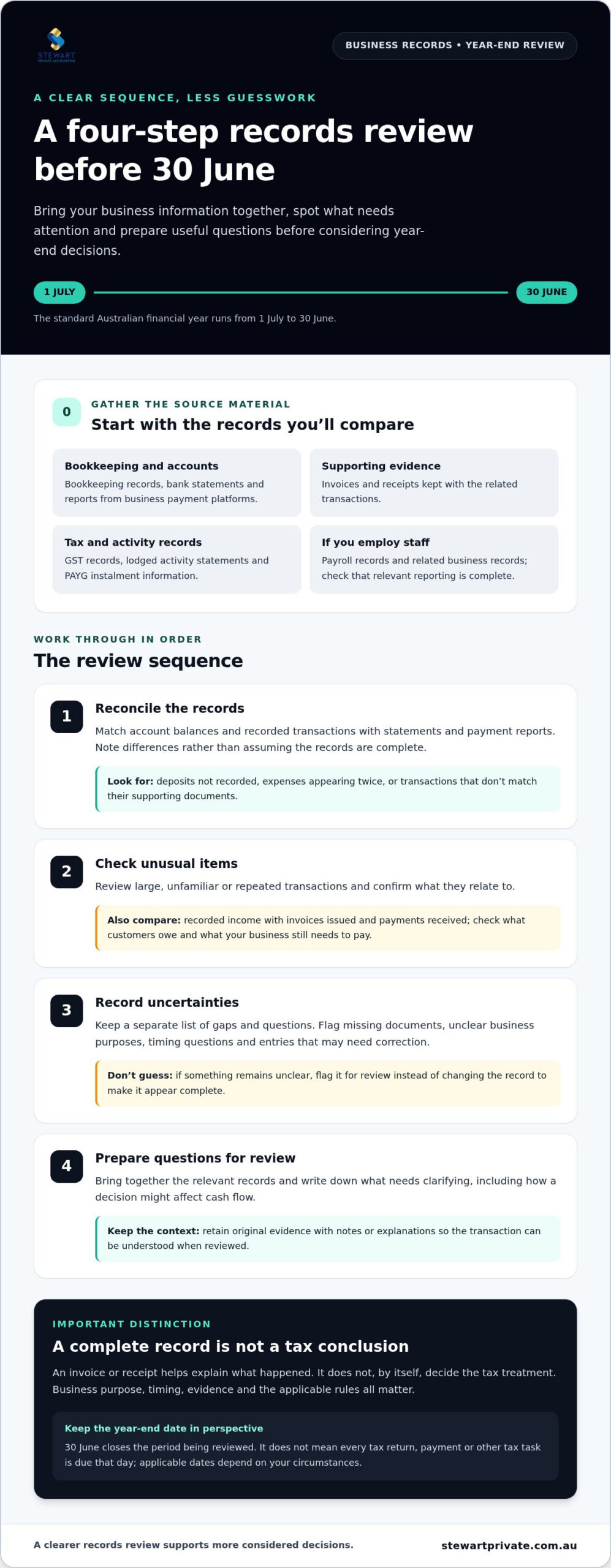
A useful records review turns scattered information into a working picture of your business. For tax planning before 30 June, identify what’s complete, what needs explaining and which questions require advice. Work through the records in a consistent order, and keep a separate list of uncertainties rather than guessing at an answer.
Reconciled records make year-end decisions clearer because you can assess the business position with fewer gaps and less guesswork. Gathering evidence is an important first step, but it doesn’t decide the tax treatment of a transaction. An invoice or receipt helps explain what happened; whether and how an item is treated for tax depends on its circumstances and the applicable rules.
Reconcile income, expenses and business accounts
Compare your bookkeeping with bank statements and reports from payment platforms used by the business. Look for deposits that haven’t been recorded, expenses appearing twice, or transactions that don’t match their supporting documents. Keep invoices and receipts with the relevant entries so the reason for each transaction is easy to follow. If something remains unclear, flag it for review instead of changing the record to make it appear complete.
Use this sequence to organise your review:
- Reconcile the records. Match account balances and recorded transactions with statements and payment reports, noting any differences.
- Check unusual items. Review large, unfamiliar or repeated transactions and confirm what they relate to.
- Record uncertainties. List missing documents, unclear business purposes, timing questions or entries that may need correction.
- Prepare questions. Gather the relevant records and write down what you need clarified, including how a decision might affect cash flow.
This process helps separate a bookkeeping issue from a tax question. For example, a payment may be correctly recorded but still need further consideration before its tax treatment can be determined. Keep the original evidence together with any notes or explanations so the context is available when the transaction is reviewed.
Review GST, PAYG and payroll information
Check that your GST records and lodged activity statements are consistent with your current bookkeeping, and identify differences that need explaining. Review PAYG instalment information alongside the business’s recorded income and payments. If you employ staff, compare payroll records with related business records and check that relevant reporting is complete. These checks can surface inconsistencies, but they don’t settle how an item should be treated.
For a Western Australian business, consider whether tax compliance obligations for small business in WA apply to its activities or workforce, and verify current requirements through official guidance. Don’t assume a rule applying to one business applies to another. The right questions depend on your operations, records and circumstances.
Bring your reconciliations, supporting documents and question list together before discussing year-end decisions. Stewart Private Accounting provides bookkeeping and tax planning support to help connect accurate records with a considered review. Learn more about Stewart Private Accounting’s tax planning support.
Which tax decisions deserve careful review before 30 June?
Assess year-end decisions in context rather than treating them as automatic ways to reduce tax. A planned purchase, repair, payment or contribution may affect your tax position, but its business purpose, timing, supporting evidence and effect on available cash all matter. The relevant treatment can also depend on your structure and the rules that apply to your circumstances.
Use these questions to organise a discussion, not as a checklist of guaranteed deductions:
- Timing: When will the transaction occur, and which income year may it relate to?
- Business purpose: Does the decision support a genuine business need or plan?
- Cash flow: Can the business meet the payment and retain enough working capital?
- Evidence: What records explain the transaction and support its treatment?
A lower taxable income isn’t automatically a better commercial outcome. Spending money solely to seek a tax benefit can leave the business with less cash and an asset or service it didn’t need. Assess the business case first, then consider the tax implications under current rules. These principles sit within broader legal small-business tax minimisation strategies, which also need to suit your circumstances.
Expenses, assets and stock: check the facts first
Review significant purchases, planned repairs and expenses that are unpaid or prepaid. Ask what the item is for, when it will be supplied or used, how it will be funded and what evidence you hold. Payment timing alone doesn’t establish deductibility, and different rules may apply depending on the transaction and your circumstances. If your business holds trading stock, consider whether stock records or a stocktake are relevant to its year-end position.
Keep quotes, contracts, invoices and payment records together, but treat them as evidence to assess, not proof of a particular tax outcome. Flag unusual arrangements for review before acting, especially if the timing is being changed mainly to influence the year’s result.
Superannuation, business structure and owner decisions
Superannuation contributions and employer obligations can involve specific eligibility, timing and record requirements. Check current Australian Taxation Office (ATO) guidance before relying on a contribution or payment as part of a year-end plan. A contribution that suits one person may not suit another, particularly where existing contributions or personal circumstances affect the available options.
Changes to a business structure and decisions involving a trust can also carry specific requirements and timing considerations. Avoid making these changes solely for a perceived tax advantage. An adviser can assess the business purpose, practical consequences and applicable rules together, so your decision supports both compliance and the direction of the business. For business owners and investors managing international property assets through specialised trust vehicles, firms like Cornerstone Real Estate Investment Services offer guidance on Delaware Statutory Trust properties for tax-deferred exchanges.
A practical timeline for tax planning before 30 June
A staged review gives you time to gather information, discuss choices and complete relevant actions without treating every task as a 30 June deadline. The right lead time depends on the issue, the records available and the requirements that apply to your business. Some decisions may need attention before year-end; reporting and lodgement tasks are generally handled later, according to their applicable due dates.
Use this sequence as a planning framework, then adapt it to your circumstances:
- Early review: assemble information and identify gaps. Bring together bookkeeping reports, bank reconciliations, payroll details and supporting documents. Note unresolved transactions, expected changes in income and planned purchases. Keep a separate list of questions about timing, eligibility or evidence so you can seek advice while there’s still time to consider the answer.
- Decision discussion: compare options before committing. Work through each proposed action in light of its business purpose, cash-flow effect and the rules that may apply. A purchase or payment that appears straightforward can involve timing or eligibility considerations. Allow extra time if records are incomplete, a decision involves more than one party, or you need to understand how it fits your broader plans.
- Pre-year-end follow-through: track what actually happens. Record agreed actions, who is responsible and the date each transaction is completed. Don’t rely on an intention, such as planning to pay an expense, as evidence that the action occurred. Retain relevant contracts, invoices, payment records and notes explaining the business context. If circumstances change, update the plan rather than forcing an action to meet an assumed tax outcome.
- Post-year-end: finalise records and meet later obligations. After 30 June, reconcile the completed year, resolve remaining record gaps and retain documents that support your reporting. Then follow current Australian Taxation Office (ATO) guidance for the reporting, lodgement and payment requirements that apply to your business. These tasks use the final year-end information, but their due dates aren’t necessarily 30 June.
Keep the timeline flexible. A routine record question may be resolved quickly, while a structure-related decision or an issue with incomplete documentation may need more time. If an action depends on a particular date, confirm the current requirement rather than assuming the year-end date is the relevant deadline.
For more preparation prompts, use the 2026 small-business EOFY tax planning checklist alongside your own records. A clear sequence helps you distinguish what needs to happen before year-end from what belongs to later reporting, while keeping business priorities and cash flow in view.
Stewart Private Accounting offers tax planning and bookkeeping support for businesses. Find out more about tax planning for your business.
How an accountant can turn your 30 June review into a plan
Your records show what has happened in the business; an accountant can help connect that information with your goals, tax considerations and cash-flow priorities. This makes tax planning before 30 June a collaborative review, not a list of actions to complete regardless of their value. Recommendations depend on your business structure, individual circumstances and the rules that apply at the time, so an approach that suits one business may not suit another.
A useful discussion can distinguish decisions you can make now from matters that need more information or current guidance. It can also bring practical considerations into view, such as whether a proposed payment fits your cash position or whether a planned change aligns with your business direction. Tailored fixed-fee service packages provide clarity about the professional support involved without suggesting every business needs the same scope of advice.
Prepare for a useful tax-planning discussion
Bring current financial reports, cash-flow information and a short outline of intended business changes. Share uncertainties early, including unusual transactions, missing records or significant proposed purchases. The more clearly you explain what the business is planning, the easier it is to focus the discussion on relevant questions rather than assumptions.
It can help to bring:
- Recent profit and loss information and relevant bank reconciliations.
- A cash-flow view that includes expected receipts and upcoming payments.
- Details of proposed business changes, purchases or ownership decisions.
- A list of questions about timing, eligibility, evidence or possible tax treatment.
Use the discussion to agree which actions matter for your business, who will handle each one and what records should be kept. That shared understanding helps prevent a general suggestion from being mistaken for a recommendation tailored to your circumstances.
Move from advice to a manageable action plan
Advice becomes more useful when you can act on it and track what happens next. Ask for the agreed steps to be recorded with their rationale, responsible person and timing. Separate items understood under current guidance from questions that need further investigation or an updated check before you proceed.
A practical plan might identify a record to obtain, a decision to revisit after reviewing cash flow, or a transaction that needs supporting documents retained. It should also allow for changes in trading conditions. If expected income or a purchase changes, revisit the relevant assumptions rather than relying on an outdated plan.
Stewart Private Accounting is a Perth-based accounting and advisory practice led by Bradley Stewart, a Chartered Tax Adviser and Registered Tax Agent with over 15 years of public accounting and consulting experience. Perth and WA business owners can learn about a tax-planning review shaped around their business position and priorities by visiting Stewart Private Accounting.
Make your next tax decision with confidence
The value of tax planning before 30 June extends beyond the year-end review. A clear plan gives you a useful reference point as your business changes, helping you revisit decisions when income, priorities or cash-flow needs shift. Keep agreed actions visible, note what still needs attention and update your records as circumstances develop.
Tax planning works best as a considered conversation about your business, not a push to act for the sake of a deadline. Stewart Private Accounting offers tailored fixed-fee service packages for accounting, tax and advisory support, helping you understand the professional services involved as you plan your next steps.
To discuss an approach shaped around your business, contact Stewart Private Accounting about tax planning. A steady review now can help you move into the next financial year with greater clarity and confidence.
Frequently Asked Questions
When should I start tax planning before 30 June?
Start as soon as you can assemble a useful picture of the business, rather than waiting until the final days of the financial year. Tax planning before 30 June can involve decisions that need time to assess, such as a proposed equipment purchase and business tax write-off or a change in trading activity. If you’re waiting on customer information or supplier documents, note what’s outstanding and discuss whether it affects the timing of your decision.
Is 30 June the deadline for lodging my business tax return?
No. 30 June marks the end of the Australian financial year, but it isn’t a universal business tax return lodgement date. The dates relevant to you can depend on your entity, obligations and arrangements. For example, a sole trader and a company may have different reporting considerations. Check the ATO’s current information for the dates that apply, and keep year-end actions separate from preparing and lodging the return.
Can I claim an expense if I pay for it before 30 June?
Not automatically. Paying a supplier before year-end doesn’t, by itself, determine whether or when an expense is deductible. For example, a payment might relate to goods or services provided over a different period, so the details and applicable rules need consideration. Keep the invoice, payment evidence and a note of the business purpose. Then check the treatment against current ATO guidance or discuss the specific transaction with your tax adviser.
What records should I organise before the end of the financial year?
Gather records that show how your business earned income, incurred costs and met its obligations. Depending on your activities, that could include customer invoices, supplier documents, bank and loan statements, payroll summaries, GST records, asset purchase details and contracts. A WA business with employees may also have workforce records relevant to its operations. Keep documents identifiable by transaction, and note anything missing so it can be followed up.
Do sole traders need to plan before 30 June?
Yes. A sole trader can review their business position before the financial year closes, while recognising that their tax affairs may also include personal income and circumstances. For example, changes in other income or business use of an asset may affect the questions to consider. Keep business and private transactions distinguishable in your records, and use ATO guidance or professional advice for decisions that depend on your situation.
What if my bookkeeping is not up to date before 30 June?
Start by identifying what is missing, such as unreconciled bank activity, unentered sales or expenses without supporting documents. Work through the gaps in a manageable order and flag transactions that can’t be confidently explained. If you’re short on time, prioritise information that could materially affect the business position or a decision being considered. Bookkeeping support can help organise the records, while a tax adviser can address tax questions arising from them.
Should I spend money before 30 June just to reduce tax?
No. A potential tax deduction doesn’t make an unnecessary purchase a sound business decision. Consider whether the item is genuinely useful, whether the business can fund it without creating cash pressure, and what the current rules say about its treatment. For instance, replacing equipment may make sense if it meets an operational need, but bringing forward a purchase solely for a hoped-for tax benefit can leave the business worse off.