

What if your most useful end-of-year tax decisions start with organised records, not a last-minute search for deductions? A clear end of year tax planning checklist for small business helps you see what’s complete, what needs attention and which questions need a closer look.
If you’re unsure whether your records are ready or worried about missing a deduction, payroll task or reporting obligation, you’re not alone. Bookkeeping and tax planning are connected, but they serve different purposes: accurate records give you a reliable starting point, while tax planning helps you consider what those records mean for your business.
This 2026 guide gives you a practical checklist to work through in manageable stages before the Australian financial year ends on 30 June. You’ll review income and expenses, reconcile accounts, check payroll and superannuation records, and flag tax items that need professional review or current ATO guidance. By the end, you’ll have a clearer picture of what’s ready for tax return preparation and where expert advice can help you make considered decisions.
Key Takeaways
- Use an end of year tax planning checklist for small business to work through year-end tasks in a clear, manageable order.
- Match bank, loan and payment-provider statements with your bookkeeping records, then investigate gaps and unmatched transactions.
- Separate expenses that are recorded and supported from items that need review before you assume they’re deductible.
- Compare GST, BAS and payroll figures with their underlying records, and check obligations against current ATO guidance.
- Sort outstanding work into missing information and decisions needing professional review, then prioritise what to resolve first.
End of year tax planning checklist: start with your 30 June position
A staged review is easier to manage than leaving every decision until tax return lodgement. Start by noting the period and business structure you’re reviewing. Gather the information first, then decide what it means for tax. The Australian financial year generally runs from 1 July to 30 June, but the details you need to check can vary by year and business circumstances. Use current ATO guidance for any rules, thresholds or reporting requirements relevant to your review.
An end of year tax planning checklist for small business helps you separate preparation from tax decisions. You can organise records, note missing information and identify unusual transactions yourself. Whether an amount is deductible, how a transaction should be treated or which rules apply to your structure may need professional review. A general overview of Small business can provide background, but it isn’t a substitute for checking current Australian tax guidance for your circumstances.
Set the scope of your small business EOFY review
First, write down the financial year you’re reviewing and how your business operates, such as as a sole trader, partnership, company or trust. These structures can have different tax and reporting considerations, so don’t assume a checklist item applies in the same way to every business. Set aside time to review records, obligations, tax questions and unresolved transactions. Breaking the work into separate sessions can make it easier to see what’s complete and what still needs attention.
Make the checklist practical before you begin
Create one secure folder for bookkeeping reports, receipts, bank and loan statements, payroll information and other supporting documents. Use clear file names that include the document type and period, so you and your adviser can find items without searching through unrelated files. If something is missing, add it to a follow-up list with the person responsible and the next action. That way, a missing supplier invoice or unclear payment won’t disappear into a general to-do list. For more context on making tax planning part of business decision-making, the Perth business tax planning guide explains how a considered approach can support your planning. For a sequenced review of the records and decisions to consider before year-end, see this guide to tax planning before 30 June.
Track progress with a simple status system
Use three labels beside each checklist item: complete, needs follow-up or requires professional review. Mark a bank reconciliation complete once the records match and any differences are explained. Use needs follow-up for a document you’re waiting on or a transaction that needs more information. Reserve professional review for questions about tax treatment, eligibility or obligations that depend on your structure and circumstances.
This simple system turns a broad year-end task into clear next steps. It also helps you distinguish routine record organisation from decisions that call for current ATO guidance or an adviser’s input. Keep unresolved items visible and note why they need attention. You’ll then have a more useful starting point for the detailed account and tax checks that follow.
Reconcile your small business accounts and organise year-end records
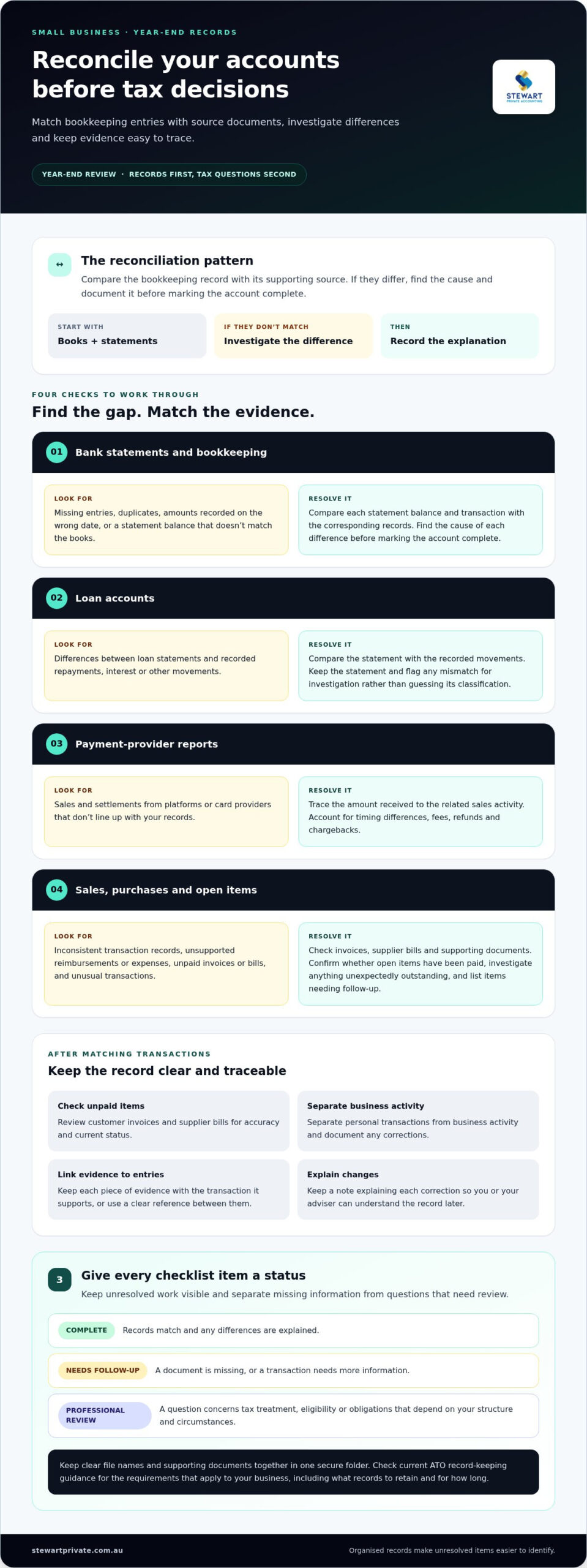
Once you’ve set the scope of your review, bring the underlying records into line. Reconciliation means comparing bookkeeping entries with source documents, then investigating differences instead of carrying them forward. Work through each account and payment channel consistently. This gives you a clearer picture of what’s recorded and helps identify missing evidence before you consider tax questions.
- Match bank statements to your books. Compare each statement balance and transaction with the corresponding bookkeeping records. Check for missing entries, duplicates and amounts recorded on the wrong date. Note any difference and find its cause before marking the account complete.
- Reconcile loan accounts. Compare loan statements with recorded repayments, interest and other movements. If an amount doesn’t match, keep the statement and flag the difference for investigation rather than guessing how it should be classified.
- Check payment-provider reports. Match sales and settlements from platforms or card providers to your records. Account for timing differences, fees, refunds and chargebacks so you can trace the amount received to the related sales activity.
- Review sales and purchases. Check that invoices, supplier bills and other transactions are recorded consistently. Compare reimbursements and business expenses with their supporting documents, and list unpaid invoices, unpaid bills and unusual transactions for follow-up.
Reconcile bank accounts, sales and unpaid items
After matching transactions, review unpaid customer invoices and supplier bills for accuracy and current status. Confirm whether a payment has been received or a bill settled, and investigate items that remain open unexpectedly. Separate personal transactions from business activity, document any corrections and keep a note explaining each change. Clear notes help you or your adviser understand the record later.
Keep each piece of evidence with the transaction it supports, or use a clear reference that links the two. For example, make sure a supplier invoice is easy to find from its bookkeeping entry. Check current ATO record-keeping guidance for the requirements that apply to your business, including what records to retain and for how long. Don’t rely on memory to explain an entry months later.
Prepare supporting documents and asset records
Gather receipts, invoices, loan statements and relevant payment-platform reports in your year-end folder. Then compare your asset register with purchases, disposals and available information about business use. If an item is missing evidence or its classification is uncertain, flag it for review rather than assuming a tax treatment. Organising a transaction is a bookkeeping step; deciding its tax treatment may require professional advice.
Keep a short list of unresolved items, noting what’s missing, who can follow it up and what question needs answering. This makes your end of year tax planning checklist for small business more useful than a folder of unlabelled documents. If you need help bringing bookkeeping records and tax questions into a clearer order, professional tax planning support can help you work through the outstanding items.
Review income, expenses and assets without assuming every claim is deductible
With your records organised, review what they show and what evidence supports each entry. A transaction appearing in your bookkeeping doesn’t automatically establish its tax treatment. At this stage, identify complete records, gather supporting information and flag questions that depend on your business circumstances or current tax rules.
Use this comparison to separate record-keeping from tax decisions:
| Status | What to check | Example |
|---|---|---|
| Recorded | The transaction appears in the right account and period. | A customer sale is included in the sales records. |
| Supported | Documents or reports provide evidence for the entry. | A supplier invoice is linked to the recorded purchase. |
| Requires review | Information is incomplete or the tax treatment needs consideration. | A purchase has mixed business and private use, or its purpose is unclear. |
This status check doesn’t confirm that an expense is deductible. It gives you and your adviser a clearer basis for deciding what needs attention.
Check income and transaction completeness
Compare bookkeeping income with sales reports, issued invoices and payment-provider summaries. Follow up on amounts that don’t match, including settlements that may relate to a different period. Check that credit notes and refunds are recorded against the relevant sale, and list receipts or transactions you can’t yet identify.
Pay particular attention to unusual timing, such as a recorded sale with no clear supporting invoice or a receipt that can’t be matched to a customer. Add a brief explanation and keep the related documents together. Significant or unusual items are easier to address during tax return preparation when you’ve documented what happened and what remains uncertain.
Review expenses, stock and business assets
For each expense, check that the supporting document is available and the recorded description reflects its business purpose. Where an item also has private use, note what you know about that use rather than treating the full cost as automatically deductible. Flag unclear claims for professional review, especially if the transaction has a complex purpose or incomplete evidence.
If your business holds trading stock, compare stock records with what you hold and investigate material differences. Stock-related tax requirements can depend on your circumstances, so check current ATO guidance before deciding what steps apply. Also list business asset purchases and disposals, with the available invoices and business-use details. Don’t assume a particular purchase qualifies for a specific deduction; the relevant rules and eligibility need to be assessed for the income year.
This part of your end of year tax planning checklist for small business helps turn transaction records into useful questions, not premature tax conclusions. For a broader view of how tax planning can inform business decisions, the small business tax minimisation guide explores strategic considerations alongside practical checks.
Check GST, BAS, payroll and super records before year-end
GST, Business Activity Statements (BAS), payroll and superannuation records sit alongside income-tax preparation, but they aren’t interchangeable with it. Treat them as separate checks: confirm that figures reported for each period agree with your bookkeeping and source records, then check questions against current Australian Taxation Office (ATO) guidance. For businesses in Western Australia, federal tax obligations still need to be considered alongside the business’s structure and circumstances.
This step in your end of year tax planning checklist for small business is about finding mismatches and unresolved reporting tasks, not assuming a BAS figure settles how an item should be treated for income tax.
Review GST, BAS and PAYG withholding information
Work through each activity statement period and compare reported figures with the sales, purchases and bookkeeping reports behind them. Check that GST amounts can be traced to the relevant transactions and that adjustments or differences have an explanation. Then compare PAYG withholding reported on activity statements with payroll reports and amounts recorded as withheld from employee payments.
Make a follow-up list for activity statements that may need attention, including any you believe are unlodged, figures that don’t reconcile or possible amendments. Don’t change a lodged figure based on a rough estimate. Gather the supporting records, identify the period and item involved, and check the correct process against current ATO guidance. This keeps the record of what happened clear and helps distinguish an accounting correction from a reporting decision.
Bring payroll and superannuation records together
Compare payroll summaries with employee records, bookkeeping entries and amounts paid. Check that gross wages, PAYG withholding and other recorded payroll figures agree across the reports. If an employee record or payment doesn’t match, note the difference and gather the relevant payslip, payroll report or payment evidence before deciding how to correct it.
Review superannuation calculations and payment records against the requirements that apply to the period. For the 2026 to 27 financial year, the Superannuation Guarantee rate is 12% of an employee’s ordinary time earnings. From 1 July 2026, employers must pay super contributions on the same day they pay wages under Payday Super rules. Keep these changes distinct from checks for an earlier period, and verify the applicable requirements before acting on a discrepancy.
- Reconcile: Compare payroll summaries with employee records and accounting entries.
- Trace: Match super calculations and payments to the relevant employee and pay period.
- Flag: Record unexplained differences and confirm the right correction steps before making changes.
Payroll and reporting questions can depend on timing, employee circumstances and the relevant income year. Stewart Private Accounting provides accounting, taxation and business advisory support, including help reviewing unresolved tax, BAS or payroll questions. Get expert tax planning support to help turn your records into clear next steps.
Turn your EOFY checklist into a clear tax planning next-step list
Your checks are most useful when they lead to clear actions. Bring the results together and group them as completed, missing information or decisions that need professional review. Then prioritise open items by their potential impact and timing. For example, a question affecting several transactions or a reporting period may need attention before a minor filing gap, while an item linked to a specific obligation should be considered in the context of that obligation. Avoid guessing at tax outcomes or applying a deadline without checking the current rules.
This final stage of your end of year tax planning checklist for small business turns a collection of records into a practical handover. It also helps separate routine follow-up from decisions that call for an adviser’s input, whether from your internal team or an external advisory firm like The Bucket List Accountant.
Create a useful handover for tax return preparation
Keep your handover brief but specific. Summarise which accounts and reports have been reconciled, note unusual transactions and identify documents still outstanding. For each open question, include the relevant period, transaction or record, what you’ve checked so far and what remains unclear. A question such as “Does this transaction need review?” is easier to resolve when you attach the supporting invoice and explain its business context.
- Reconciliations: Note which records agree and any differences still being investigated.
- Outstanding documents: List what’s missing, who is following it up and the next action.
- Review questions: Group questions about business structure, tax treatment or reporting requirements.
- Decisions made: Record the date, decision and source of guidance used, including relevant ATO information.
This gives your tax return preparation a clear starting point without implying that every bookkeeping entry has already been assessed for tax purposes. Keep the source documents with the handover so the reasoning can be followed later.
Use year-end findings to plan the next financial year
Look for repeated gaps and turn them into routine bookkeeping tasks. If receipts are often missing, set a regular process for attaching them to transactions. If payment-provider settlements take time to match, schedule a recurring check. A small change to how you gather records during the year can reduce unresolved items at the next year-end.
You can also use the review to consider expected cash requirements for known tax and business obligations. Base the discussion on your current information and circumstances, and seek advice where amounts or timing are uncertain. The aim is a more considered view of upcoming commitments, not a promised tax result.
If you’d like a professional perspective on your open questions or help shaping the next steps, you can discuss tailored tax planning with Stewart Private Accounting. A focused conversation can help connect your organised records with decisions suited to your business.
Carry a clearer plan into the year ahead
A useful end of year tax planning checklist for small business can do more than prepare you for tax return discussions. Use what you’ve learned to build a steadier rhythm for the next financial year, with regular record reviews and clear points for advice before decisions become difficult to resolve.
Some questions are straightforward to close once you locate a document. Others may call for a considered review of your business structure, reporting position or tax treatment. Working through those decisions with an adviser can help you move forward with greater clarity, without assuming every situation has the same answer.
Stewart Private Accounting is led by Bradley Stewart, a Chartered Tax Adviser and Registered Tax Agent with more than 15 years of public accounting and consulting experience. Its tailored fixed-fee accounting, tax and advisory packages provide a clear way to access support suited to your business, from bookkeeping and compliance to strategic advice.
When you’re ready to turn your year-end questions into considered next steps, discuss tailored small business tax planning with Stewart Private Accounting. A clear plan can help you approach the year ahead with confidence.
Frequently Asked Questions
Is the Australian small business financial year end always 30 June?
For most Australian businesses, the financial year runs from 1 July to 30 June, but 30 June isn’t universal in every case. Some businesses may use an ATO-approved substituted accounting period, which changes the dates used for certain tax reporting purposes. If your business has approval to use different dates, make sure your checklist follows that period rather than assuming standard year-end dates apply.
Can I claim a business expense if I cannot find the receipt?
Possibly, but you’ll need evidence that meets the relevant substantiation rules, and a bank statement alone may not show what you bought or how it relates to your business. Ask the supplier for a duplicate invoice or look for a digital receipt or order record. Keep a note of the business purpose, and don’t claim an amount if you can’t establish the expense and its connection to your business.
How long should a small business keep tax records in Australia?
As a general guide, keep tax records for at least five years, but the period can depend on the record and the relevant event or lodgement. For example, information about an asset may be needed well beyond the year you bought it, so retain its purchase and disposal records until the applicable retention period has passed. Check current ATO guidance for the record type and your circumstances before discarding documents.
What should I do if I find an error in a lodged BAS?
Work out which activity statement and figures are affected, then check the ATO’s current instructions for correcting that type of error. Depending on the error and circumstances, you may be able to correct it on a later BAS or need to revise the lodged statement. Keep supporting records and don’t simply change your bookkeeping without addressing the reported BAS figure. A registered tax agent can help you determine the appropriate correction process.
Do sole traders and companies use the same end-of-year tax checklist?
No. The same end of year tax planning checklist for small business can help both identify missing records and questions, but tax reporting differs by structure. A sole trader generally reports business income in their individual tax return, while a company has its own tax return and obligations. Partnerships and trusts also have distinct reporting considerations. Confirm which checks apply to your structure before treating a general checklist as complete.
Should I make a purchase before 30 June to reduce my small business tax?
Not automatically. A purchase should make commercial sense for your business, and its tax treatment depends on factors such as when it’s acquired, its business use and current eligibility rules. For 2025 to 26, the instant asset write-off threshold is A$20,000 for eligible small businesses; the measure is permanent from 1 July 2026, but conditions still apply. Check current ATO guidance before relying on a deduction when making a purchase decision.