

What if the most reliable way to reduce your tax bill starts months before you lodge your return? If you’re asking how to minimise tax for small business Australia, the answer isn’t a last-minute hunt for deductions. It’s a considered, year-round approach that reflects your business structure and supports each decision with clear records.
It’s understandable to feel unsure about which costs you can claim, whether a tax strategy suits your business, and how to plan for tax bills and instalments. These pressures are easier to manage when you make informed decisions throughout the financial year, rather than trying to resolve everything at tax time.
This guide covers practical steps to discuss and implement, from improving your records and reviewing expenses to planning purchases and setting aside funds for tax obligations. You’ll also learn why your business structure matters and how timely advice can help you build a clearer plan, avoid preventable surprises and meet your responsibilities with greater confidence.
Key Takeaways
- Learn how to minimise tax for small business Australia through lawful planning based on genuine business activity and clear records.
- Understand how to assess expenses, separate private use and keep evidence for legitimate deduction claims.
- Use a practical review process before making asset purchases or other tax decisions, weighing potential deductions against cash flow.
- See why small-business concessions, super obligations and state requirements depend on eligibility and need careful checking.
- Build a quarterly routine for records, forecasts and instalments, with a pre-30 June review to help avoid last-minute surprises.
How to minimise tax for a small business legally in Australia
Legal tax minimisation means applying tax rules to your genuine business circumstances. Each decision should have a clear commercial purpose and be supported by evidence. It’s not about finding a loophole at any cost. Your options depend on factors such as your entity type, turnover, transactions and the legislation that applies for the relevant income year. A strategy that suits one business may create extra tax or compliance obligations for another.
For a broad introduction to how different taxes and levels of government fit together, see this Overview of Australian Taxation. For decisions affecting your business, use current Australian tax rules and your specific circumstances to guide the approach.
Tax minimisation versus tax avoidance: what is the difference?
Legitimate planning is transparent, evidence-based and consistent with the law. It might involve claiming an expense that genuinely relates to earning business income, or making a transaction decision after weighing its tax and commercial effects. You should be able to explain what happened, why the business did it and how you calculated the figures.
Hiding income, misrepresenting private expenses as business costs or creating sham arrangements is different. A transaction may attract scrutiny if it lacks commercial substance or appears designed to disguise what really occurred. If a proposed arrangement is unusual, complex or difficult to explain in ordinary business terms, get individual professional advice before acting. A tax outcome alone doesn’t make a decision appropriate for your business.
Why business structure and circumstances change the answer
Sole traders, companies, partnerships and trusts don’t all pay tax in the same way. Their tax treatment, reporting responsibilities and access to particular concessions can differ. The outcome may also depend on who earns the income, how the business operates, the nature of a transaction and whether eligibility conditions are met.
Don’t choose or change a structure based only on a headline tax rate or someone else’s experience. Consider your commercial plans, personal circumstances, administration needs and how profits may be used. Tailored tax planning for Perth businesses can help you assess these factors and document the reasoning behind decisions, rather than relying on a generic strategy.
Good records are central to this process. Keep invoices, receipts, contracts, bank records and notes that show the business purpose of significant transactions. Record how you calculated any business-use portion and retain evidence that supports the figures in your tax return. Consistent bookkeeping also makes it easier to identify missing information before lodgement.
Accurate records turn a tax position from an assertion into a decision you can explain and support. This is the practical foundation of how to minimise tax for small business Australia legally: make decisions that fit your circumstances, check the applicable rules and keep a clear trail of evidence.
Claim legitimate business deductions with clear records
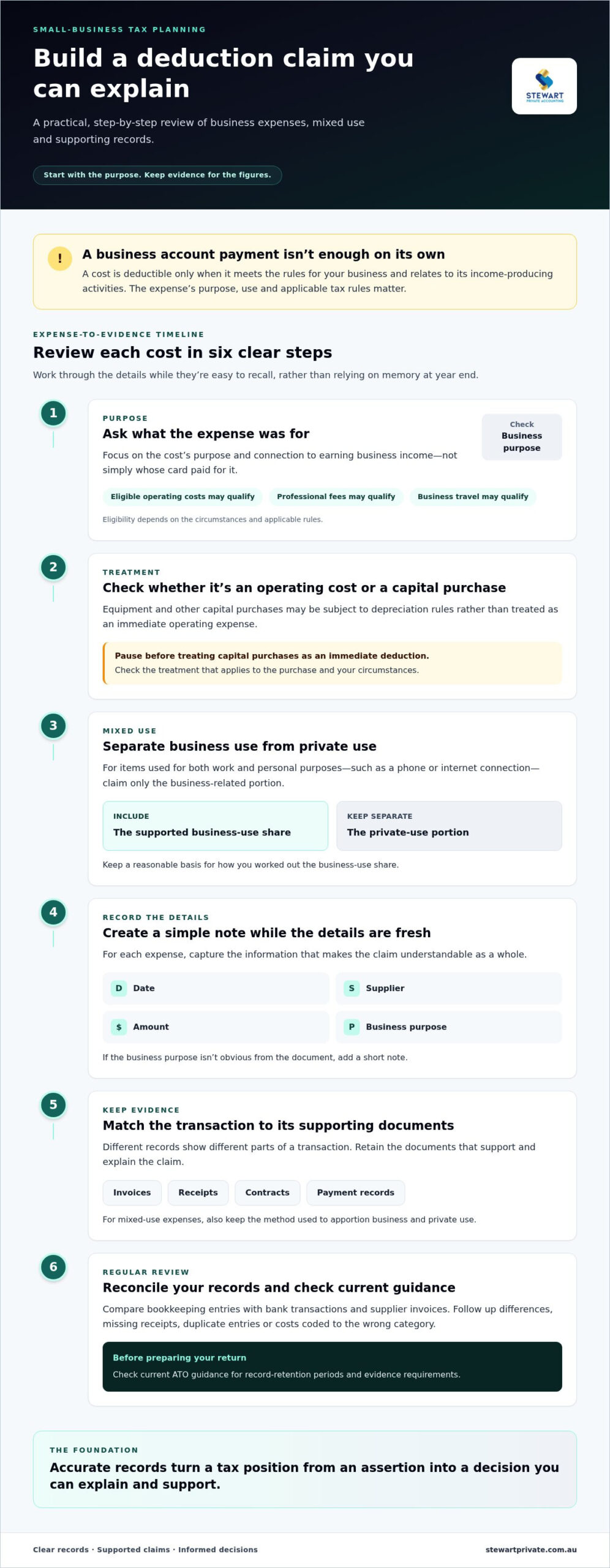
A cost is deductible only when it meets the rules for your business and relates to its income-producing activities. The amount you can claim depends on the expense’s purpose, how it was used and the tax rules that apply. Paying from a business account doesn’t automatically make a purchase deductible. If an expense has both business and private use, claim only the business-related portion and keep a reasonable basis for calculating it.
Which common business costs may be deductible?
Depending on the circumstances, eligible operating costs, professional fees and business travel may be deductible. Focus on what the expense was for, not simply whose card paid for it. A work-related subscription may have a clear business purpose, while a personal purchase remains private even if it was paid from the business account.
Pause before claiming costs that may need different treatment. Equipment and other capital purchases may be subject to depreciation rules rather than treated as an immediate operating expense. For mixed-use items, such as a phone or internet connection used for both work and personal purposes, work out and record the business-use share. Keep the private portion separate instead of claiming the full cost.
How to keep evidence that supports your tax return
Create a simple record for each expense while the details are easy to recall. Keep the source document and note the date, supplier, amount and business purpose. Where relevant, also record how you calculated the business-use portion. Invoices, receipts, contracts and payment records each show a different part of the transaction, so retain documents that make the claim understandable as a whole.
- Match each transaction to an invoice, receipt or other source document.
- Add a short note when the business purpose isn’t obvious from the document.
- Record the method used to apportion mixed business and private use.
- Reconcile bookkeeping entries against bank transactions regularly.
- Check current ATO guidance for record-retention periods and evidence requirements.
Regular reconciliation helps you find missing receipts, duplicate entries or transactions coded to the wrong category before preparing your return. For example, compare the bookkeeping entry with the bank transaction and supplier invoice, then follow up any differences. This gives you a clearer basis for checking the claim and reduces the chance of relying on memory at year end.
Timely records support accurate deductions and help reduce year-end questions. If you’d like consistent bookkeeping and tax records to support considered decisions, accounting and bookkeeping support can help keep the process organised throughout the year. That discipline is a practical part of how to minimise tax for small business Australia without claiming costs that don’t fit your circumstances.
Plan asset purchases, income and tax instalments carefully
Tax decisions are easier to assess when you follow a clear sequence. Before acting, work through these five steps:
- Forecast: Update your expected income, expenses and cash position for the year.
- Assess the transaction: Identify its business purpose, payment timing and effect on cash flow.
- Check eligibility: Confirm which tax rules apply to your structure and circumstances.
- Document: Keep contracts, invoices and notes explaining the decision.
- Review: Revisit the outcome if your circumstances or current rules change.
This process helps you compare a decision’s tax treatment with its commercial value. Buying equipment solely to claim a deduction can still leave you with less cash, especially if the purchase isn’t needed or the deduction is smaller or slower than expected.
Assessing business assets and depreciation
Before buying an asset, consider who will own it, how the business will use it, how the cost should be treated and whether your entity meets the relevant conditions. An asset used partly for private purposes may need to be apportioned, and a capital purchase may be deducted over time rather than claimed as an ordinary running cost.
For the 2026-27 income year, the instant asset write-off threshold is A$20,000 per eligible asset for a small business with aggregated annual turnover below A$10 million. Eligible new and second-hand assets may qualify. If you’re GST-registered, the threshold is GST-exclusive. Assets costing A$20,000 or more may be placed in the small business simplified depreciation pool, subject to the rules, with a 15% deduction in the first year and 30% in later years. Check current ATO guidance before relying on a deduction, as eligibility, business use and timing still matter.
Managing income, trading stock and PAYG instalments
Record income and expenses in line with the genuine transaction and applicable accounting and tax rules. Don’t shift them between periods simply to change the tax result. Review outstanding invoices and follow a consistent recovery process. If a debt is genuinely unrecoverable, document the steps taken and the decision to write it off. An overdue invoice alone doesn’t establish that it’s a bad debt.
Trading-stock treatment depends on your business and the rules that apply, so keep records of purchases, sales and stock values that support your reporting. If income changes materially, review your PAYG instalments against an updated forecast. Discuss any adjustment with your tax adviser so instalments reflect current figures and you can plan cash flow without creating an unexpected balance later.
Careful forecasting and timely tax planning make it easier to assess choices before they affect cash flow. That’s a practical part of how to minimise tax for small business Australia while keeping tax decisions tied to real business activity.
Check small-business concessions, super and state obligations
Tax concessions can make a difference, but they’re conditional rather than automatic. Eligibility may depend on your business structure, aggregated turnover, asset use, ownership history and transaction details. Keep income-tax planning separate from GST reporting, employer super and state taxes. A concession in one area doesn’t remove obligations in another.
When small-business concessions may be relevant
Potential measures include simplified depreciation, small-business CGT concessions and the small-business income tax offset for eligible unincorporated businesses. Treat each as a possibility to assess, not an entitlement to assume. Before relying on a concession, check current ATO guidance and how the rules apply to the relevant entity and transaction.
This overview can help you identify the questions to investigate:
| Strategy or obligation | Who may qualify | Useful records | What to verify |
|---|---|---|---|
| Simplified depreciation | Eligible small businesses using qualifying assets for business | Purchase documents, asset register and business-use details | Current turnover, asset and timing conditions |
| Small-business CGT concessions | Businesses meeting the relevant conditions when an asset is sold | Ownership history, sale documents and evidence of asset use | Eligibility tests and which concessions fit the transaction |
| Small-business income tax offset | Eligible sole traders and partners in a partnership | Business income and tax-return calculations | Current turnover, income and offset rules |
| Employer super | Employers with employees who are entitled to super | Payroll records, payslips and contribution confirmations | Current rate, payment timing and fund requirements |
| WA payroll tax | Employers whose total wages meet the relevant state threshold | Wage records and related payroll information | Current WA threshold, rates and grouping rules |
For the 2026-27 income year, eligible unincorporated small businesses with aggregated turnover below A$5 million may qualify for an offset of up to A$1,000. The amount depends on the rules and the business’s circumstances, so include it in your planning only after checking eligibility. For a sale, CGT outcomes can hinge on asset use, ownership and other tests. Review the specific transaction before committing to a sale or restructuring.
Superannuation and Western Australian obligations
Employer super is a legal obligation, separate from choosing to make personal contributions as part of a wealth strategy. From 1 July 2026, the superannuation guarantee rate is 12%, and Payday Super requires contributions to reach employees’ funds within seven calendar days of payday. The Small Business Super Clearing House closes permanently on 1 July 2026, so employers need an alternative SuperStream-compliant arrangement.
GST, income tax, super and WA payroll tax have separate rules and reporting requirements. Payroll tax is state-based, so check current Western Australian thresholds and requirements against your wage position rather than relying on a general national figure. Tailored tax planning can help you assess conditions and document decisions across these obligations. Arrange tailored tax planning to bring your business’s concessions and compliance responsibilities into one considered plan.
Build a year-round small-business tax plan with steady support
Tax planning works best as a regular business habit, not a task reserved for the weeks before lodging your return. A quarterly review helps you keep decisions current as income, costs and priorities change. It also gives you time to follow up missing information and consider tax and cash-flow effects before decisions are final.
A practical rhythm for reviewing tax through the year
At each quarterly review, reconcile your records, check cash flow and compare actual performance with your forecast. Review tax instalments against updated figures, note emerging issues and assign follow-up tasks to a responsible person. Record the decision, the supporting evidence and a date to revisit it. This brief record helps you and anyone supporting your accounts understand what was decided and why.
Before a major purchase, asset sale or change to how the business operates, assess the commercial purpose alongside potential tax treatment and cash-flow effects. A decision can be sound for the business even if it doesn’t produce an immediate deduction. The aim is to understand likely consequences before committing, rather than trying to adjust the records afterwards.
Before 30 June, review your forecast and resolve open questions while there’s still time to make considered decisions. Check whether a proposed transaction depends on an eligibility test, and seek qualified advice where the rules or circumstances are complex. Keep the review focused on what has changed and what needs attention, rather than a last-minute search for extra claims.
When expert tax planning can help
Some decisions deserve advice before you act. Selling an asset, making trust distributions, restructuring or responding to a change in income or ownership can have consequences beyond the current tax return. The right approach depends on your business structure, commercial plans and personal circumstances, so a strategy that worked previously may not fit the situation now.
Stewart Private Accounting provides tailored tax planning and accounting support to help businesses make considered, documented decisions and maintain a year-round plan. Led by Bradley Stewart, a Chartered Tax Adviser and Registered Tax Agent, the Perth practice also offers tailored fixed-fee packages designed to provide fee clarity. This support can bring regular bookkeeping, forecasts and tax decisions into a steadier routine.
If you’re working out how to minimise tax for small business Australia, start by making your review routine manageable and consistent. For support aligning your records and tax planning, explore Stewart Private Accounting’s tailored fixed-fee accounting approach.
Make your next tax decision with greater confidence
A more considered approach to how to minimise tax for small business Australia begins with one practical step: set aside time to review the decisions your business is facing, not just the return that’s due. A short, well-prepared discussion can help you identify which questions need attention and what information will support a sound decision.
For some businesses, that may mean planning around a change in ownership or a major investment. For others, it may mean creating a more consistent way to manage forecasts and tax obligations. The right plan should reflect your circumstances and give you a clear basis for moving forward. You don’t need to resolve every question at once. Start with the decision that matters most to your business now.
Stewart Private Accounting brings more than 15 years of public accounting and consulting experience to tailored support for business owners. Discuss a clear, tailored tax plan with Stewart Private Accounting and take your next step with greater clarity and confidence.
Frequently Asked Questions
Can I minimise small-business tax without breaking Australian tax law?
Yes. Understanding how to minimise tax for small business Australia starts with using rules that genuinely fit your situation. For example, a business may claim a qualifying expense or concession when it meets the relevant conditions and can support its position. Report all income accurately, and don’t disguise personal spending as a business cost. If a proposed arrangement is unusual or commercially complex, get tailored tax advice before proceeding.
Are all expenses paid by a small business tax-deductible?
No. A business payment alone doesn’t make an expense deductible. If you use a mobile phone for both client calls and personal use, for example, you may need to separate the business portion and explain how you calculated it. A laptop or other long-term asset may also receive different tax treatment from a routine operating cost. Keep the transaction details and check the applicable rules if the purpose or treatment isn’t clear.
Can a small business claim an immediate deduction for equipment?
Sometimes, but a purchase doesn’t qualify just because it’s used at work. Before ordering, consider which entity will own the equipment, when it will be used, whether it has private use and which tax rules apply. Keep the supplier documents and record how the asset supports the business. Check current ATO guidance for the relevant income year, as thresholds and eligibility conditions can change.
Do small businesses have to pay PAYG instalments?
Some businesses must pay PAYG instalments towards their expected income tax, depending on their circumstances and ATO requirements. Check your myGov or business tax account and any ATO notices to understand your obligations and due dates. If your income outlook changes, update your forecast before considering an instalment variation. Keep the figures behind that decision, since instalments contribute towards your tax bill rather than reducing the underlying income-tax amount.
Can a small business claim a tax loss?
Sometimes, but a loss doesn’t automatically create an immediate tax refund or offset. For example, a sole trader’s loss may be affected by non-commercial loss rules, while a company generally needs to meet conditions to use prior-year losses. The treatment also depends on how the business is structured and the activity that produced the loss. Keep records of the transactions and business activity, then check the relevant ATO rules before applying the loss.
Does GST registration reduce the income tax a small business pays?
No. GST registration doesn’t, by itself, reduce income tax. The two systems have separate reporting and calculation rules. A registered business may claim GST credits for eligible business purchases, which can affect how costs are recorded for income-tax purposes. For example, your accounts should distinguish the GST component from the expense where a credit is available. Check current registration requirements and reconcile your GST reporting with your bookkeeping, including for your Western Australian business.
Can I reduce tax by paying myself super from my small business?
It depends on your business structure and the type of contribution. A sole trader’s personal super contribution may be deductible only if the relevant conditions are met, including required notice steps and contribution limits. A company contribution is treated differently and should be recorded through the company’s accounts. Before making a contribution, check current ATO rules and consider how it affects working capital. Employer super obligations for eligible employees are a separate responsibility.