

What if a tax adviser’s professional qualification and their registration to provide tax agent services describe two different things? A search for “chartered tax adviser Perth” support often starts with that question, alongside a practical concern: how can you meet your obligations and make financial decisions with confidence?
It’s worth looking beyond a title. The right support should pair recognised tax expertise with guidance that’s relevant to your personal or business circumstances. This article explains what the Chartered Tax Adviser designation means, how it differs from Registered Tax Agent status, and what to consider when choosing tax and accounting support in Perth.
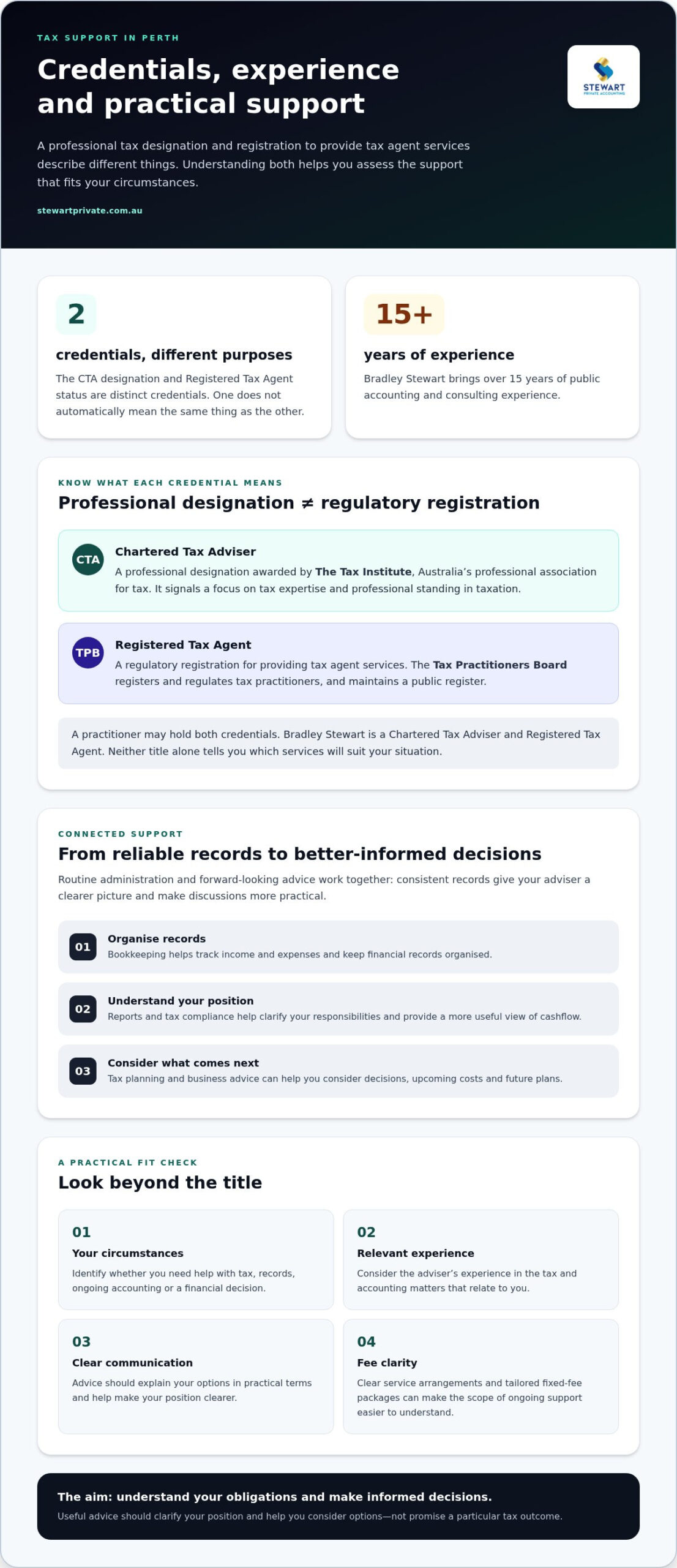
It also looks at how tax planning, bookkeeping and business advice can work together, and why clear service arrangements matter when you’re setting a budget. At Stewart Private Accounting, Bradley Stewart is a Chartered Tax Adviser and Registered Tax Agent with over 15 years of public accounting and consulting experience. This guide will help you understand your options and take a considered next step.
Key Takeaways
- Understand how the Chartered Tax Adviser designation differs from Registered Tax Agent status, and why each may matter when seeking tax support.
- A chartered tax adviser Perth clients work with can connect tax compliance with practical support such as bookkeeping, business advice and tax planning.
- Assess whether support fits by considering your circumstances, the adviser’s relevant experience, their communication style and fee clarity.
- Be ready to discuss your business structure, record-keeping and reporting responsibilities so advice can reflect your situation.
- Bradley Stewart brings over 15 years of public accounting and consulting experience to his work as a Chartered Tax Adviser and Registered Tax Agent.
What does a Chartered Tax Adviser in Perth do?
A Chartered Tax Adviser (CTA) is a tax professional who holds a designation awarded by The Tax Institute, Australia’s professional association for tax. In practical terms, a chartered tax adviser Perth clients work with can explain how tax rules relate to their circumstances, support tax compliance and help them consider options for future decisions.
That support may include clarifying reporting responsibilities, organising tax records or assessing the tax implications of a business or personal decision. Useful advice should make your position clearer, rather than promise a particular tax outcome. For broader context, Taxation in Australia covers the federal and state systems in which this advice sits.
What does the CTA designation represent?
The CTA designation is a professional credential associated with The Tax Institute. It signals a focus on tax expertise, but it doesn’t guarantee a particular result or describe every service a practitioner provides. Your needs may extend beyond technical tax advice, so consider the adviser’s relevant experience and whether they explain your options in clear, practical terms.
For example, a small business owner planning a change may need to understand its tax implications while keeping day-to-day records organised. Clear advice can help them weigh options and plan next steps with a better understanding of their responsibilities.
How is a Chartered Tax Adviser different from a Registered Tax Agent?
The distinction is between a professional designation and a regulatory registration. The Tax Institute awards the CTA designation, while the Tax Practitioners Board (TPB) registers and regulates tax practitioners, including registered tax agents. These credentials serve different purposes, and one doesn’t automatically mean the same thing as the other.
Registered Tax Agent status relates to providing tax agent services under Australia’s regulatory framework. Registration requirements are set by the TPB, which maintains a public register. The CTA designation, by contrast, recognises a person’s professional standing in taxation through The Tax Institute. A practitioner may hold both, as Bradley Stewart does, but neither title alone tells you which services will suit your situation.
When comparing credentials, consider the whole picture: what you need help with, the adviser’s experience in relevant tax and accounting matters, and how clearly they communicate. A strong working relationship should leave you better equipped to understand your obligations and make informed decisions.
How a Perth tax adviser can support your business and personal tax needs
Tax support is most useful when it links the regular work of keeping records and meeting obligations with decisions about what comes next. A chartered tax adviser Perth clients work with can coordinate accounting and taxation support so you can understand your current position and consider the choices ahead.
Routine administration includes organising financial records, preparing reports and managing tax compliance. Forward-looking advice uses that information to help you consider business decisions, cashflow and tax planning. The two are connected: accurate, consistent records give your adviser a clearer picture and make discussions more practical.
Support for Perth small and medium-sized businesses
For a business, support can bring together accounting, tax obligations, bookkeeping and business advice. Well-maintained books help you track income and expenses, while clear reporting gives you a more useful view of cashflow. That visibility can help you plan for upcoming costs and consider how a decision may affect the business.
Your needs may change as your business develops. A newer business may need reliable bookkeeping and help understanding its reporting responsibilities. An established SME may benefit from advice that takes its current operations and future plans into account. Tax planning can form part of that wider picture, rather than sitting apart from everyday financial management.
Clear service arrangements matter, too. Tailored fixed-fee packages make the scope of ongoing support easier to understand. For more on this approach, read the guide to fixed-fee accounting support.
Support for individuals and business owners
Your personal tax position may connect with your business income, investments or longer-term financial decisions. If you own a business, considering personal and business matters together can help you see how one decision may affect the other. Superannuation strategies may also form part of a broader discussion, depending on your circumstances. They shouldn’t be treated as a promise of a particular result.
Bradley Stewart’s work brings tax expertise together with practical accounting, bookkeeping and business advice. The Tax Institute is the professional body associated with the Chartered Tax Adviser designation, while day-to-day support still needs to fit each client’s situation. Explore Stewart Private Accounting’s tax and accounting support to see how these services can work together.
How to assess whether a Chartered Tax Adviser is right for you
Choosing tax support is about fit, not just credentials. Start by identifying what you need help with: a tax return, ongoing business accounting, clearer records or advice before a financial decision. Then consider whether the adviser has relevant experience, explains matters in plain language and sets out the work and fees clearly.
The right level of guidance depends on your circumstances. If your needs are straightforward, you may only need focused help with a specific tax matter. If you run a business or have connected personal and business decisions, coordinated accounting, tax and advisory support may be more useful. The aim is to identify the help that’s relevant, not to take on services you don’t need.
Look beyond the designation
Consider how an adviser’s experience relates to your situation and whether their explanations help you make informed choices. A clear scope of work should set out the services included and what you can expect, so you share an understanding from the outset. Bradley Stewart brings over 15 years of public accounting and consulting experience. That’s useful context, not a universal benchmark for every client.
Notice how the adviser responds to your questions. You should be able to understand the advice, the practical steps involved and where a decision may affect your tax position. A strong working relationship depends on clear communication as well as technical knowledge.
Consider how fees are structured
A tailored fixed-fee package can make the agreed work and fee easier to understand before you proceed. It can also support more predictable budgeting when the scope reflects your needs. No fee model is automatically right for everyone, and a fixed fee doesn’t mean the same services are included by every practice.
Compare what’s covered, how additional work is handled and whether the arrangement suits the support you need. For more context, see this guide to accountant costs in Perth. You can also explore the differences between fixed-fee and hourly arrangements as you consider which structure feels clearest for your business.
For a chartered tax adviser Perth clients can work with confidently, look for relevant expertise, practical communication and a clear agreement that fits your circumstances. Explore Stewart Private Accounting’s tax and accounting support to see how tailored assistance can bring these elements together.
What Perth and Western Australian clients should discuss with a tax adviser
A useful tax discussion starts with your circumstances, not a generic checklist. Your business structure, income sources, record-keeping processes and reporting responsibilities can all affect what needs attention. A chartered tax adviser Perth clients consult can help clarify which matters apply to them and what to prioritise.
Deadlines and obligations can depend on your circumstances and the type of reporting involved. Before acting on a due date or compliance requirement, make sure the information reflects current Australian Taxation Office (ATO) guidance and your situation. This keeps planning grounded in what applies to you, rather than assumptions based on another business or taxpayer.
Which records and questions help make an initial discussion useful?
Bring relevant, current financial records and a short summary of what you want to resolve. The useful information will vary, but you might cover:
- how your business is structured and how you currently organise financial records
- which reporting tasks or tax matters you find difficult to manage
- cashflow concerns or upcoming business and personal decisions
- questions about your existing bookkeeping and reporting processes
You don’t need to have every document perfectly organised before seeking guidance. A clear picture of what’s working, what’s unclear and which decisions are approaching gives the conversation a practical starting point. From there, an adviser can help identify relevant priorities and support that fits.
How can ongoing advice reduce administrative uncertainty?
Agreed, regular communication can help keep responsibilities visible and address questions as they arise, rather than leaving everything until reporting time. Bookkeeping support can help maintain organised financial records, while accounting and taxation services can help you understand reporting needs and tax matters. If your business has employees, discuss how payroll-related records fit into your overall record-keeping and responsibilities.
Current, organised records make tax discussions clearer because they give your adviser a more reliable picture of your financial position. That clarity can help focus conversations on what needs attention, whether you’re reviewing reporting processes or considering a business change.
For practical support with accounting, taxation and bookkeeping, discuss your tax and accounting needs with Stewart Private Accounting.
Meet Stewart Private Accounting: qualified tax advice with practical support
For individuals and small to medium-sized businesses, tax advice is most useful when it connects technical knowledge with the practical work of managing finances. Stewart Private Accounting is a Perth-based practice led by Bradley Stewart, a Chartered Tax Adviser and Registered Tax Agent with over 15 years of public accounting and consulting experience.
That experience sits alongside accounting and taxation services, bookkeeping, business advice and expert tax planning. Bringing these areas together can help you consider routine financial responsibilities alongside the decisions you’re working towards. Support is shaped around your circumstances and the agreed scope, rather than assuming every client needs the same arrangement.
A tailored approach for Perth businesses and individuals
Your priorities might include keeping records organised, understanding your tax position or getting a clearer view of your business finances. Stewart Private Accounting tailors support to those needs, with clear communication about the work involved. Tailored fixed-fee packages make the service scope and fees clearer, helping you plan for the agreed support.
The Trusted Concierge service offers a hands-on approach for clients. The right arrangement depends on your circumstances and priorities. Whether you need a specific accounting or tax service or support across several areas, practical guidance should help you understand your next steps without promising a particular outcome.
What happens when you start a conversation?
An initial discussion can focus on your current arrangements, what’s working well and where you’d value support. Explain your business or personal priorities and raise questions about your accounting, tax or bookkeeping needs. This gives the conversation a clear starting point.
Proposed support should set out the scope of work, responsibilities and fees in a way you can understand. That clarity helps you decide whether the arrangement fits before moving forward. You don’t need to have every question resolved in advance. A considered conversation can help bring the relevant issues into focus.
If you’re looking for a chartered tax adviser Perth individuals and businesses can turn to for qualified advice and practical accounting support, discuss your accounting and tax needs with Stewart Private Accounting.
Take the next step with clear, practical tax support
Choosing a chartered tax adviser Perth clients can work with confidently means looking beyond a professional title. Consider how the adviser’s experience fits your circumstances, whether they explain your responsibilities clearly, and how their services and fees are scoped. A Chartered Tax Adviser designation and Registered Tax Agent status have distinct roles, so understanding both can help you make a more informed choice.
Good support connects day-to-day accounting and tax compliance with the decisions ahead. Clear, current records help make advice more useful, while tailored fixed-fee packages can make the agreed accounting, tax and advisory support easier to understand and plan for.
At Stewart Private Accounting, Bradley Stewart is a Chartered Tax Adviser and Registered Tax Agent with over 15 years of public accounting and consulting experience. To discuss support that reflects your priorities, discuss your tax and accounting needs with Stewart Private Accounting.
A clear conversation can help you identify a practical next step and move forward with greater confidence.
Frequently Asked Questions
Is a Chartered Tax Adviser the same as a Registered Tax Agent?
No. A Chartered Tax Adviser designation is a professional credential associated with The Tax Institute, while Registered Tax Agent status is a registration under Australia’s tax practitioner framework, overseen by the Tax Practitioners Board (TPB). The credentials have different purposes, and neither guarantees a particular result. One person may hold both. Bradley Stewart is a Chartered Tax Adviser and Registered Tax Agent, combining professional tax expertise with registration to provide tax agent services.
What does a Chartered Tax Adviser do for a small business?
A Chartered Tax Adviser may help your small business understand tax responsibilities, organise relevant records and consider tax decisions or upcoming obligations. The right support depends on your business and the services agreed. At Stewart Private Accounting, accounting and taxation, bookkeeping and business advisory support can be tailored to client needs. Clear records and relevant advice can help you understand your position, but no particular tax saving or outcome should be assumed without considering your circumstances.
How do I find a Chartered Tax Adviser in Perth?
Start by identifying what you need, such as tax compliance, business accounting or ongoing advice. Then consider relevant qualifications and experience, communication style, service scope and fee clarity. You can check tax agent registration through the TPB’s official register and learn about the CTA designation through The Tax Institute. Stewart Private Accounting is a Perth-based practice led by Bradley Stewart, a Chartered Tax Adviser and Registered Tax Agent.
Can a Chartered Tax Adviser help with tax planning?
Yes. A Chartered Tax Adviser can provide tax guidance and planning that reflects your circumstances and the services agreed. Useful planning considers current rules, your business or personal objectives and the information available, rather than relying on generic promises of savings. An adviser should explain options and their possible implications in plain language. Check tax requirements and dates against current Australian Taxation Office guidance, as details can depend on your situation.
Is a Chartered Tax Adviser worth it for a small business?
It depends on your finances, the decisions you face and how much support you need. An adviser may help bring structure to tax compliance and provide clearer guidance for business decisions, while a smaller or simpler operation may only need focused assistance. Consider relevant experience, communication, responsibilities and fee clarity. A professional designation alone doesn’t determine whether a particular service is right for your business or guarantee a specific outcome.
What should I prepare before meeting a tax adviser?
Gather the financial records and recent tax or business documents you have, along with a short list of questions or decisions you’d like to discuss. It can help to outline your business activities, current reporting processes and any upcoming dates you know about. You don’t need to have everything perfectly organised before the conversation. Your adviser can explain what other information would be useful for your circumstances and the support you’re considering.
How are fixed-fee accounting services different from hourly advice?
Fixed-fee services set an agreed fee for a defined scope of work, while an hourly arrangement charges according to time spent. Which approach suits you depends on the work required and how clearly it can be scoped. Ask for a plain explanation of what’s included and how additional work is handled. Stewart Private Accounting offers tailored fixed-fee packages for accounting, tax and advisory support, designed to clarify the agreed services and fees.