

Staying ahead of the ATO starts with accurate records, complete income reporting, timely tax and super obligations, and deductions supported by evidence. GST registration generally applies when current or projected GST turnover reaches $75,000, subject to special rules. Monitor both tests rather than waiting for annual accounts. ATO compliance help for a small business can turn these duties into a clear routine while keeping you informed about the ATO’s compliance focus areas, which are updated quarterly.
ATO compliance help for small business starts with a manageable routine for tax reporting, payroll and record-keeping. When these tasks compete with daily operations, a consistent process helps you track obligations and spot gaps early.
This guide explains when early professional advice can help, which tax obligations and financial reports to keep in view, and what the ATO is currently focusing on. You’ll also learn how to approach business deductions carefully, so your claims are supported by records and reflect genuine business use.
Key Takeaways
- Seek tax advice early if you’re unsure about an obligation or may have difficulty meeting a payment or lodgement deadline.
- Build a regular routine for reconciling accounts, organising records and reviewing financial reports before lodgement.
- Keep business and personal spending separate, and make sure income and deductions are accurately recorded.
- Claim only the business-use portion of expenses that serve a business purpose, and retain evidence to support each claim.
- Monitor current and projected GST turnover monthly; the general registration threshold is $75,000, subject to special rules.
Getting early advice from a bookkeeper or accountant
Early advice can help you correct an error before it affects a tax return, business activity statement or payment. The Australian Taxation Office advises small businesses that cannot pay tax debts in full or on time to contact the ATO or a registered tax practitioner early. Raise concerns before lodgements and payments are due, while there is time to review records and discuss options.
Seek help if you are unsure how to report income, classify an expense or meet a tax or super obligation. For example, if your accounts do not match your bank statements, a bookkeeper can trace missing transactions and update the records. An accountant or tax adviser can then consider how the corrected information affects your reporting.
How can small businesses get free or low-cost ATO compliance help? Start with the Australian Taxation Office’s small-business guidance and Tax time toolkit for general information. For advice about your records or circumstances, contact the ATO or speak with a registered tax practitioner before a due date.
Bookkeeping software can organise invoices, receipts and transactions, but it cannot determine whether an expense is deductible or a tax treatment is correct. Set a monthly routine to match transactions to documents and review unexplained differences. If the same errors keep appearing, take examples and reports to a bookkeeper or accountant.
How can a small business check an accountant or tax agent is registered in Australia? Search the Tax Practitioners Board register for the practitioner’s name and confirm their registration details. Check before engaging them for tax advice, then ensure their advice reflects your business structure and records.
Prepare for a useful appointment by gathering recent accounts, lodged returns, business activity statements and any ATO letters. Write down your question, the relevant dates and any action already taken. A clear file helps an adviser identify missing records, reporting errors or deadlines that need attention.
If you expect difficulty paying, act early rather than waiting for the due date to pass. The ATO offers payment plans for businesses with tax debt and may request evidence of financial difficulty. Plans generally require an upfront payment, with repayments completed in the shortest possible timeframe to reduce general interest charges.
Professional accounting advice can connect bookkeeping routines with tax reporting and business decisions. A tax practitioner can explain which records a return requires, review an identified error and discuss whether an amendment or voluntary disclosure is appropriate. For ATO compliance help for a small business, raise the issue while the facts and supporting documents are easy to assemble.
Understanding tax obligations and financial reports
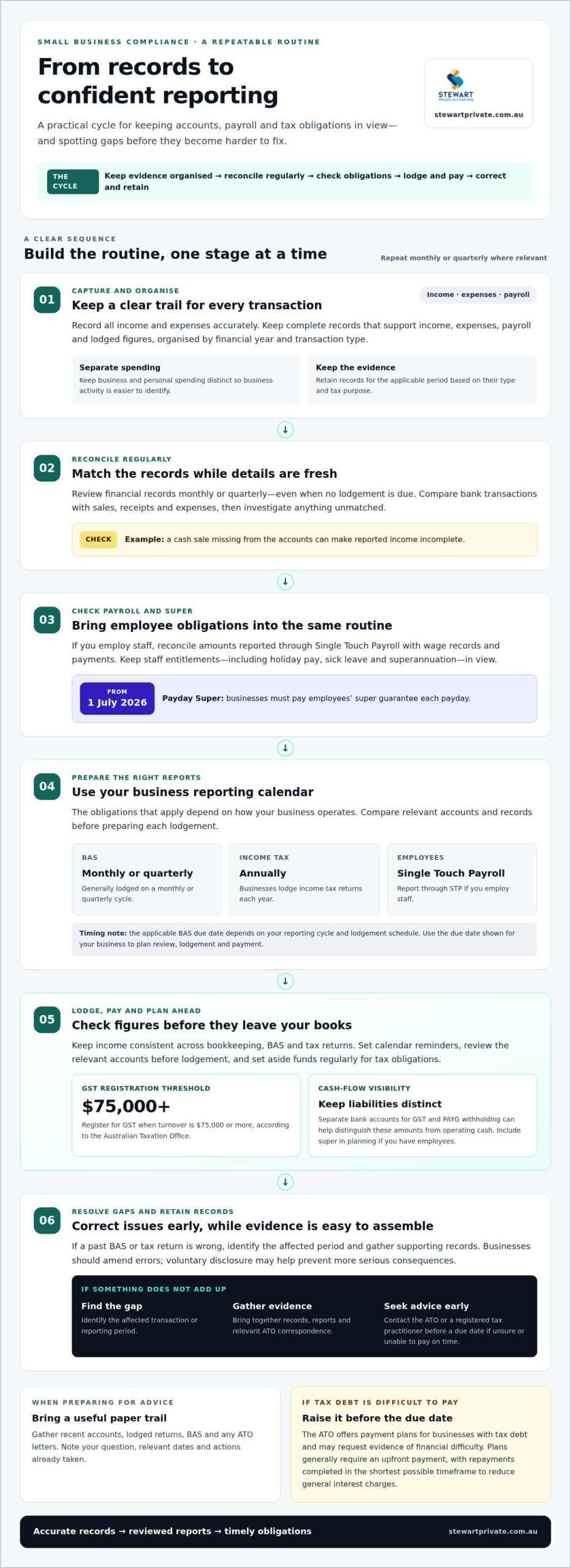
Your reporting calendar depends on how your business operates and which obligations apply. Australian small businesses generally lodge business activity statements monthly or quarterly, while businesses lodge income tax returns annually. If you employ staff, you must report through Single Touch Payroll. Set a calendar reminder for each obligation, then compare the relevant accounts and records before preparing each lodgement.
What are the ATO BAS lodgment and payment deadlines for small businesses? BAS reporting is generally monthly or quarterly, and the applicable due date depends on your reporting cycle and lodgement schedule. Use the due date shown for your business to plan your review, lodgement and payment steps.
Review financial records monthly or quarterly, even when a lodgement is not due. Compare bank transactions with sales, receipts and expenses, then investigate unmatched items while the details are familiar. For example, a cash sale missing from the accounts can make reported income incomplete. Keep income reporting consistent across your bookkeeping, BAS and tax return.
How should a small business keep records to meet ATO requirements, and for how long? Keep complete, accurate records supporting income, expenses, payroll and lodged figures, and organise them by financial year and transaction type. Retain each record for the applicable period based on its type and tax purpose, so you can retrieve the evidence behind a report or claim.
For payroll, reconcile amounts reported through Single Touch Payroll with wage records and payments. Employers also need to provide staff entitlements such as holiday pay, sick leave and superannuation. From 1 July 2026, businesses must pay employees’ super guarantee each payday under Payday Super. Make payroll checks part of the same routine as reviewing accounts, rather than leaving them until year-end.
Set aside funds regularly for tax obligations. Keeping GST and PAYG withholding in separate bank accounts can help distinguish money collected for these liabilities from operating cash. If you have employees, include super in your planning too. Separating these funds makes it easier to compare available cash with upcoming payments and identify a shortfall early.
If you find an error in a past BAS or tax return, identify the affected period and gather supporting records. Businesses should amend errors, and voluntary disclosure may help prevent more serious consequences. Review reports before lodgement to catch mismatches between recorded sales, expenses and reported amounts. A calendar of due dates makes follow-up part of routine administration.
Closing a business also requires a planned final reporting process. Cancel the ABN, lodge final tax returns and BAS, and meet final payroll and super obligations. Make a checklist covering outstanding income, expenses, staff payments and lodgements before closing accounts. If you need help aligning reporting routines with business decisions, business advisory support can help you bring those responsibilities into one workable plan.
ATO small business compliance focus areas
The ATO updates its small business compliance focus areas quarterly, so review them as part of your regular record checks. Its ongoing “Getting it right” campaign for small businesses began in 2024. The practical message is consistent: keep accurate, complete records, report income correctly and meet tax obligations on time. These habits make it easier to explain figures if the ATO asks questions.
Record-keeping matters because reports rely on evidence for each transaction. Keep invoices, receipts, bank records and business documents together, then check they match your accounts. For example, confirm that a supplier invoice supports the amount recorded and identifies what the business bought. Separate personal and business accounts to reduce confusion when sorting income and expenses.
GST reporting also deserves attention. The ATO identified accurate records and moving to monthly GST reporting where required as small-business priorities. It planned to move around 3,500 small businesses from quarterly to monthly GST reporting, with the change starting on 1 April 2025. Check the reporting cycle that applies to your business and adjust bookkeeping routines if it changes.
Other behaviours that may attract compliance attention include failing to register, report or pay correctly and on time. The ATO also identifies undeclared contractor income, incorrect GST registration and using business funds for personal lifestyle expenses as risks. Review sales channels, contractor payments and account transactions together. This can reveal omissions, such as income in a separate platform account that is missing from business reporting.
How do ATO compliance requirements differ for sole traders, companies and trusts? Accurate records and correct reporting matter across all structures, but tax reporting depends on how the business is set up. Make sure income, expenses and lodgements are recorded under the correct structure rather than assuming one business’s process suits another.
The ATO also focuses on undeclared income and deductions that are inflated or unsupported. Its data analytics and data matching can identify work-related expenses for review. Before claiming an expense, match it to a business purpose and supporting evidence. If an item has both business and private use, record the business portion clearly instead of claiming the full amount.
Incorrect reporting can have financial consequences: penalties depend on the breach and circumstances. False or misleading statements, late lodgement and late payment have different penalty and interest rules; 75% is not a universal maximum. If you find a mistake, identify the affected report, collect the supporting records and address the error. Checking records against lodged figures helps you take practical action early, rather than allowing an overlooked discrepancy to carry into later reporting.
Deductions and small-business concessions
A deduction needs a clear business purpose and supporting records. If an expense has both business and private purposes, claim only the business-use portion. For example, separate the business share of a mixed-use expense from personal use, then keep a note explaining your calculation. A private cost does not become deductible simply because you paid for it from a business account.
Before claiming an expense, connect the purchase to the work your business performs. Keep evidence showing what you bought, who supplied it and when you paid. For each expense, retain the supplier name, tax invoice number, amount, goods or services, payment date and document date. These details help explain how the claim relates to business income if the ATO asks.
Tax reference material and software used for tax purposes can be deductible business costs. Keep the invoice or receipt and record the item clearly in your accounts. Do not treat every digital tool as tax-purpose software: identify its actual function and use. A program used to prepare tax information is different from software serving unrelated personal needs.
Check claims against your records before including them in a tax return or quarterly statement. Match each amount to its invoice, receipt or other supporting document, and investigate differences before lodgement. If you are unsure whether an expense has a business purpose, note how it supports your work and get tax advice before claiming it. Clear explanations are more useful than estimates.
Concessions also need careful attention. The ATO identifies non-commercial losses, the small business CGT concession and recent “boost” measures among the areas receiving compliance attention. A concession’s name alone does not establish eligibility. Keep records of relevant transactions and business activity, and consider how the concession applies to your circumstances before reporting it. Do not copy a claim from a business with a different structure or activity.
For a practical review, group potential claims by type and compare each item with its supporting evidence. Separate mixed-use expenses, flag missing documents and check that totals agree with your accounts. This can also reveal duplicate entries or personal purchases recorded as business costs. Correcting mistakes before lodging helps keep your figures consistent.
Primary producers may be eligible for additional tax-time concessions. If your business operates in this sector, identify the activity and supporting records relevant to each claim. A short written explanation linking the expense or concession to the business can make later reviews clearer. Good preparation means your income, deductions and records tell the same story.
What are the current GST registration turnover thresholds and rules in Australia?
Businesses generally need GST registration when current or projected GST turnover reaches $75,000, with registration required within 21 days. Special rules apply, including for not-for-profits and taxi or ride-sourcing services. Treat this threshold as a point to monitor through your sales records, not a figure to review only at tax time. Keep invoices and sales reports organised so you can see how turnover is changing.
Start by reviewing income recorded across your business accounts and sales channels. Compare invoices with deposits and recorded transactions, and follow up any gaps. For example, if sales appear in an online platform report but not your bookkeeping records, investigate and correct the difference. Complete records give you a clearer basis for tracking turnover.
Make turnover checks part of your regular bookkeeping routine. A monthly review can help you notice changes sooner, while a business preparing BAS quarterly can include a turnover check in its reporting preparation. Use records consistently, and note the figures reviewed and any adjustments made.
Separate business income from personal transfers before reviewing sales totals. A deposit into a business account is not automatically a sale, so record its purpose and keep supporting documentation. Likewise, do not overlook income received through another sales channel. Matching each entry to an invoice, receipt or platform report helps explain what the figure represents.
If turnover is approaching the threshold, organise current records and expected sales information before deciding what action to take. Consider whether recent changes, such as new contracts or a different sales channel, affect the figures you monitor. Clear records help you discuss your position with a registered tax professional and plan next steps without guesswork.
After registration, make GST-related transactions easy to identify in your accounts and supporting documents. Reconcile recorded sales and expenses before preparing each BAS, whether your reporting cycle is monthly or quarterly. If a report does not agree with your records, find the cause and correct it before lodgement. This makes later reviews more straightforward.
Use a simple checklist: review sales records, reconcile account entries, note changes in turnover and keep the documents supporting your figures. If you’re unsure how your records relate to GST registration or reporting, get accounting and tax support to help assess the information and plan your next steps.
Stewart Private Accounting: Accounting & Taxation Services
Stewart Private Accounting helps businesses bring tax reporting, bookkeeping and business decisions into a clearer routine. If you are unsure how to organise records, prepare for a lodgement or assess a tax position, its Accounting & Taxation Services and Bookkeeping Services can support these practical needs.
For business decisions or tax planning, Business Advisory Services and Expert Tax Planning can help you consider the financial information behind your next steps. Bring the records, ATO correspondence or specific questions you want to discuss, so the advice can focus on the issue at hand.
For a steady approach to small business tax responsibilities in Western Australia, contact Stewart Private Accounting or visit stewartprivate.com.au.
Make compliance part of your next business decision
Good compliance is more than a task to complete at tax time. It gives you a dependable basis for deciding what to invest in, how to manage cash flow and where your business needs attention next. Effective ATO compliance help for small business owners connects accurate financial information with decisions made throughout the year.
Stewart Private Accounting offers Accounting & Taxation Services, Bookkeeping Services and Business Advisory Services. Bring the questions or reporting challenges taking up your attention and start a practical conversation about support that fits your business needs.
Contact Stewart Private Accounting to discuss your next step. A clearer process can help you focus on running your business with greater confidence.
Frequently Asked Questions
Want to stay ahead of the ATO?
Build a regular review routine around the ATO’s quarterly small-business compliance focus areas. For ATO compliance help for a small business in Western Australia, assign someone to monitor updates and note changes affecting your records or reporting. For example, if your GST reporting cycle changes, update your bookkeeping calendar and staff responsibilities. This turns new requirements into manageable tasks rather than last-minute surprises.
What is ATO compliance?
ATO compliance means meeting your Australian tax reporting, payment and record-keeping obligations accurately. It includes declaring business income, lodging required reports and supporting claims with evidence. For example, if a customer pays in cash, record the sale in your accounts and retain the related sales information. A consistent paper trail shows how reported figures were calculated and makes it easier to respond to an ATO enquiry.
What ATO tax obligations apply to small businesses in Australia?
Your obligations depend on business activities and whether you employ staff. They can include income tax returns, business activity statements, GST reporting and Single Touch Payroll reporting for employees. If your business starts employing staff, add payroll reporting and employee entitlements to your compliance calendar. Review applicable obligations whenever your structure or operations change, such as adding an income stream or hiring workers.
What are the small business income tax rates, deductions and concessions?
Income tax treatment depends on your business structure and taxable income, so no single rate applies to every small business. A deduction must relate to a business purpose, and mixed-use expenses can only be claimed for their business-use portion. Concessions that may need careful review include non-commercial losses and the small business CGT concession. Keep supporting records and get tax advice before relying on a concession.
What ATO payment plans and small business tax debt support are available?
A business with tax debt may arrange a payment plan that divides the amount owed into instalments. Plans generally require an upfront payment, and repayments should finish in the shortest possible timeframe to reduce general interest charges. If financial difficulty affects your ability to pay, raise it early and prepare evidence of the business’s position. A clear cash-flow forecast can help you assess what instalments the business can manage.
What are the penalties and interest for late lodgement or payment to the ATO?
Late lodgement, false or misleading statements and late payment have different consequences. Shortfall penalties depend on conduct and can be increased or reduced; a 75% figure is not a universal cap. Unpaid tax can also attract general interest charges, which is why resolving a debt promptly matters. If you discover a missed lodgement or incorrect figure, identify the affected period, gather the relevant records and address the error. Voluntary disclosure may help prevent more serious consequences when correcting past reporting.