

A budget that only gets opened at tax time isn’t helping you make decisions. The business budgeting help small business owners need starts with turning bookkeeping and accounting records into a plan that reflects how the business actually works. That can feel difficult when you’re unsure what to allocate, or worry the numbers will become outdated as costs and income change.
A useful budget doesn’t need to be complicated or set in stone. It gives you a clear starting point, then helps you compare your plan with what’s happening and adjust when circumstances shift. With practical business budgeting help, small business owners can build realistic assumptions and make decisions with greater confidence.
This guide explains how to create a budget from your records, organise expected income and expenses, and review actual results against your plan. You’ll also learn how to use those comparisons to guide decisions, keep your budget relevant as the business changes, and recognise when professional bookkeeping, accounting or business advisory support could bring more structure to your planning.
Key Takeaways
- Set a clear budget period and business goals to give your financial planning direction.
- Use bookkeeping reports, invoices, payroll records and known commitments to ground your estimates in business records.
- Keep your budget as a plan, then update your forecast as new information and changing conditions affect expectations.
- Review actual results against the budget, investigate variances and use what you learn to guide your next decisions.
- Business budgeting help small business owners can use may bring structure to unclear records, recurring surprises and difficult trade-offs.
Why a small business budget gives you a clearer plan
A business budget is a forward-looking plan for the income you expect and the spending needed to operate and pursue your goals. It turns past records and current commitments into a view of what may lie ahead. For a broad overview of the concept, see What is a budget? In practice, your budget should reflect the way your business earns and spends, rather than sit apart from everyday decisions.
That visibility helps you weigh priorities before you commit. You can see how much of your expected income is already needed for regular costs, then consider what remains for a new hire, equipment or growth. A budget is a guide, not a guarantee or a rigid spending rule. Income and costs can change, so the value lies in having a considered starting point you can revisit.
For example, imagine your business expects A$24,000 in monthly receipts and estimates A$17,000 for operating costs and commitments. That leaves A$7,000 available in the plan. If you’re considering equipment costing A$9,000, the budget makes the A$2,000 gap visible before you decide. You might adjust the timing, review other spending or revisit the assumptions. The example is illustrative, but the decision-making benefit is practical: a shortfall becomes something to plan for, rather than a surprise.
What can a business budget help you decide?
A budget connects expected income and costs to your priorities. It lets you compare planned spending with the resources you expect to have, then consider whether a decision fits the broader plan. Before hiring, purchasing or pursuing growth, you can look at the likely effect on other commitments and decide what needs to change. This is where business budgeting help small business owners use can move beyond organising numbers and support clearer choices.
Which small businesses benefit from budgeting?
Sole traders and small teams can begin with a simple plan that groups income and key expenses. An established business may find it useful to budget by project, department or location, depending on how it makes decisions. The right format depends on the work: a seasonal business may need to account for uneven income, while changing supplier or staffing costs can affect any business. Start with a structure you can maintain.
Bookkeeping and accounting records give your estimates a grounded starting point, while business advisory can help connect those assumptions to priorities. Keep the plan clear enough to use, and flexible enough to change as your business circumstances shift.
How to build a small business budget from your records
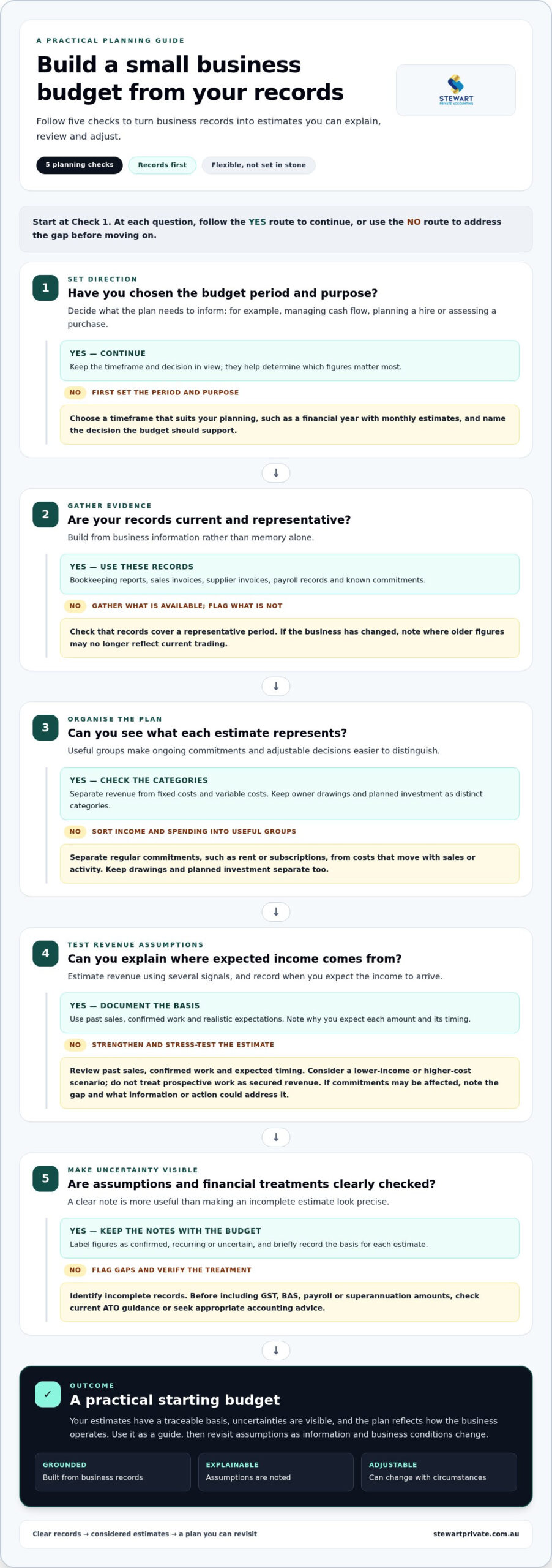
A useful budget begins with information your business already holds, then turns it into estimates you can explain and review. Start with a manageable structure rather than trying to predict every detail. This records-first process can give business budgeting help small business owners a practical foundation, while making gaps and uncertain assumptions easier to spot.
- Set the period and purpose. Choose a timeframe that suits your planning, such as a financial year with monthly estimates. Define what you want the budget to inform, whether that’s managing cash flow, planning a hire or assessing a purchase. The purpose helps you decide which figures matter most.
- Gather recent records. Bring together bookkeeping reports, sales invoices, supplier invoices, payroll records and known commitments. Use current records rather than memory alone, and check that the information covers a representative period. If the business has changed, note where older figures may no longer reflect current trading.
- Sort income and spending into useful groups. Estimate revenue separately from fixed costs, such as regular rent or subscriptions, and variable costs that move with sales or activity. Include owner drawings and planned investment as distinct categories. This makes it easier to see which commitments are ongoing and which decisions can be adjusted.
- Estimate revenue and test the assumptions. Use past sales, confirmed work and realistic expectations to build your estimate. Record why you expect each amount and when you expect it to arrive. Then consider a lower-income or higher-cost scenario. If that changes whether you can meet commitments, note the gap and decide what information or action could address it.
- Label uncertainties and check treatment. Mark estimates as confirmed, recurring or uncertain, and write a short note explaining the basis for each. Identify incomplete records rather than disguising them as precise figures. Before including GST, BAS, payroll or superannuation amounts, check current ATO guidance or seek appropriate accounting advice so the budget reflects the correct treatment.
Gather the figures and decide what to include
Separate regular commitments from costs that rise and fall with activity. Invoices and supplier records can help reveal timing as well as amounts, while payroll records show planned staffing costs. Include relevant tax, superannuation and payroll obligations using current guidance. A clear category structure helps you see where an estimate comes from and makes later comparisons more meaningful.
Estimate revenue and document your assumptions
Use several signals rather than relying on one strong month: review past sales, confirmed work and the timing of expected income. Note seasonal patterns where they apply, and be cautious about treating prospective work as secured revenue. If records are incomplete, flag the gap and use a conservative estimate until better information is available. Clear assumptions make it easier to revise the plan without losing sight of why you set it.
Bookkeeping and accounting support can help organise source figures and clarify the assumptions behind a plan. For tailored guidance that connects your records with business decisions, Stewart Private Accounting’s business advisory support can form part of your budgeting process.
Budget vs forecast: how to plan for changing business conditions
A budget gives your business a planned direction. A forecast updates your view of likely results as new information comes in. Keeping both in view helps you distinguish between the goals you set and what current conditions suggest may happen. Neither document guarantees future performance; each supports decisions from a different angle.
| Business budget | Business forecast |
|---|---|
| Sets planned income, spending and priorities for a defined period. | Uses current information to estimate likely income and spending. |
| Helps communicate goals and guide how resources are allocated. | Helps you respond when trading or costs differ from expectations. |
| Provides a reference point for reviewing results. | Changes as actual results and new information become available. |
When should you use a budget and when should you update a forecast?
Use the budget to set direction and guide planned resource allocation. Update the forecast when recent results, confirmed work or new costs change your expectations. For example, if expected sales soften, revise the forecast to show the likely effect on income and planned spending. If a supplier advises of a higher cost, update the relevant estimate and consider which decisions may need to shift. Keep the original budget as a useful comparison, rather than rewriting the target every time circumstances change.
This distinction makes business budgeting help small business owners seek more practical: the budget holds the plan steady enough to assess progress, while the forecast stays responsive. A difference between the two is a prompt to understand what has changed, not a reason to assume the plan has failed.
How can scenarios make budget assumptions more useful?
Scenario planning helps you test uncertain assumptions before they shape commitments. Build a realistic view based on your current expectations, a cautious view that allows for weaker sales or higher costs, and a growth view that reflects stronger demand. These are planning cases, not predictions. For each one, identify the assumptions that change and which costs or decisions you could adjust.
For instance, if sales arrive later than expected, the forecast may show that income is delayed even if the work is still likely to proceed. That timing difference can affect when you schedule discretionary purchases or other commitments. A supplier cost increase might have a different effect: you may need to revisit pricing, spending priorities or the timing of a planned investment. Write down the trigger for reviewing each scenario, such as a change in confirmed work or a new cost estimate. This keeps the exercise connected to decisions rather than turning it into a set of abstract numbers.
Budget analysis can also flag when expected income and payment dates may not line up with outgoing commitments. For a closer look at managing the timing of cash coming in and going out, see the Perth small business cash flow management guide. Reviewing scenarios alongside your budget and forecast helps you prepare measured responses while keeping the business’s priorities in view.
How to review your budget and respond to variances
A budget becomes more useful when you review it against what actually happened, then use the difference to guide a decision. A variance is simply the gap between a planned figure and an actual result. It isn’t automatically evidence of failure. The cause may be a timing shift, an unusual expense or a change in business activity, and each calls for a different response.
Choose a review rhythm that fits how your business operates and how often reliable records are available. The aim is a repeatable process, not a fixed schedule that adds unnecessary administration. Use this sequence:
- Compare actuals with the budget. Look at income and spending for the same period, using current bookkeeping records.
- Identify the differences that matter. Note where actual results are higher or lower than planned, and consider the effect on business priorities.
- Investigate the cause. Check source records and ask whether the variance reflects timing, a change in sales or costs, or a different level of activity.
- Decide and follow up. Choose a response, assign responsibility and set a date to review whether it helped.
What should you check when actual results differ?
Start with the records before changing your assumptions. Check that invoices, payments and other entries are recorded in the correct period, then distinguish a delayed transaction from a lasting change. Ask whether the difference is temporary, recurring or linked to a decision that altered the original plan. This prevents a one-off event from driving a permanent change, while helping you spot a pattern that deserves attention.
For example, lower-than-planned sales might reflect work invoiced later than expected, or a sustained reduction in demand. Those situations look similar in a basic comparison but may need different actions. Likewise, a higher cost could be a one-time repair or a recurring increase in supplier charges. Confirming the detail first helps you make a measured decision rather than reacting to a number in isolation.
How do you turn a budget review into an action?
Match your response to the cause. If income is delayed, you might reconsider the timing of a discretionary purchase. If a cost increase is recurring, review the relevant estimate and its effect on other priorities. Record the action, who will take responsibility and when you’ll check the result. If the variance points to an issue with payment timing, the cash flow management guide offers related guidance.
For broader planning, connect budget decisions with your business goals through a considered business advisory approach. This is where business budgeting help small business owners rely on can bring more structure to the review: organising records, testing assumptions and linking each action to a clear decision. To build that structure into your planning, explore business advisory support.
When small business budgeting help can bring more clarity
You may benefit from support if your records are difficult to interpret, costs keep catching you by surprise or every spending decision feels like a trade-off between competing priorities. These are practical signs that your budget needs more structure, not reasons to put planning aside. Business budgeting help small business owners can use should make the figures easier to understand and connect them to decisions you need to make.
Support works best as a collaboration. You bring knowledge of your customers, operations and goals; an adviser can help organise the financial information, clarify assumptions and consider how different choices may affect the plan. The budget then becomes part of business decision-making, rather than a set of figures disconnected from how the business runs.
What can an adviser contribute to the budgeting process?
An adviser can help interpret bookkeeping and accounting records, identify where an estimate needs more evidence and make assumptions explicit. Together, you can relate those figures to goals such as taking on staff, managing seasonal activity or considering an investment. This keeps the discussion grounded in your business and its priorities. For broader context on this kind of support, explore the business advisory guide.
Stewart Private Accounting supports small and medium-sized businesses in Western Australia with bookkeeping, accounting and business advisory. Led by Bradley Stewart, a Chartered Tax Adviser and Registered Tax Agent with over 15 years of public accounting and consulting experience, the practice brings these areas together to support more structured planning. Tailored fixed-fee service packages can also make the cost of ongoing professional support more predictable, without making a promise about a particular business outcome.
If you’re weighing up whether outside guidance would help, a guide to what a business adviser does can help you understand how an adviser may contribute to planning and operational decisions.
How can you get ready for a budgeting conversation?
You don’t need to have every figure resolved before starting. Gather recent financial reports, known commitments and a brief outline of your current priorities. Then note the questions you want the budget to help answer, such as whether a planned purchase fits, how much room there is for a hire or what to do if income changes. A list of uncertainties is useful too, because it shows where estimates need care.
With that preparation, the conversation can focus on interpreting the information and agreeing on practical next steps. If a more structured, collaborative approach would help you plan with greater clarity, you can explore Stewart Private Accounting’s support at your own pace.
Make your next business decision with greater confidence
Your budget doesn’t need to answer every question at once. Choose one upcoming decision, such as adjusting capacity or committing to a purchase, and use your figures to clarify what you need to know before acting. That gives your planning a practical next step and helps keep the process manageable.
If the assumptions behind your numbers feel uncertain, or the trade-offs are difficult to weigh, business budgeting help small business owners can access through an adviser may add useful structure. A calm, collaborative review can help connect your financial information with the choices ahead, so your plan supports the way you want to run and develop your business.
For guidance that fits your business priorities, explore practical business advisory support. A clearer plan can make the next decision feel more considered and within reach.
Frequently Asked Questions
How do I create a budget for my small business?
Start by choosing a planning period that matches the decision you need to make, then work from reconciled business records rather than memory. If you’re considering a new staff member, for example, note the expected start date and related costs separately so you can see when they may affect results. Add a brief note beside uncertain figures, and keep a dated copy of each revision to track why your assumptions changed.
What should a small business budget include?
Include categories that show where funds are expected to come from and where they need to go, such as sales, regular commitments, activity-linked costs, payroll, owner drawings and planned purchases. A trades business might track materials separately from vehicle and office expenses to see which costs move with workload. You could also include a contingency allowance for unexpected needs. Keep categories consistent with your records, and check Australian tax treatment against current guidance.
What is the difference between a business budget and a forecast?
A budget records the targets and allocations you set for a chosen period; a forecast updates your view using information available now. If a confirmed project moves from one month to another, the budget can remain as the original benchmark while the forecast shifts expected income between periods. Reviewing both helps you see whether the business is tracking towards its aims and what current evidence suggests, without treating either view as certain.
How often should a small business review its budget?
Review your budget often enough to inform decisions, while choosing a rhythm your records can support. A business with steady activity might check figures as part of its regular bookkeeping close, while a seasonal operator may review them before a busy period. If a major contract, staffing change or supplier shift occurs, revisit the relevant figures sooner rather than waiting for the next scheduled check. Consistency matters more than a universal timetable.
Can a small business budget help manage cash flow?
Yes, a budget supports cash flow planning by showing expected income and spending, but timing needs a closer view. A profitable month on paper can still feel tight if customers pay after supplier invoices fall due. Pair the budget with a schedule of expected receipts and payment dates, then compare actual timing with the plan. This can help you anticipate pressure points and consider adjustments before committing to discretionary spending.
What should I do if my business is over budget?
First confirm that the overrun is recorded correctly and belongs to the period you’re reviewing. Then check whether it came from a one-off event, a higher unit cost, increased activity or a missed assumption. If the cost is continuing, revise your expectations and decide whether to adjust another expense, change timing or accept the trade-off. Record the decision and the result you’ll monitor, so the next review can show whether your response is helping.
Do I need an accountant to make a small business budget?
No, you can build a straightforward budget yourself if your records are clear and the decisions are manageable. An accountant or business adviser may help when entries are difficult to interpret, tax treatment affects comparisons, or choices such as hiring and investment compete for limited resources. For businesses dealing with overseas operations or UK reporting requirements, chartered firms like Fair View Accounting Services offer specialist support navigating tax investigations and compliance obligations. Business budgeting help small business owners can use should clarify options and assumptions while leaving priorities and final decisions with you.
What is the best budgeting method for a small business?
The best method is the simplest one that gives you a reliable view and is easy to update. A spreadsheet may suit a sole trader with a small number of income and expense categories; a growing team may prefer a budget organised around departments or projects. Choose headings that match your bookkeeping reports, record where estimates came from and avoid detail you won’t maintain. Revisit the format as the business changes.