
Could buying a car for your business reduce your tax bill without making the car “free”? If you’re researching buying a car for business tax write-off australia 2025, the answer depends on more than the purchase itself. Business use, eligibility rules and supporting records all affect what you may be able to claim.
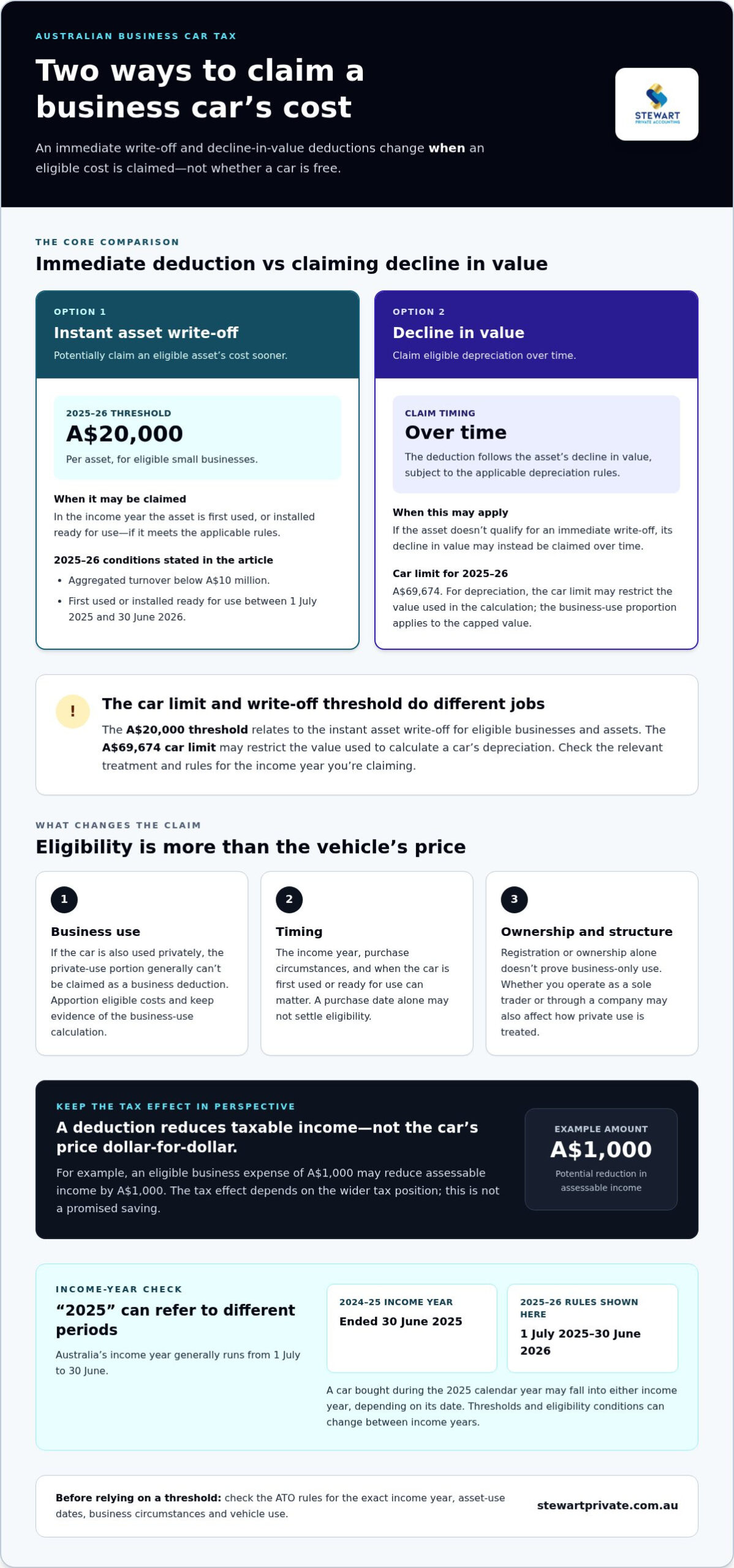
A “write-off” doesn’t usually mean the whole cost comes off your tax straight away. A deduction reduces taxable income. An instant asset write-off may let an eligible business claim an asset’s cost sooner, subject to the rules and limits that apply. For eligible small businesses, the 2025-26 instant asset write-off threshold is A$20,000 per asset, with turnover and timing conditions.
This guide explains the difference between a deduction and an instant write-off, the eligibility questions to consider before buying, and how to keep evidence of business and private driving. It also covers how a vehicle decision fits into broader tax planning and when tailored advice can help you understand your options.
Key Takeaways
- Understand why a tax deduction doesn’t usually reduce a car’s purchase price dollar-for-dollar.
- See how an instant asset write-off differs from claiming a vehicle’s decline in value over time.
- Learn how business and private use, ownership structure and vehicle type can affect your claim.
- Use the buying a car for business tax write-off australia 2025 checklist to plan your purchase and organise supporting records.
- Find out how tailored tax planning can help Perth business owners consider a vehicle purchase alongside their wider business finances.
Buying a business car in Australia: what does “tax write-off” mean?
If you’re researching buying a car for business tax write-off australia 2025, start by separating the everyday phrase “write-off” from what a tax deduction does. A deduction is an amount you may be able to claim against assessable income when an expense or asset meets the relevant tax rules. It isn’t a refund of the car’s price, a grant or a reimbursement from the Australian Taxation Office (ATO).
Business use matters. If you also use the car privately, the private-use portion generally can’t be claimed as a business deduction. Consider how the vehicle will be used and what records will support that use. The tax treatment may also depend on who owns the car and whether its cost is treated as a vehicle expense or as a depreciating asset.
“Write-off” can refer to an eligible asset cost claimed immediately under an instant asset write-off, or to deductions claimed over time as the asset declines in value. These are different timings for a deduction, not different ways to make the car free. Whether either treatment applies depends on the rules for the income year, asset and business.
Keep two questions separate: is there a deductible business amount, and when can you claim it? A vehicle may have a business purpose but still not qualify for an immediate deduction. Thresholds and eligibility conditions can change between income years, so confirm the rules that apply to your purchase date and circumstances.
What does a business car tax deduction actually do?
A tax deduction generally reduces the income on which tax is calculated, rather than reducing your tax bill by the same amount. For example, an eligible business expense of A$1,000 may reduce assessable income by A$1,000. The tax effect depends on your wider tax position, so this example doesn’t represent a promised saving.
A tax write-off is a deduction that may reduce taxable income; it doesn’t make the vehicle’s purchase price free. The timing is a separate matter: an eligible cost may be claimed immediately under a specific rule, or deductions may be spread over time. ATO rules determine which treatment applies.
Which 2025 period are you asking about?
In Australia, the income year generally runs from 1 July to 30 June. “2025” may mean the 2024-25 income year, which ended on 30 June 2025, or a car bought during the 2025 calendar year. A calendar-year purchase may fall across two income years, depending on its date.
The purchase date alone may not settle the question. Eligibility dates and when the car is first used or ready for use can also matter, as can the income year in which you claim. Before relying on a threshold, check the ATO guidance and rules that apply to your transaction date and circumstances.
How business car deductions and the instant asset write-off work
Once you’ve established that a vehicle has a genuine business purpose, consider how its cost can be claimed. An immediate deduction and a deduction for decline in value are different tax treatments. Neither automatically means you can claim the full purchase price: eligibility, business use and applicable limits still matter.
The rules depend on the income year. For 2025-26, current ATO guidance sets the instant asset write-off threshold at A$20,000 per asset for eligible businesses with aggregated turnover below A$10 million. The asset must be first used, or installed ready for use, between 1 July 2025 and 30 June 2026. Don’t apply these conditions to a purchase in another income year without checking that period’s rules.
Instant asset write-off or decline in value?
An eligible instant asset write-off may allow a business to claim an asset’s cost in the income year it is first used or installed ready for use. If the asset doesn’t qualify, its decline in value may instead be claimed over time, subject to the applicable depreciation rules.
Eligibility can depend on the business, asset cost, timing and use. For a car, the depreciation limit may also restrict the value used to calculate depreciation. For 2025-26, the car limit is A$69,674, and the business-use proportion applies to the capped value. Confirm the car limit and treatment for the income year you’re claiming.
For 2024-25 claims, use the ATO guidance for that income year before relying on a threshold or eligibility condition. Write-off eligibility is year-specific, so check the ATO rules for the exact income year and asset-use dates.
How business use affects the claim
If a car serves both business and private purposes, you may need to apportion eligible costs according to business use. A vehicle used for client visits and personal errands, for example, isn’t automatically wholly business use. Keep evidence to support how you calculate the business portion and use a method that suits your circumstances.
Business-use percentage is not the same as ownership or registration. A car registered to a business isn’t necessarily used only for business, and a vehicle registered in an individual’s name still needs to meet the relevant rules before business expenses can be claimed. Your structure, such as operating as a sole trader or through a company, may also affect how private use is treated.
Before committing to a vehicle, consider its type, who will own it, expected business and private use, and when it will be ready for work. These details can shape the income-tax treatment and related obligations. Don’t assume the vehicle’s price or registration settles the deduction. For Perth business owners, tailored business tax planning can help bring the purchase decision and its tax treatment into one review.
Business car tax claims compared: use, ownership and vehicle type
A car’s business registration or ownership doesn’t, by itself, establish that its full cost is deductible. How you use it, who owns it and how the vehicle is classified can all change the tax questions to consider. This applies whether you’re buying a car for business tax write-off australia 2025 or reviewing a vehicle already in use.
Business-only use: The vehicle is used for business activities, and your records should support the business purpose and costs claimed. Eligibility and applicable limits still need to be considered.
Mixed business and private use: Identify and substantiate the business-use portion. Private use generally can’t be treated as business use when calculating a claim.
Primarily private use: A small amount of work-related travel doesn’t automatically make the vehicle a business asset or make all its costs deductible. Assess the actual use and relevant rules.
Business use, private use and substantiation
Keep evidence of how the vehicle is used and how you worked out the business proportion. Depending on your structure and the method available, this may include a logbook and expense records, or records supporting business kilometres claimed. A logbook is evidence of usage, not automatic proof that every cost is deductible or that the vehicle qualifies for a particular tax treatment.
For sole traders and partnerships, the ATO provides cents-per-kilometre and logbook methods for claiming car expenses. Companies and trusts must use the actual-costs method, according to the rules supplied for this article. Keep business and private travel distinguishable in your records, and follow ATO requirements for the relevant income year and claim method.
Sole trader, company and vehicle category differences
For a sole trader, the business-use share of eligible car expenses is generally central to the claim. A company-owned vehicle raises different questions: who has access to it, whether it’s available for private use, and whether fringe benefits tax (FBT) applies. Private use of a company car can raise FBT considerations, so don’t assume income-tax treatment answers every obligation.
Vehicle category also matters. Ordinary passenger cars and other vehicle types may receive different treatment, and a car depreciation limit can restrict the value used when working out depreciation. Classification depends on the relevant tax definitions and vehicle details, so check current ATO guidance rather than relying on a general label such as “work ute” or “commercial vehicle”.
GST credits are separate from income-tax deductions. GST registration, business use and specific vehicle rules can affect whether a credit is available and its amount. A vehicle purchase may therefore have different GST and income-tax outcomes. Don’t assume that claiming one means you can claim the other in full. Consider ownership, use, vehicle category and the applicable year together before recording the transaction.
Before buying a business car: a practical Australian tax checklist
Before buying a car for business tax write-off australia 2025, work through the decision in order. A pre-purchase review can help you understand the likely tax treatment, plan for private use and avoid assuming an immediate deduction will apply.
Questions to resolve before signing
- Confirm the purpose. Write down how the car will support the business, such as visiting clients or carrying equipment. Include realistic estimates of personal errands and other private trips.
- Confirm the relevant period. Identify the purchase date and the income year in which the vehicle may be claimed. Check the ATO rules, eligibility dates and enacted law for that period, rather than relying on a threshold from another year.
- Decide who will own the vehicle. Consider whether it will be owned personally or by a business entity. Ownership can affect the tax questions to review, including how private use is treated.
- Estimate business and private use. Make a practical estimate of how the car will be driven. Choose a record-keeping approach that can support the business-use proportion under the applicable ATO rules.
- Review the vehicle and its likely treatment. Check whether the vehicle’s category affects its tax treatment and whether a car limit or other threshold applies. Consider the purchase, running costs, GST and private-use implications separately.
- Consider cash flow as well as tax. Compare the full purchase and running costs with the expected business use. A deduction may affect taxable income, but it isn’t a discount on the purchase price.
Records to keep for the tax return
Set up a dedicated place to store paperwork from the outset. Keep the purchase invoice, finance documents, registration details and receipts for running costs. Maintain trip and expense records in the format required for your claim method. A logbook may help substantiate business use where the method and ATO requirements call for one, but it doesn’t establish that every expense is deductible.
Keep records that explain the business purpose of trips and show how you calculated the business-use share. This makes it easier to reconcile the claim with your accounts and respond to questions later. Your records should reflect how the vehicle is actually used, not just the intended use when you bought it.
At year end, review the vehicle’s asset treatment, deductions claimed, business-use percentage and GST position. Also consider whether private use creates other tax compliance responsibilities for small business in WA, particularly if a company owns or provides the vehicle. The relevant checks depend on your structure and circumstances, so use ATO guidance for the correct income year. A broader tax planning before 30 June review can put the purchase in context alongside other business decisions.
For a tailored review of purchase timing, records and tax treatment, discuss your business tax planning with Stewart Private Accounting.
Plan a business car purchase with clear tax advice in Perth
A vehicle decision involves more than the purchase price. Timing, ownership, business use and record-keeping can all affect its tax treatment. Reviewing these factors before you commit can help you understand which questions apply and how the purchase fits your wider business plans.
What a tailored vehicle tax review can clarify
Stewart Private Accounting supports small and medium-sized businesses in Perth with tax planning and business advice. A tailored review can consider the vehicle’s business purpose alongside your ownership structure and expected private use, rather than treating the purchase as a standalone deduction. It can also identify which income-year rules, eligibility dates and vehicle limits need attention before you prepare a claim.
Records are part of the decision, too. Planning how you’ll document business travel and running costs can make it easier to support your tax return. A review can bring together the vehicle’s likely tax treatment, cash-flow impact and place in your broader business tax plan. This gives you a clearer basis for comparing options without assuming a particular deduction or tax saving.
If you’re weighing up buying a car for business tax write-off australia 2025, be clear about which income year and transaction date you mean. Rules can differ between years, and the relevant ATO guidance should be considered alongside your circumstances. Bradley Stewart, a Chartered Tax Adviser and Registered Tax Agent, leads the practice and brings more than 15 years of public accounting and consulting experience to its work with businesses.
A steady next step for Perth business owners
You don’t need to resolve every tax detail alone before making a decision. Start by understanding your options, the evidence you’ll need and how the purchase may sit alongside other business commitments. Professional advice can help organise those questions, while keeping the final decision grounded in your operational needs and financial position.
Stewart Private Accounting offers tailored fixed-fee service packages, providing clarity about professional fees. This can help you understand the scope of support as you consider a vehicle purchase and its broader tax implications. Advice can clarify the rules and relevant records, but it can’t guarantee that a specific vehicle or expense will qualify for a deduction.
If you’d like to consider a vehicle purchase as part of your business tax plan, discuss your business tax planning with Stewart Private Accounting. A considered review can bring the timing, use, ownership and record-keeping questions into clearer focus before you proceed.
Make your next vehicle decision with confidence
A business car is a commercial decision as well as a tax one. Before you commit, consider how the vehicle supports your plans, how its costs fit your cash flow and what evidence you can keep. This perspective can help you choose with greater confidence, whether you’re buying now or planning ahead.
If you’re still weighing up buying a car for business tax write-off australia 2025, tailored advice can turn the rules into practical questions for your circumstances. Stewart Private Accounting’s Perth-based tax planning and business advisory support brings together purchase timing, intended use and wider business priorities, without promising a particular deduction or tax outcome.
Bradley Stewart is a Chartered Tax Adviser and Registered Tax Agent, with more than 15 years of public accounting and consulting experience. Tailored fixed-fee accounting, tax and advisory packages provide clarity about professional fees as you consider the support that suits your business.
When you’re ready to plan your next step, discuss your business tax planning with Stewart Private Accounting. A considered decision, supported by clear advice, can help you move forward with greater peace of mind.
Frequently Asked Questions
Can I write off the full cost of a car bought for my business in Australia in 2025?
Not automatically. Buying a car for business tax write-off australia 2025 depends on the income year, eligibility rules, vehicle treatment and business use. A vehicle bought in the 2025 calendar year could fall under different income-year rules depending on the transaction and when it’s first used or ready for use. If you also use it privately, keep evidence to support the business portion rather than assuming the entire cost can be claimed.
What is the instant asset write-off threshold for a car in 2025?
There isn’t one threshold that applies to every date in calendar year 2025. For 2025-26, the threshold is A$20,000 per asset for eligible businesses with aggregated turnover below A$10 million, subject to timing and other conditions. A car bought earlier in 2025 may fall in 2024-25, so check the ATO rules for that income year before relying on a threshold or planning a claim.
Can a sole trader claim a car used for both business and private trips?
Yes, a sole trader may be able to claim eligible car expenses for business travel, while private trips aren’t included as business use. The ATO’s cents-per-kilometre and logbook methods may be available, subject to their requirements. For example, record client visits separately from commuting or family errands, then use the method’s rules to work out a supported claim. Keep evidence of the trips and expenses you include.
Is buying a car through a company always better for tax?
No. Company ownership doesn’t automatically produce a better tax result. The overall position depends on business use, vehicle costs, structure and private access. A company car available for an employee’s or director’s private use may raise fringe benefits tax questions. Compare the expected tax treatment with administration and cash-flow effects before deciding who should own the car, rather than choosing a structure based on the idea of a larger deduction.
Can my business claim GST credits as well as a car tax deduction?
Potentially, but GST credits and income-tax deductions are separate claims with different eligibility rules. GST registration, business purpose and vehicle classification can affect whether a credit is available and how much can be claimed. For example, a business buying a car above the applicable car limit may face a cap on its GST credit. Check the ATO guidance for the transaction year and don’t assume one claim establishes the other.
What records should I keep when claiming business car expenses?
Keep purchase and finance paperwork, registration details, receipts for running costs and records supporting business travel. Depending on your claim method, you may also need a logbook or evidence showing how business kilometres were calculated. For instance, retain appointment details or job records that help explain why a trip was made for work. Make sure your records align with your method and the ATO substantiation rules for that income year.
Does a business car tax write-off mean the car is free?
No. A tax deduction doesn’t pay for the car or remove the purchase cost. It may reduce the income on which tax is calculated, and the timing of that deduction depends on the applicable rules. You still need to manage the purchase price, finance repayments and running costs. Treat a possible deduction as one part of the decision, not as a discount or guaranteed tax saving.