ClickCease

New Kids On The SMSF Block: Millenials & Gen Y Shaping Their Futures

by | Aug 30, 2022

Individuals may be looking to opt for an SMSF because these provide entire control over where the money is invested. While this may have traditionally been the domain of middle-aged, experienced investors with higher fund balances, a new breed of investors is arising.

Millennials and Gen Y represent the fastest-growing segment of newly created SMSF account holders, with this group accounting for 10 per cent of all those opened in the past two years – double the rates seen in 2016-2019.


Thanks to technology and a wealth of complex financial information and advice now available online, this new breed of investors is making decisions about share markets traditionally reserved for institutional investors.

While this sounds enticing, the downside is that an SMSF involves a lot more time and effort as all investment is managed by the members/trustees.

Firstly, SMSFs require a lot of on-going investment of time:

  • Aside from the initial set-up, members need to continually research potential investments.
  • It is important to create and follow an investment strategy that will help manage the SMSF – but this will need to be updated regularly depending on the performance of the SMSF.
  • The accounting, record keeping and arranging of audits throughout the year and every year also need to be conducted up to par.

Data shows that SMSF trustees spend an average of 8 hours per month managing their SMSFs. This adds up to more than 100 hours annually and demonstrates that running an SMSF is much more time-occupying than other superannuation methods.

Secondly, there are set-up and maintenance costs of SMSFs such as tax advice, financial advice, legal advice and hiring an accredited auditor. These costs are difficult to avoid if you want the best out of your SMSF. A statistical review has shown that on average, the operating cost of an SMSF is $6,152. This data is inclusive of deductible and non-deductible expenses such as auditor fees, management and administration expenses etc., but not inclusive of costs such as investment and insurance expenses.

Thirdly, investing into SMSF requires financial and legal knowledge and skill. Trustees should understand the investment market to build and manage a diversified portfolio. Further, when creating an investment strategy, it is important to assess the risk and plan for retirement, which can be difficult if one is not equipped with the necessary knowledge. In terms of legal knowledge, complying with tax, super, and other relevant regulations requires a basic level of understanding at the very least. Finally, insurance for fund members also needs to be organised, which can be difficult without additional knowledge.

Although SMSFs have the advantage of autonomy when investing, this comes at a price. Members/trustees need to invest time and money into managing the fund and on top of this, are required to have some financial and legal knowledge to successfully manage the fund.

Before deciding to invest your time and money into establishing an SMSF, consider your long-term financial goals and determine if an SMSF is right for you. Consult with a professional regarding your options for further information

  • Chartered Tax Adviser Perth: What to Expect from Expert Tax Support Chartered Tax Adviser Perth: What to Expect from Expert Tax Support - What if a tax adviser’s professional qualification and their registration to provide tax agent services describe two different things? A…

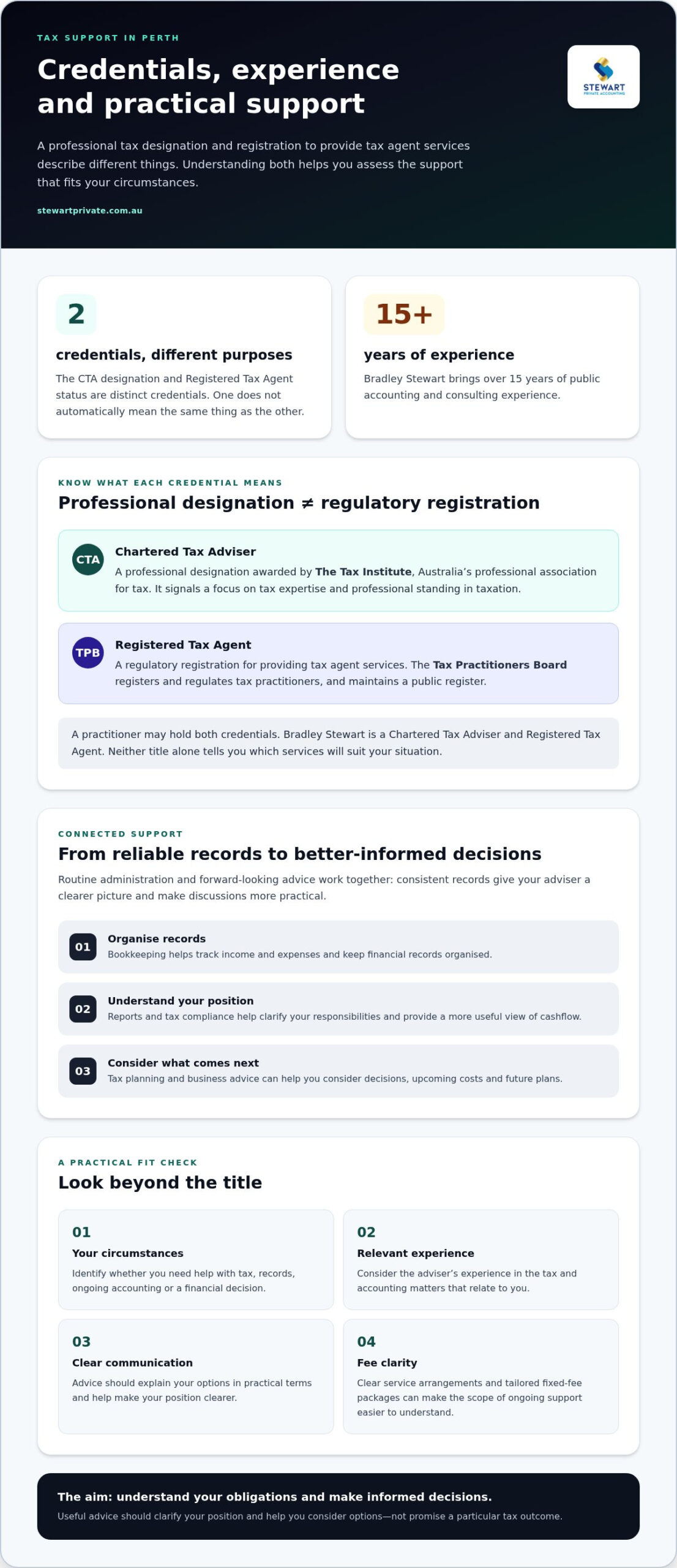
    What if a tax adviser’s professional qualification and their registration to provide tax agent services describe two different things? A search for “chartered tax adviser Perth” support often starts with that question, alongside a practical concern: how can you meet your obligations and make financial decisions with confidence?

    It’s worth looking beyond a title. The right support should pair recognised tax expertise with guidance that’s relevant to your personal or business circumstances. This article explains what the Chartered Tax Adviser designation means, how it differs from Registered Tax Agent status, and what to consider when choosing tax and accounting support in Perth.

    It also looks at how tax planning, bookkeeping and business advice can work together, and why clear service arrangements matter when you’re setting a budget. At Stewart Private Accounting, Bradley Stewart is a Chartered Tax Adviser and Registered Tax Agent with over 15 years of public accounting and consulting experience. This guide will help you understand your options and take a considered next step.

    Key Takeaways

    • Understand how the Chartered Tax Adviser designation differs from Registered Tax Agent status, and why each may matter when seeking tax support.
    • A chartered tax adviser Perth clients work with can connect tax compliance with practical support such as bookkeeping, business advice and tax planning.
    • Assess whether support fits by considering your circumstances, the adviser’s relevant experience, their communication style and fee clarity.
    • Be ready to discuss your business structure, record-keeping and reporting responsibilities so advice can reflect your situation.
    • Bradley Stewart brings over 15 years of public accounting and consulting experience to his work as a Chartered Tax Adviser and Registered Tax Agent.

    What does a Chartered Tax Adviser in Perth do?

    A Chartered Tax Adviser (CTA) is a tax professional who holds a designation awarded by The Tax Institute, Australia’s professional association for tax. In practical terms, a chartered tax adviser Perth clients work with can explain how tax rules relate to their circumstances, support tax compliance and help them consider options for future decisions.

    That support may include clarifying reporting responsibilities, organising tax records or assessing the tax implications of a business or personal decision. Useful advice should make your position clearer, rather than promise a particular tax outcome. For broader context, Taxation in Australia covers the federal and state systems in which this advice sits.

    What does the CTA designation represent?

    The CTA designation is a professional credential associated with The Tax Institute. It signals a focus on tax expertise, but it doesn’t guarantee a particular result or describe every service a practitioner provides. Your needs may extend beyond technical tax advice, so consider the adviser’s relevant experience and whether they explain your options in clear, practical terms.

    For example, a small business owner planning a change may need to understand its tax implications while keeping day-to-day records organised. Clear advice can help them weigh options and plan next steps with a better understanding of their responsibilities.

    How is a Chartered Tax Adviser different from a Registered Tax Agent?

    The distinction is between a professional designation and a regulatory registration. The Tax Institute awards the CTA designation, while the Tax Practitioners Board (TPB) registers and regulates tax practitioners, including registered tax agents. These credentials serve different purposes, and one doesn’t automatically mean the same thing as the other.

    Registered Tax Agent status relates to providing tax agent services under Australia’s regulatory framework. Registration requirements are set by the TPB, which maintains a public register. The CTA designation, by contrast, recognises a person’s professional standing in taxation through The Tax Institute. A practitioner may hold both, as Bradley Stewart does, but neither title alone tells you which services will suit your situation.

    When comparing credentials, consider the whole picture: what you need help with, the adviser’s experience in relevant tax and accounting matters, and how clearly they communicate. A strong working relationship should leave you better equipped to understand your obligations and make informed decisions.

    How a Perth tax adviser can support your business and personal tax needs

    Tax support is most useful when it links the regular work of keeping records and meeting obligations with decisions about what comes next. A chartered tax adviser Perth clients work with can coordinate accounting and taxation support so you can understand your current position and consider the choices ahead.

    Routine administration includes organising financial records, preparing reports and managing tax compliance. Forward-looking advice uses that information to help you consider business decisions, cashflow and tax planning. The two are connected: accurate, consistent records give your adviser a clearer picture and make discussions more practical.

    Support for Perth small and medium-sized businesses

    For a business, support can bring together accounting, tax obligations, bookkeeping and business advice. Well-maintained books help you track income and expenses, while clear reporting gives you a more useful view of cashflow. That visibility can help you plan for upcoming costs and consider how a decision may affect the business.

    Your needs may change as your business develops. A newer business may need reliable bookkeeping and help understanding its reporting responsibilities. An established SME may benefit from advice that takes its current operations and future plans into account. Tax planning can form part of that wider picture, rather than sitting apart from everyday financial management.

    Clear service arrangements matter, too. Tailored fixed-fee packages make the scope of ongoing support easier to understand. For more on this approach, read the guide to fixed-fee accounting support.

    Support for individuals and business owners

    Your personal tax position may connect with your business income, investments or longer-term financial decisions. If you own a business, considering personal and business matters together can help you see how one decision may affect the other. Superannuation strategies may also form part of a broader discussion, depending on your circumstances. They shouldn’t be treated as a promise of a particular result.

    Bradley Stewart’s work brings tax expertise together with practical accounting, bookkeeping and business advice. The Tax Institute is the professional body associated with the Chartered Tax Adviser designation, while day-to-day support still needs to fit each client’s situation. Explore Stewart Private Accounting’s tax and accounting support to see how these services can work together.

    How to assess whether a Chartered Tax Adviser is right for you

    Choosing tax support is about fit, not just credentials. Start by identifying what you need help with: a tax return, ongoing business accounting, clearer records or advice before a financial decision. Then consider whether the adviser has relevant experience, explains matters in plain language and sets out the work and fees clearly.

    The right level of guidance depends on your circumstances. If your needs are straightforward, you may only need focused help with a specific tax matter. If you run a business or have connected personal and business decisions, coordinated accounting, tax and advisory support may be more useful. The aim is to identify the help that’s relevant, not to take on services you don’t need.

    Look beyond the designation

    Consider how an adviser’s experience relates to your situation and whether their explanations help you make informed choices. A clear scope of work should set out the services included and what you can expect, so you share an understanding from the outset. Bradley Stewart brings over 15 years of public accounting and consulting experience. That’s useful context, not a universal benchmark for every client.

    Notice how the adviser responds to your questions. You should be able to understand the advice, the practical steps involved and where a decision may affect your tax position. A strong working relationship depends on clear communication as well as technical knowledge.

    Consider how fees are structured

    A tailored fixed-fee package can make the agreed work and fee easier to understand before you proceed. It can also support more predictable budgeting when the scope reflects your needs. No fee model is automatically right for everyone, and a fixed fee doesn’t mean the same services are included by every practice.

    Compare what’s covered, how additional work is handled and whether the arrangement suits the support you need. For more context, see this guide to accountant costs in Perth. You can also explore the differences between fixed-fee and hourly arrangements as you consider which structure feels clearest for your business.

    For a chartered tax adviser Perth clients can work with confidently, look for relevant expertise, practical communication and a clear agreement that fits your circumstances. Explore Stewart Private Accounting’s tax and accounting support to see how tailored assistance can bring these elements together.

    Chartered Tax Adviser Perth: What to Expect from Expert Tax Support

    What Perth and Western Australian clients should discuss with a tax adviser

    A useful tax discussion starts with your circumstances, not a generic checklist. Your business structure, income sources, record-keeping processes and reporting responsibilities can all affect what needs attention. A chartered tax adviser Perth clients consult can help clarify which matters apply to them and what to prioritise.

    Deadlines and obligations can depend on your circumstances and the type of reporting involved. Before acting on a due date or compliance requirement, make sure the information reflects current Australian Taxation Office (ATO) guidance and your situation. This keeps planning grounded in what applies to you, rather than assumptions based on another business or taxpayer.

    Which records and questions help make an initial discussion useful?

    Bring relevant, current financial records and a short summary of what you want to resolve. The useful information will vary, but you might cover:

    • how your business is structured and how you currently organise financial records
    • which reporting tasks or tax matters you find difficult to manage
    • cashflow concerns or upcoming business and personal decisions
    • questions about your existing bookkeeping and reporting processes

    You don’t need to have every document perfectly organised before seeking guidance. A clear picture of what’s working, what’s unclear and which decisions are approaching gives the conversation a practical starting point. From there, an adviser can help identify relevant priorities and support that fits.

    How can ongoing advice reduce administrative uncertainty?

    Agreed, regular communication can help keep responsibilities visible and address questions as they arise, rather than leaving everything until reporting time. Bookkeeping support can help maintain organised financial records, while accounting and taxation services can help you understand reporting needs and tax matters. If your business has employees, discuss how payroll-related records fit into your overall record-keeping and responsibilities.

    Current, organised records make tax discussions clearer because they give your adviser a more reliable picture of your financial position. That clarity can help focus conversations on what needs attention, whether you’re reviewing reporting processes or considering a business change.

    For practical support with accounting, taxation and bookkeeping, discuss your tax and accounting needs with Stewart Private Accounting.

    Meet Stewart Private Accounting: qualified tax advice with practical support

    For individuals and small to medium-sized businesses, tax advice is most useful when it connects technical knowledge with the practical work of managing finances. Stewart Private Accounting is a Perth-based practice led by Bradley Stewart, a Chartered Tax Adviser and Registered Tax Agent with over 15 years of public accounting and consulting experience.

    That experience sits alongside accounting and taxation services, bookkeeping, business advice and expert tax planning. Bringing these areas together can help you consider routine financial responsibilities alongside the decisions you’re working towards. Support is shaped around your circumstances and the agreed scope, rather than assuming every client needs the same arrangement.

    A tailored approach for Perth businesses and individuals

    Your priorities might include keeping records organised, understanding your tax position or getting a clearer view of your business finances. Stewart Private Accounting tailors support to those needs, with clear communication about the work involved. Tailored fixed-fee packages make the service scope and fees clearer, helping you plan for the agreed support.

    The Trusted Concierge service offers a hands-on approach for clients. The right arrangement depends on your circumstances and priorities. Whether you need a specific accounting or tax service or support across several areas, practical guidance should help you understand your next steps without promising a particular outcome.

    What happens when you start a conversation?

    An initial discussion can focus on your current arrangements, what’s working well and where you’d value support. Explain your business or personal priorities and raise questions about your accounting, tax or bookkeeping needs. This gives the conversation a clear starting point.

    Proposed support should set out the scope of work, responsibilities and fees in a way you can understand. That clarity helps you decide whether the arrangement fits before moving forward. You don’t need to have every question resolved in advance. A considered conversation can help bring the relevant issues into focus.

    If you’re looking for a chartered tax adviser Perth individuals and businesses can turn to for qualified advice and practical accounting support, discuss your accounting and tax needs with Stewart Private Accounting.

    Take the next step with clear, practical tax support

    Choosing a chartered tax adviser Perth clients can work with confidently means looking beyond a professional title. Consider how the adviser’s experience fits your circumstances, whether they explain your responsibilities clearly, and how their services and fees are scoped. A Chartered Tax Adviser designation and Registered Tax Agent status have distinct roles, so understanding both can help you make a more informed choice.

    Good support connects day-to-day accounting and tax compliance with the decisions ahead. Clear, current records help make advice more useful, while tailored fixed-fee packages can make the agreed accounting, tax and advisory support easier to understand and plan for.

    At Stewart Private Accounting, Bradley Stewart is a Chartered Tax Adviser and Registered Tax Agent with over 15 years of public accounting and consulting experience. To discuss support that reflects your priorities, discuss your tax and accounting needs with Stewart Private Accounting.

    A clear conversation can help you identify a practical next step and move forward with greater confidence.

    Frequently Asked Questions

    Is a Chartered Tax Adviser the same as a Registered Tax Agent?

    No. A Chartered Tax Adviser designation is a professional credential associated with The Tax Institute, while Registered Tax Agent status is a registration under Australia’s tax practitioner framework, overseen by the Tax Practitioners Board (TPB). The credentials have different purposes, and neither guarantees a particular result. One person may hold both. Bradley Stewart is a Chartered Tax Adviser and Registered Tax Agent, combining professional tax expertise with registration to provide tax agent services.

    What does a Chartered Tax Adviser do for a small business?

    A Chartered Tax Adviser may help your small business understand tax responsibilities, organise relevant records and consider tax decisions or upcoming obligations. The right support depends on your business and the services agreed. At Stewart Private Accounting, accounting and taxation, bookkeeping and business advisory support can be tailored to client needs. Clear records and relevant advice can help you understand your position, but no particular tax saving or outcome should be assumed without considering your circumstances.

    How do I find a Chartered Tax Adviser in Perth?

    Start by identifying what you need, such as tax compliance, business accounting or ongoing advice. Then consider relevant qualifications and experience, communication style, service scope and fee clarity. You can check tax agent registration through the TPB’s official register and learn about the CTA designation through The Tax Institute. Stewart Private Accounting is a Perth-based practice led by Bradley Stewart, a Chartered Tax Adviser and Registered Tax Agent.

    Can a Chartered Tax Adviser help with tax planning?

    Yes. A Chartered Tax Adviser can provide tax guidance and planning that reflects your circumstances and the services agreed. Useful planning considers current rules, your business or personal objectives and the information available, rather than relying on generic promises of savings. An adviser should explain options and their possible implications in plain language. Check tax requirements and dates against current Australian Taxation Office guidance, as details can depend on your situation.

    Is a Chartered Tax Adviser worth it for a small business?

    It depends on your finances, the decisions you face and how much support you need. An adviser may help bring structure to tax compliance and provide clearer guidance for business decisions, while a smaller or simpler operation may only need focused assistance. Consider relevant experience, communication, responsibilities and fee clarity. A professional designation alone doesn’t determine whether a particular service is right for your business or guarantee a specific outcome.

    What should I prepare before meeting a tax adviser?

    Gather the financial records and recent tax or business documents you have, along with a short list of questions or decisions you’d like to discuss. It can help to outline your business activities, current reporting processes and any upcoming dates you know about. You don’t need to have everything perfectly organised before the conversation. Your adviser can explain what other information would be useful for your circumstances and the support you’re considering.

    How are fixed-fee accounting services different from hourly advice?

    Fixed-fee services set an agreed fee for a defined scope of work, while an hourly arrangement charges according to time spent. Which approach suits you depends on the work required and how clearly it can be scoped. Ask for a plain explanation of what’s included and how additional work is handled. Stewart Private Accounting offers tailored fixed-fee packages for accounting, tax and advisory support, designed to clarify the agreed services and fees.


  • 7 Signs You Need a New Accountant - and How to Decide What Comes Next 7 Signs You Need a New Accountant – and How to Decide What Comes Next - One frustrating interaction rarely tells you it’s time to change accountants. The more useful question is whether the problem keeps…

    One frustrating interaction rarely tells you it’s time to change accountants. The more useful question is whether the problem keeps recurring and whether your accountant takes practical steps to resolve it. The signs you need a new accountant often show up as a pattern: slow or unclear communication, missed follow-through, advice that arrives only when a deadline is close, or support that no longer fits the way your business operates.

    It’s understandable to feel uncertain about what to do next. You may want clearer answers and more help planning for tax and cash flow, without making a major change over one frustrating mistake. This article will help you recognise persistent service problems, raise your concerns and assess whether the response leads to real improvement. You’ll also learn what to look for in accounting support that suits your current needs, and how to decide on a practical next step with a clear head, whether you’re an individual or run a business in Western Australia.

    Key Takeaways

    • Look for recurring service issues rather than deciding based on one late reply or mistake.
    • The signs you need a new accountant may include unclear answers, repeated errors or support that no longer matches your needs.
    • Record what happened and how it affected your obligations or decisions before raising concerns.
    • Use a clear conversation about expectations and responsibilities to assess whether the relationship can improve.
    • When considering a better fit, weigh communication, scope, relevant expertise and planning support; you can check a Registered Tax Agent through the Tax Practitioners Board.

    Signs You Need a New Accountant: When Does a Concern Become a Pattern?

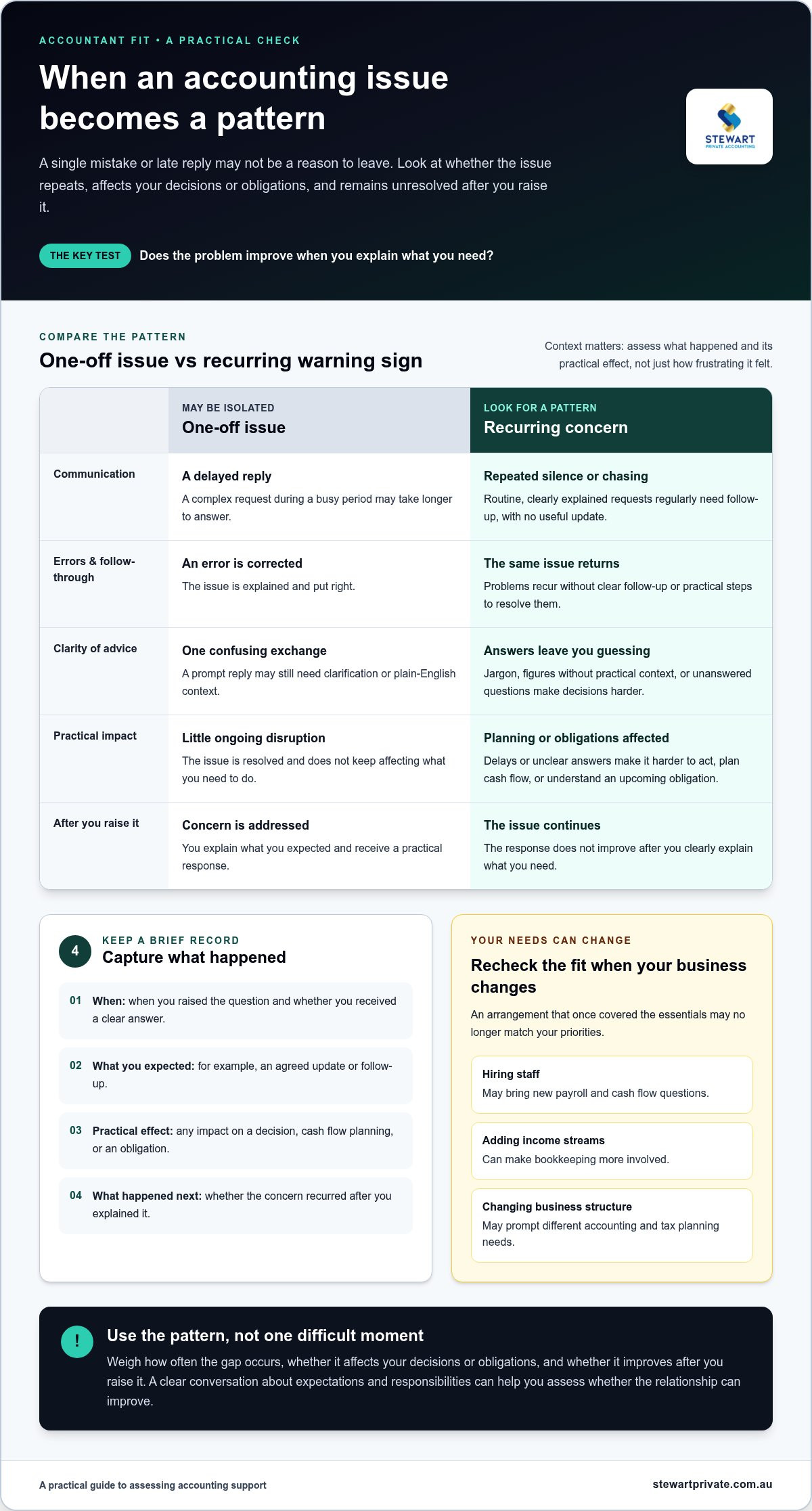
    Reviewing whether your accountant still suits you is a normal part of running a business or managing your finances. Your needs can change over time, and a relationship that once worked well may need to adapt. One late reply or corrected error on its own may not be a reason to leave a long-standing accountant. The more useful question is whether problems repeat, affect your decisions or obligations, and remain unresolved after you raise them.

    Accountants help make sense of financial information and support decisions about what comes next. For a general overview of the profession, Wikipedia explains that Practitioners of accounting are known as accountants. In practice, the value of that support depends on whether it helps with your circumstances and decisions. This checklist is relevant to Australian individuals and small-to-medium businesses, including Perth businesses balancing day-to-day operations with financial planning.

    How to tell a one-off problem from a recurring warning sign

    Context matters. A delayed response to a complex request during a busy period may be different from repeated silence on straightforward questions, especially when you need an answer to make a time-sensitive decision. An isolated error that is explained and corrected is also different from the same issue recurring without clear follow-up.

    Keep a brief record so you can assess what’s happening rather than relying on a general feeling of frustration. Note:

    • When you raised the question and whether you received a clear answer.
    • What you expected, such as an agreed update or follow-up.
    • Any effect on a decision, cash flow planning or an obligation.
    • Whether the concern happened again after you explained it.

    This record isn’t about assuming intent or assigning blame. It helps you distinguish a one-off from a pattern and describe the practical impact calmly. If the issue continues after you’ve raised it clearly, the response is useful information about the relationship.

    Why changing business needs can affect accountant fit

    A business can outgrow an arrangement that once covered the essentials. Hiring staff may bring new payroll and cash flow questions. Adding income streams can make bookkeeping more involved, while a change in business structure may prompt different accounting and tax planning needs. Your priorities may also shift from completing compliance tasks to getting useful guidance for upcoming decisions.

    “Accountant fit means matching your changing needs with consistent, useful support.” If your current service still handles basic bookkeeping or compliance but leaves your newer priorities unanswered, the mismatch may call for a conversation about scope and expectations. Looking at the signs you need a new accountant means weighing the gap, how often it occurs and whether it improves when addressed, rather than reacting to one difficult moment.

    Signs Your Accountant Is Hard to Reach or Leaves You Guessing

    Communication problems matter when they make it harder to manage your finances, not simply because a reply took longer than you hoped. Accountants may have busy periods, and a general query won’t always need the same attention as a deadline-sensitive issue. Consider what you agreed about communication, how often you need to follow up, and whether delays leave you unable to act.

    When slow responses become a meaningful concern

    Ask whether you regularly have to chase routine requests that were clearly explained. One delayed response may have a reasonable explanation; repeated follow-ups with no useful update can become a service concern, particularly if you’re waiting to make a time-sensitive decision or understand an upcoming obligation.

    Consider the effect, too. If you can’t confirm what information is needed, when a task is expected to be completed, or how a financial commitment may affect cash flow, planning becomes harder. Note the date, what you asked, any follow-up and the practical consequence. This helps you describe the pattern accurately without treating every delay as a warning sign.

    When accounting explanations are not helping you decide

    A reply can arrive promptly and still leave you guessing. Repeated jargon, figures without practical context or explanations that don’t answer your question may make it difficult to understand your financial position. You might know a figure has changed, for example, but not what that means for a planned purchase or business decision.

    Ask for the answer in plain English and explain what you’re trying to decide. Then assess whether the response makes the options and relevant figures clearer. Useful accounting advice explains financial choices in terms you can use to make a decision. If the same questions remain unanswered after you’ve clarified what you need, that’s more telling than a single confusing exchange.

    To assess whether communication is a genuine concern, review the pattern against the expectations you and your accountant agreed. Consider whether:

    • Routine, clearly explained requests often require repeated follow-ups.
    • You receive a useful update when a response or task is delayed.
    • Answers address your question and explain what the information means for your next step.
    • Communication improves after you raise the concern directly.

    These are practical signs you need a new accountant to weigh, not an automatic verdict. If the response doesn’t improve, consider what clearer, more hands-on accounting support might look like. For Perth businesses seeking a personal approach, explore accounting and advisory support.

    Signs Your Accountant Is Reactive, Inaccurate or No Longer Suits Your Needs

    Repeated corrections, support that arrives only as a deadline approaches, or advice that no longer fits your business can point to a deeper mismatch. One error that is promptly explained and corrected doesn’t necessarily define the relationship. The concern grows when the same issues return, create extra work or leave you uncertain about what needs attention next.

    Repeated errors and last-minute compliance pressure

    Keep a record of corrections and their practical effects. Note what needed changing, when you raised it, how it was resolved and whether it led to rework, delayed decisions or uncertainty about responsibilities. This creates a fair picture without assuming why an error occurred or drawing conclusions about intent or negligence.

    Also consider whether you receive support only when information is due, rather than enough guidance to prepare in a steady, organised way. Last-minute requests for records, unclear ownership of tasks or recurring gaps in bookkeeping may leave you rushing to assemble information. A single correction or busy period is different from a pattern that repeatedly creates pressure.

    Compliance work focuses on meeting relevant reporting and record-keeping needs. Forward-looking advice uses financial information to help you plan for choices such as managing cash flow or considering a business decision. If you’re unsure about a tax obligation or requirement, check current information from the Australian Taxation Office rather than relying on assumptions.

    When your accountant’s support no longer matches your business

    Your business may have changed since you first agreed on the support you needed. Hiring staff can bring payroll questions; new income streams may make bookkeeping more involved; growth can prompt more frequent cash flow planning. An arrangement focused on routine records or compliance may no longer address the questions you need help with now.

    As business complexity changes, review whether your accounting support still matches the decisions you need to make. Start with a clear conversation about what’s changed and what support would be useful. If the current arrangement doesn’t cover your priorities, the issue may be a mismatch in scope rather than poor service in every area.

    These may be signs you need a new accountant, but assess frequency and impact before deciding. Ask yourself:

    • Are corrections recurring, and do they create repeated rework or uncertainty?
    • Does support arrive early enough for you to prepare, or mainly at the last minute?
    • Have your staffing, income streams or planning needs changed beyond the current support?

    Your answers can help you identify whether a concern calls for clearer responsibilities, a broader conversation about support or a change in accounting relationship.

    7 Signs You Need a New Accountant - and How to Decide What Comes Next

    How to Use This Accountant Checklist Before You Make a Decision

    A checklist is most useful when it helps you make a measured decision, not when it turns every frustration into a verdict. Before deciding whether the signs you need a new accountant are adding up, work through the concerns in order: record what’s happening, assess its impact, raise it clearly, then review the response and any follow-through.

    A practical review process for your accountant relationship

    Start with specific examples rather than a broad conclusion such as “I’m not getting enough support”. Note dates, what you asked or expected, what happened, and how it affected a business or personal decision. Then compare the support you currently receive with your actual needs, including tax, bookkeeping and advisory questions.

    Before speaking with your accountant, decide what a satisfactory resolution would look like. You might want clearer responsibility for providing records, more useful explanations of your financial position or a better understanding of which tasks are included in your arrangement. If fee clarity or scope is part of the concern, this fixed-fee accountant guide for Perth businesses can help you consider what to clarify.

    What a constructive response should help clarify

    Raise your concerns respectfully and focus on what needs to change. A useful discussion should help clarify responsibilities, expectations and next steps. A reassuring promise matters less than a practical plan you can both understand and revisit.

    After the conversation, choose a reasonable review point that suits the issue and any relevant deadlines. There’s no universal timeframe for every concern. Check whether communication, work quality or the agreed support has improved by then. Keep your notes factual, whether the matter is resolved or remains outstanding. That gives you a fair basis for deciding what to do next without assuming one conversation will settle everything.

    If the discussion reveals that your needs have changed, revisit the scope of support you require, such as bookkeeping, tax planning or advice on business decisions. Clear expectations can help you judge whether the relationship is improving or whether a different arrangement may fit better. For accounting and advisory support tailored to your needs, explore support for your business.

    What to Look for in an Accountant Who Fits Your Next Chapter

    A good fit is about more than completing tax and bookkeeping tasks. Look for accounting support that matches the way you operate now, explains financial information clearly and helps you plan appropriately. Accessible communication, a clear scope of work and relevant experience can make it easier to manage routine responsibilities and emerging business questions.

    In Australia, you can check a practitioner’s Registered Tax Agent status through the Tax Practitioners Board. Verify current registration details directly, and consider whether the accountant’s experience and approach align with your needs. The signs you need a new accountant can help you define what isn’t working, but your next choice should be based on the practical support you need going forward.

    Questions that help assess a potential accounting relationship

    Use an initial conversation to understand how the working relationship would operate. Ask how responsibilities are divided, what work is included and how communication is handled. Discuss whether the support can address your current bookkeeping, tax planning or business advice needs.

    Compare how clearly each area is explained, not just how confidently someone describes their service. A useful discussion should leave you with a better understanding of the scope, the way questions are handled and whether the support suits your priorities. Avoid basing the decision on a single promise. Look for a clear, considered fit.

    How steady, personalised accounting support can bring clarity

    For individuals and businesses in Western Australia, Stewart Private Accounting provides tailored fixed-fee accounting, tax and advisory support. Its fixed-fee service packages set predetermined fees for agreed services, helping clarify what the arrangement covers and avoid surprise bills. Services span compliance and bookkeeping to strategic business advice. The practice is led by Bradley Stewart, a Chartered Tax Adviser and Registered Tax Agent, with over 15 years of experience in public accounting and consulting.

    Support that connects compliance with practical questions about cash flow, payroll or business decisions can help you see how accounting work relates to the choices ahead. The right scope depends on your circumstances, so focus on whether the proposed support addresses your current needs and whether the communication feels clear and collaborative.

    If you’re reviewing your accounting relationship and would like to discuss what support could suit your needs, Discuss accounting support for your needs.

    Choose Accounting Support That Moves With You

    The signs you need a new accountant are more meaningful when they form a pattern, affect your decisions and continue after you’ve raised your concerns. Keep the conversation factual, agree on what better support looks like, and review whether communication and follow-through improve. Your needs may change as your business grows, so the right accounting relationship should keep pace.

    For individuals and businesses in Western Australia considering a different approach, Stewart Private Accounting offers tailored fixed-fee accounting, taxation and advisory packages. The practice is led by Bradley Stewart, a Chartered Tax Adviser and Registered Tax Agent with over 15 years of public accounting and consulting experience.

    If you’d like to discuss accounting support that fits your current needs, Discuss accounting support for your needs. A considered next step can bring greater clarity as you plan ahead.

    Frequently Asked Questions

    What are the most common signs you need a new accountant?

    Common signs you need a new accountant include repeated communication delays, answers that don’t address your questions, recurring errors and support that arrives only when a deadline is close. A mismatch can also emerge when your business grows but your accounting support stays the same. Consider how often the problems occur, their effect on your decisions or obligations, and whether they improve after you raise them.

    Should I change accountants if they make a mistake?

    Not necessarily. A single mistake that’s acknowledged, corrected and followed up may not justify ending a long-standing relationship. Look for a pattern instead: repeated corrections, unclear explanations or similar issues continuing after you’ve discussed them. Record what was changed and any practical impact, such as extra work or uncertainty about a decision. This gives you a factual basis for discussing the issue and deciding what to do next.

    How do I know if my accountant is being proactive enough?

    Proactive support helps you understand relevant financial information before a decision or deadline becomes urgent. It might include discussing cash flow, payroll or tax planning in the context of your business, rather than only requesting records when work is due. Consider whether the advice helps you prepare and plan, and whether you know what actions to take. The support should suit your circumstances, not just cover routine tasks.

    Can I talk to my accountant before deciding to leave?

    Yes. A direct, respectful conversation can clarify whether a concern is understood and what can change. Bring specific examples, explain how they affected your work or decisions, and state what support you need. Agree on responsibilities and practical next steps, then review whether the response leads to improvement. You don’t have to decide during that discussion. A considered follow-up can help you assess the relationship more fairly.

    How can I check whether an Australian tax agent is registered?

    You can use the Tax Practitioners Board’s online register to check whether a practitioner is registered as a tax agent. Search using their name or other identifying details, and review the current registration information shown in the register. Checking registration is one part of assessing an accountant’s fit. Also consider whether their experience, communication and agreed services suit your needs as an individual or business in Western Australia.

    Is it a problem if my business has outgrown its accountant?

    Not automatically, but it’s a reason to review whether your current support still fits. Hiring staff, adding income streams or facing new cash flow and payroll questions can change what you need from accounting support. A service that once covered bookkeeping and compliance may not address your current priorities. Discuss the gap and whether the scope can adapt. If it can’t, consider what support would better suit your business now.

    What should I look for in a new accountant?

    Look for clear communication, an understandable scope of work, relevant expertise and support that suits your planning needs. Ask how responsibilities are divided and whether the work can address your bookkeeping, tax planning or business advice requirements. In Western Australia, you can also check a tax agent’s current registration through the Tax Practitioners Board. Stewart Private Accounting offers tailored fixed-fee accounting, taxation and advisory support, led by Bradley Stewart, a Chartered Tax Adviser and Registered Tax Agent with over 15 years of public accounting and consulting experience.

  • How Much Does an Accountant Cost in Perth? A 2026 Guide How Much Does an Accountant Cost in Perth? A 2026 Guide - There isn’t one standard fee for accounting support in Perth. The cost depends on what needs doing and how much…

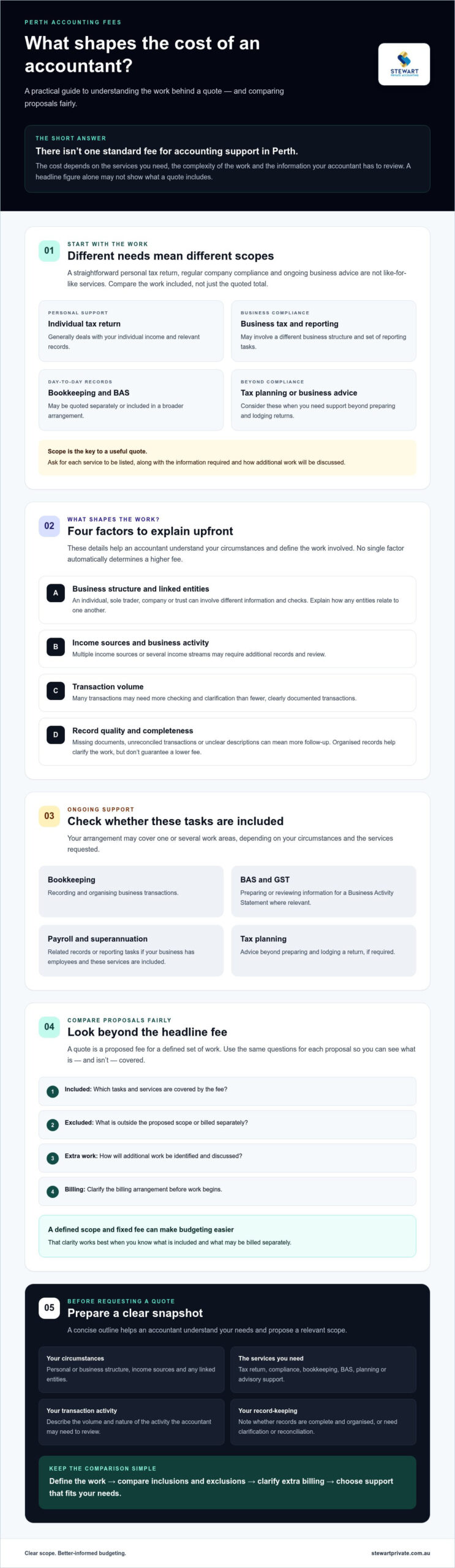
    There isn’t one standard fee for accounting support in Perth. The cost depends on what needs doing and how much work is involved. If you’re asking “how much does an accountant cost in Perth?”, published figures can be a starting point, but they may not show what a quote actually includes. It’s reasonable to want a clear budget before choosing support.

    This guide explains the factors that shape accounting fees, from your personal circumstances or business structure to transaction volumes and the condition of your records. A straightforward tax return and ongoing business support aren’t like-for-like services, so comparing scope matters as much as comparing fees. You’ll learn what details to share when requesting a quote, how to compare proposals and what to ask about billing before work begins. A defined scope and fixed fee can make budgeting easier when you know what’s included and what may be billed separately.

    Key Takeaways

    • To understand how much does an accountant cost in Perth, start by defining the work you need rather than relying on a single average.
    • Your business structure, income sources, transaction volume and record-keeping help shape the scope of a quote.
    • Compare what each proposal includes, excludes and charges for extra work, not just the headline fee.
    • Prepare a clear snapshot of your circumstances and required services before asking accountants for quotes.
    • Choose support that fits your needs, and consider whether bookkeeping, tax planning or advisory help should form part of the arrangement.

    How Much Does an Accountant Cost in Perth? Start With the Work You Need

    There’s no single fee that applies to every Perth client. How much does an accountant cost in Perth depends on the work involved, its complexity and whether you need one-off help or ongoing support. Preparing an individual tax return is a different scope from handling a company’s regular compliance work, and both differ from ongoing business advice.

    An accounting quote is the proposed fee for a defined set of work. Look beyond the total and check which tasks are included, what information the accountant needs from you and how additional work will be discussed. That context makes quotes more useful than a single Perth-wide figure, which can be misleading when firms include different services or clients have different circumstances.

    Which accounting services might your quote cover?

    A personal tax return generally deals with your individual income and relevant records. Business tax and compliance work may involve a different structure and set of reporting tasks. Bookkeeping, which records day-to-day transactions, and preparation of a Business Activity Statement (BAS) may be quoted separately or included in a broader arrangement. Tax planning or business advice may also be relevant if you need support beyond preparing and lodging returns. Ask the accountant to list each service in the proposed scope.

    Qualifications can help you understand who will handle your work and their professional background. If you’re unfamiliar with the designation, read more about what a Chartered Accountant is, then confirm the accountant’s specific qualifications and registration directly.

    Why the same accountant may quote different fees

    The scope changes with the number of connected tasks, the structure involved and the state of your records. An accountant preparing a return from complete, organised information may need to do different work from one who first has to clarify transactions or reconcile incomplete records. Well-organised documents can reduce follow-up, but they don’t guarantee a lower fee.

    Consider two hypothetical Perth clients. A sole trader may need help with business income, expenses and a personal tax return. A company may need its own tax and compliance work, alongside bookkeeping or BAS support. Even if both approach the same accountant, their requirements and records differ, so the proposed work may differ too. A clearly scoped quote helps you understand why, plan for the support you need and ask about unclear inclusions before proceeding.

    What Factors Change Accountant Fees for Perth Individuals and Businesses?

    The work behind a quote depends on more than your location. Your business structure, transaction volume, income sources and record quality all affect what an accountant needs to review and prepare. That’s why the question “how much does an accountant cost in Perth?” is best answered by looking at your circumstances and the exact services you’re requesting.

    How business structure and activity affect the work

    A personal tax return may involve different checks from a sole trader’s business and personal records or a company’s financial and tax information. A trust or several linked entities can add coordination, while multiple income sources may require additional records and review. None of these structures automatically means a higher fee. The relevant consideration is the work required for that specific engagement.

    Business activity matters too. A business with many transactions or several income streams may need more checking and clarification than one with fewer, clearly documented transactions. If you operate more than one entity, explain how they relate when requesting a quote so the accountant can define the scope accurately.

    How records and ongoing tasks influence the quote

    Complete, well-organised records can make it easier to review your financial information. Missing documents, unreconciled transactions or unclear descriptions may require extra follow-up and checking. Good records don’t guarantee a lower fee, but they help an accountant understand the work involved and identify what still needs attention.

    Ongoing requirements can also broaden the engagement. Depending on your circumstances, the quote may need to account for separate work areas such as:

    • Bookkeeping: recording and organising business transactions.
    • BAS and GST: preparing or reviewing information for a Business Activity Statement where relevant.
    • Payroll and superannuation: handling related records or reporting tasks if your business has employees and these services are included.
    • Tax planning: advice beyond preparing and lodging a return, if you need it.

    GST registration, BAS reporting and employment-related requirements depend on your circumstances. Ask which tasks the quote covers, and check current obligations with the Australian Taxation Office (ATO) or your accountant rather than assuming every business has the same requirements.

    In short, fee differences reflect the complexity of the work, the condition of your records and the service scope you agree on. Before proceeding, ask how extra work will be identified and approved. If you’re considering tailored support across accounting, tax or bookkeeping, you can review Perth accounting and tax support as one option.

    How to Compare Accountant Quotes in Perth Without Comparing Apples With Oranges

    The lowest quoted fee isn’t automatically the best-value option. One quote may cover only a tax return, while another includes related reporting or time to discuss your circumstances. To judge whether a proposal suits you, compare the work and service behind the figure, not just the total. That gives you a clearer answer to “how much does an accountant cost in Perth?” for the support you actually need.

    What should an accountant’s quote clearly explain?

    Ask each accountant to describe the agreed work in plain language. Check which returns, lodgements, meetings or reporting tasks are included, what’s excluded and what records the accountant needs from you. Confirm expected timing, how you can contact the accountant and whether the quoted amount includes GST. If something falls outside the agreed scope, ask how it will be priced and whether you’ll be asked to approve it before the extra work begins.

    Use a simple comparison to keep the details side by side:

    scope to comparewhat to confirm
    Included tasksWhich returns, lodgements, meetings or reports are covered?
    ExclusionsWhat work or follow-up isn’t part of the quote?
    TimingWhen must you supply records, and what completion timing is proposed?
    ContactWho is your main contact, and how are questions handled?
    Additional workHow will extra tasks be explained, priced and approved?

    A written scope also helps you spot differences that a headline fee can hide. If one proposal leaves key items unclear, ask for clarification before comparing it with a more detailed quote.

    How fixed fees and hourly billing differ in practice

    A fixed fee sets an agreed amount for defined work, while hourly billing charges for time spent. Neither model is automatically right for every situation. A fixed fee can make budgeting clearer when the scope, exclusions and process for additional work are specific. It isn’t necessarily a saving if the included work doesn’t match your needs. With either arrangement, check what could change the bill.

    For a closer look at how the two approaches compare, read the planned guide to fixed-fee versus hourly accounting. The key is to choose an arrangement you understand, with clear expectations on both sides before work starts.

    How Much Does an Accountant Cost in Perth? A 2026 Guide

    What to Prepare Before Asking a Perth Accountant for a Quote

    A little preparation can help an accountant understand your situation and describe the work a quote would cover. You don’t need to have every detail resolved first. A clear outline of what you know, which records you have and where you need guidance is a useful starting point.

    Information to gather before requesting a quote

    Before contacting accounting firms in Perth or elsewhere in Western Australia, make a short checklist. Share what you can and flag anything you’re unsure about so the accountant can clarify it.

    • 1. Identify the relevant financial year and whether you’re seeking help with a personal return, business requirements or both.
    • 2. Describe your structure and income sources. Note whether you’re an individual, sole trader, company or trust, and outline any other income streams or related entities.
    • 3. Give a sense of your business activity. For a business, describe transaction volume and any regular tasks you need help with, such as bookkeeping or BAS preparation.
    • 4. Gather available records. These might include bookkeeping information, prior tax returns and existing accounting records. Ask the accountant which documents they need before sending sensitive material.
    • 5. List questions about GST, BAS, payroll or superannuation. Explain what applies, if known, and ask the accountant to assess anything you’re uncertain about.
    • 6. State the support you’re seeking. Separate immediate compliance work from any additional tax planning or business advice you’d like to discuss.

    Questions that clarify scope and communication

    Once you’ve shared the outline, ask who will handle the work and how you’ll receive questions or progress updates. Confirm which tasks are included, what falls outside the agreed scope and how any additional work will be explained before proceeding. It’s also sensible to check what information you’re expected to provide and when, so responsibilities and timing are clear.

    Ask how the firm will confirm the final scope and fee arrangement in writing. A clear record of the agreed work gives you a practical reference if your needs change or new tasks arise. It also helps you understand what you’re comparing when you review proposals from different accountants.

    With these details ready, you’ll be better placed to discuss how much does an accountant cost in Perth for your circumstances, rather than relying on a broad estimate that may not fit. To talk through your requirements, contact Stewart Private Accounting. Sharing your structure, records and support needs can help frame a discussion about the work involved, without assuming a particular quote or package.

    Choosing Accountant Support in Perth: From a Clear Quote to Ongoing Confidence

    A suitable accountant’s quote should make it easy to see what work is covered, what you need to provide and how anything outside the agreed scope will be handled. Choose support that fits your circumstances, rather than paying for services you don’t need or relying on a quote that leaves important tasks unclear. This is a more useful way to assess how much does an accountant cost in Perth for your situation.

    You may need help with a personal tax return or a defined piece of business compliance work. If your needs continue throughout the year, it could also be worth discussing bookkeeping, tax planning or business advisory support. Ongoing help isn’t necessary for everyone. The decision depends on your workload, the complexity of your affairs and the level of guidance you want.

    When tailored accounting support may suit your situation

    For an individual, accounting and taxation services may address personal tax needs. For a small business, bookkeeping can help organise financial records, while tax and advisory support may be relevant to broader business requirements. If regular contact would help you keep records and upcoming tasks organised, ask whether the proposed arrangement includes a consistent point of contact and how updates are managed. You can then decide whether ongoing support is useful or whether a one-off service better suits your needs.

    What to expect when discussing services with Stewart Private Accounting

    Stewart Private Accounting is a Perth-based practice led by Bradley Stewart, a Chartered Tax Adviser and Registered Tax Agent with more than 15 years of public accounting and consulting experience. The practice offers accounting, taxation, bookkeeping, business advisory and tax planning, with tailored fixed-fee packages for accounting, tax and advisory support. A fixed-fee approach can help you budget when the agreed work is clearly defined, but confirm the current inclusions and exclusions before proceeding.

    As you discuss your requirements, outline your circumstances and ask which services match the work you need. Confirm how the scope will be documented, what records are required and how the practice will raise any additional work. That conversation can help you make a considered choice without assuming that every client needs the same package or ongoing arrangement.

    If you’re ready to discuss your accounting and tax needs, contact Stewart Private Accounting to talk through your requirements and ask for information about the proposed scope.

    Choose Support That Fits Your Next Step

    There’s no single figure that answers how much does an accountant cost in Perth for every person or business. The fee reflects the work, its complexity, your records and the support included. Before deciding, compare the scope, exclusions and process for approving additional work, then choose a service that matches what you actually need.

    If your requirements extend beyond a one-off task, consider whether bookkeeping, tax planning or business advisory support would help you stay organised. Ongoing support isn’t essential for everyone, but a clearly defined arrangement can make responsibilities and budgeting easier to understand.

    Stewart Private Accounting is a Perth-based practice led by Bradley Stewart, a Chartered Tax Adviser and Registered Tax Agent with more than 15 years of public accounting and consulting experience. The practice offers tailored fixed-fee packages for accounting, tax and advisory services, with scope to discuss based on your needs.

    To talk through your requirements, discuss your accounting needs with Stewart Private Accounting. A clear conversation is a steady first step towards choosing support with confidence.

    Frequently Asked Questions

    How much does an accountant cost in Perth?

    There’s no single fee for every Perth client. How much does an accountant cost in Perth depends on the work you need, its complexity, the quality of your records and whether you’re seeking one-off or ongoing support. Preparing an individual return differs from company compliance or regular bookkeeping. To assess a quote, check its inclusions, exclusions and process for approving additional work, rather than relying on a broad average.

    What factors affect how much an accountant charges?

    An accountant’s fee is shaped by the scope and effort involved. Your business structure, number of entities, income sources and transaction volume can affect how much needs to be reviewed. Missing or unreconciled records may require extra follow-up. Services such as bookkeeping, BAS preparation, payroll or tax planning may also sit outside a basic tax return. Share these details upfront so the accountant can define the work more accurately.

    Is a fixed-fee accountant better than an hourly accountant?

    Neither fee model is automatically better for every client. A fixed fee sets an agreed amount for clearly defined work, which can make budgeting more predictable. Hourly billing charges for time spent, so the final amount can depend on how much work is required. With either arrangement, confirm what’s included, what may cost extra and how additional work will be discussed before it begins.

    How much does an accountant cost for a sole trader in Perth?

    There isn’t one set fee for every sole trader in Perth. The quote depends on factors such as business activity, transaction volume, record quality and whether you need help with bookkeeping or BAS as well as tax work. A sole trader with organised records and a defined request may need a different scope from someone seeking several connected services. Ask for the inclusions and exclusions in writing.

    What should an accountant’s quote include?

    A clear quote should describe the agreed tasks, such as which returns, lodgements, meetings or reports are covered. It should also identify exclusions, what records you need to provide and any relevant timing expectations. Ask how questions will be handled and how extra work will be explained and approved. If anything is unclear, request clarification before engaging the accountant so you can compare proposals fairly.

    Are accounting fees tax-deductible in Australia?

    Fees paid to a registered tax agent for preparing your tax return are generally tax-deductible in the following year, according to the information available for this guide. The treatment can depend on the type of fee and your circumstances, so don’t assume every accounting service is deductible in the same way. Check the Australian Taxation Office guidance or ask your tax agent how to treat your specific expense.

    Can I ask an accountant for a quote before I engage them?

    Yes, you can ask an accountant to outline the proposed scope and fee before deciding to engage them. Provide a concise summary of your financial year, structure, income sources, records and the services you think you need. Ask what documents they require and how they’ll confirm the agreed work. A quote or initial discussion isn’t necessarily free, so check whether any fee applies before proceeding.