

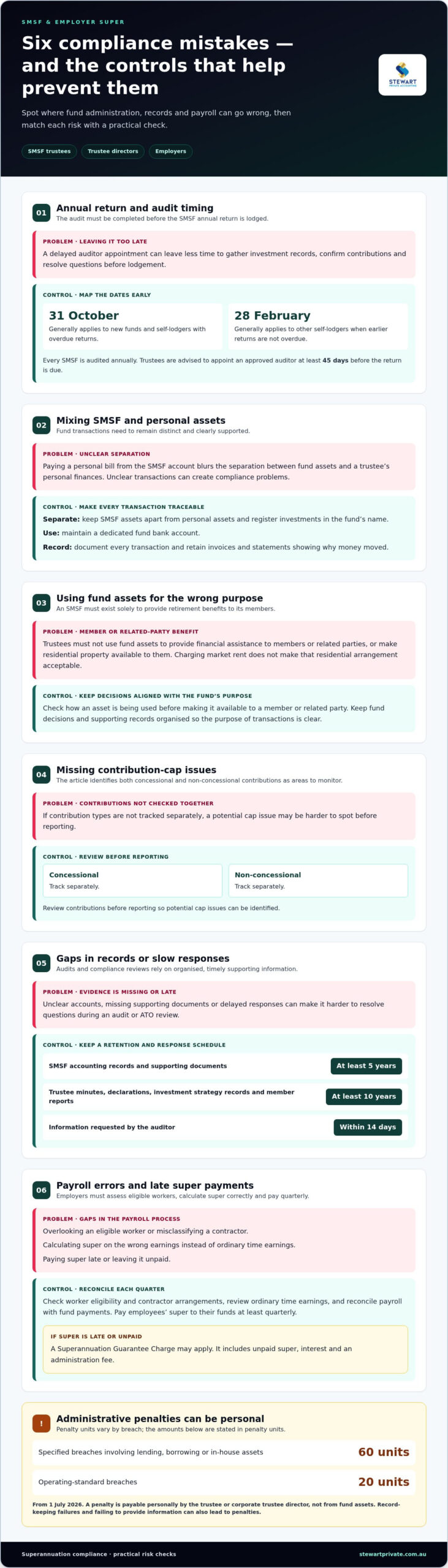
Superannuation compliance mistakes often begin with missed deadlines, incorrect contributions or gaps in fund records. Every SMSF must be audited annually, and the audit must be completed before its annual return is lodged; new funds and self-lodgers with overdue returns generally lodge by 31 October, while other self-lodgers generally have until 28 February. Employers must pay super to employees’ funds at least quarterly, and late or unpaid amounts can lead to a Superannuation Guarantee Charge.
These obligations can feel demanding: SMSF trustees and employers must manage different rules, records and due dates. This guide explains five common superannuation compliance mistakes, including late annual returns, contribution cap breaches, administrative penalties and overdue super payments, so you can see where problems arise and what they may mean for your responsibilities.
You’ll also see how record-keeping, fund decisions and payroll processes fit together. Understanding the rules and the areas that need attention can help you organise your next steps with greater confidence.
Key Takeaways
- Map your SMSF’s annual return deadline early: new funds and self-lodgers with overdue returns generally lodge by 31 October, while other self-lodgers generally have until 28 February.
- Keep SMSF money and assets separate from personal finances, and record fund transactions clearly to support accurate accounts and reporting.
- Track concessional and non-concessional contributions separately so you can spot potential cap issues and review contributions before reporting.
- Understand that SMSF administrative penalties can apply personally to trustees or corporate trustee directors, depending on the type of breach.
- Pay employees’ super by the quarterly due dates; late payments can trigger a Superannuation Guarantee Charge that includes unpaid super, interest and an administration fee.
1. When is the SMSF annual return due?
For an SMSF self-lodger, the annual return is generally due on 28 February if earlier returns aren’t overdue. A new fund or a self-lodger with an overdue return generally has a 31 October deadline. These annual dates give trustees a practical starting point for scheduling accounts, an audit and lodgement.
Every SMSF must be audited annually, and the audit must be finished before the annual return is lodged. Trustees are advised to appoint an approved auditor at least 45 days before the return is due. The auditor examines financial statements and assesses whether the fund complies with superannuation law. Delaying the appointment can leave less time to gather investment records, confirm contributions and resolve questions before lodgement.
Small businesses and household employers follow the same general superannuation framework when they employ eligible workers: calculate super on ordinary time earnings and pay it to the employee’s fund quarterly. The employer’s size or household setting does not remove the need to assess whether a worker is eligible.
When an employee starts a job, the stapled-fund arrangement is intended to keep their existing super account linked, rather than opening a new account automatically. This arrangement began on 1 November 2021; organise the employee’s fund details as part of payroll setup and account for the stapled-fund process where relevant.
Contractor status also needs attention during payroll reviews. The Superannuation Guarantee (Administration) Act 1992 is the legislation cited for determining whether contractors are entitled to superannuation in Australia, according to the Federal Register of Legislation. A contractor paid mainly for their labour may be treated as an employee for super purposes, so assess the actual working arrangement rather than relying only on the contract label.
Keep records ready for both the annual audit and any compliance review. SMSF accounting records and supporting documents generally need to be retained for at least five years. Trustee minutes, declarations, investment strategy records and member reports generally need to be retained for at least ten years. Trustees must provide requested information to their auditor within 14 days.
Set quarterly payroll reminders to check super calculations, employee lists and payment dates. A short, repeatable review can help catch an overlooked worker or a calculation based on total earnings instead of ordinary time earnings. For SMSFs, review the investment strategy at least annually and update it when a member’s circumstances change.
An ATO review or audit is easier to manage when transactions match the fund’s accounts and supporting documents. Keep bank statements, investment records and contribution evidence organised, and resolve discrepancies before lodging the annual return. If an auditor identifies a compliance concern, respond with the relevant records and a clear explanation. Accurate, timely documentation supports the review and helps trustees understand what to do next.
2. What Are SMSF Compliance Mistakes?
SMSF compliance mistakes often happen when trustees treat fund assets, decisions or records as personal matters. Keeping SMSF assets separate from trustees’ personal assets and registering investments in the fund’s name are important parts of sound fund administration. Use a dedicated fund bank account, record every transaction, and retain invoices and statements showing why money moved. For example, paying a personal bill from the SMSF account blurs the separation and can create a compliance problem.
An SMSF must exist solely to provide retirement benefits to its members. Trustees must not use fund assets to provide financial assistance to members or related parties, or make residential property available to them. Charging market rent does not make that residential arrangement acceptable. Illegal early access is another serious breach: a member who accesses super without meeting a condition of release must include the amount in assessable income, even if they later repay it. Additional income tax, shortfall penalties and interest may also apply.
Administrative penalties vary with the breach. From 1 July 2026, trustees or corporate trustee directors may face 60 penalty units for specified breaches involving lending, borrowing or in-house assets; operating-standard breaches may attract 20 penalty units. Record-keeping failures and failing to provide information can lead to penalties. A penalty is payable personally by the trustee or director, not from fund assets.
Common employer superannuation compliance mistakes include overlooking eligible workers, calculating super on the wrong earnings, paying late and misclassifying contractors. Check ordinary time earnings, review employee and contractor arrangements, and reconcile payroll with fund payments each quarter.
ATO compliance support starts with clear records and timely action. Keep accounts, minutes and trustee-change documents organised, and respond to requests for information. An education direction can require a person to complete an approved trustee education course within a set period. It can also require a trustee declaration to be signed or re-signed within 21 days after completing the course.
Before choosing an SMSF, weigh the time required to manage investments, contributions, reporting and trustee decisions against the control you want. ASIC states that SMSF trustees spend an average of more than 100 hours a year managing their fund. If administration competes with your work or retirement planning, compare that commitment with the simpler structure of managed super.
Where fund records, decisions or business arrangements need clearer oversight, business advisory support can help you organise the issues and consider practical next steps.
3. Concessional and non-concessional contribution caps
Contribution caps limit how much can be added to a member’s super during a financial year. Concessional contributions are generally made before tax, while non-concessional contributions come from after-tax money. SMSF trustees need to track both categories because exceeding a cap can create tax consequences and extra administration for the member.
Start a contribution register for each member. Record the date, amount, type and source of every contribution, then reconcile the register with bank statements and fund records. Include employer and personal contributions, and classify each correctly before preparing annual statements. The payment’s label alone does not determine its category: its circumstances and tax treatment also matter.
Caps can depend on the financial year and a member’s circumstances. Before making a large voluntary contribution, review the member’s existing contributions and the cap that applies for that year. Check whether earlier payments, employer contributions or other contributions have already used part of the available limit. Planning voluntary contributions early gives trustees more time to spot a potential excess and adjust planned payments. Early timing does not remove the need to check the cap.
For example, before making a personal contribution near year-end, compare the proposed amount with the fund’s contribution register and available statements. Confirm when the payment will be received and recorded, then retain evidence of its source and intended treatment. If a member has more than one super fund, contributions across those funds may affect their overall position, so do not assess the SMSF’s records in isolation.
Contractor classification can affect employer contributions and a worker’s contribution picture. A contractor paid mainly for personal labour may be entitled to super, even if their agreement calls them an independent contractor. The Superannuation Guarantee (Administration) Act 1992 is cited for determining contractor entitlement in Australia, according to the Federal Register of Legislation.
Assess the working arrangement, not just the contract title. Indicators include payment for personal effort or skills, payment by the hour or task rather than for a result, and limited ability to delegate the work. A business that overlooks an eligible contractor may also miss required super contributions. Review contractor arrangements when duties, payment methods or control over the work change.
Trustees can reduce errors by matching contribution records with bank transactions and member statements before finalising the annual accounts. Keep notes explaining unusual payments, corrections and refunds. If an amount appears misclassified or close to the applicable cap, pause further voluntary payments while you establish the member’s contribution position and correct the fund’s records.
4. Who pays SMSF administrative penalties?
For an SMSF administrative penalty, the trustee or responsible corporate trustee director pays personally. The fund’s assets cannot be used to pay or reimburse that penalty. This separates individual accountability from the SMSF’s finances, so trustees should treat a notice as a personal liability and respond with accurate records.
The penalty depends on the conduct. From 1 July 2026, specified breaches involving lending, borrowing or in-house assets may attract 60 penalty units. Operating-standard breaches may attract 20 penalty units, while failures involving accounts, minutes or trustee-change records may attract 10. Failing to provide information to the regulator may attract 5 penalty units. From 1 July 2026, each penalty unit is A$364.
For example, a 60-unit penalty is A$21,840 from 1 July 2026. That amount is payable by the relevant trustee or director, not from the super fund. Trustees should identify who received the notice, the conduct cited and the response deadline, then assemble the records that explain the fund’s actions.
Employers face a separate exposure when they fail to meet Superannuation Guarantee obligations. The ATO can impose penalties of up to 200% of the Superannuation Guarantee Charge. The charge includes unpaid super, interest and an administration fee, must be lodged with the ATO, and isn’t tax-deductible. Under the Superannuation Guarantee (Administration) Act 1992, it includes a A$20 charge per employee per quarter and interest at 10 per cent per annum from the start of the relevant quarter.
Payroll records show how an employer calculated and paid super. Keep employee details, ordinary time earnings calculations, contribution records and payment evidence together, then reconcile them with payroll reports. Provide required information when the ATO requests it. A clear record trail makes it easier to explain an apparent shortfall or correct an error.
ATO enforcement may involve directions as well as penalties. Failing to comply with an SMSF rectification direction is an offence of strict liability. Treat a direction as a formal requirement: record the action needed, assign responsibility and retain evidence that the fund completed the rectification.
A serious breach can have consequences beyond an administrative penalty. The outcome depends on the breach and the applicable process; an offence of strict liability is distinct from an administrative penalty. If a trustee receives a notice or direction, a prompt response with relevant records can clarify the fund’s status and the action required.
5. Late super payments and the Superannuation Guarantee Charge
Australian employers generally calculate super at 11% of employees’ ordinary time earnings and pay it to their super funds quarterly, by the ATO’s due dates. A payment that misses its due date can trigger the Superannuation Guarantee Charge (SGC), even if the employer later pays the super directly to the fund.
The SGC is a tax imposed on employers who fail to pay the Superannuation Guarantee. It must be lodged with the ATO and is not tax-deductible. Its components include the unpaid super, interest and an administration fee.
A late payment can therefore cost more than the original contribution. For example, if an employer misses a quarterly payment for an eligible employee, the outstanding super remains part of the calculation, alongside applicable interest and the administration fee. Paying the employee’s fund later does not remove the need to lodge and pay the SGC.
To address a missed payment, identify the affected employees and quarter, calculate the shortfall, then prepare and lodge the required SGC statement with the ATO. Keep the payroll calculations, payment records and statement together. Clear records help explain how the amount was calculated and show what the employer has paid or still owes.
Unpaid SGC can remain outstanding and be subject to ATO collection. As at 30 June 2021, Australian employers owed A$2.9 billion in unpaid SGC. On average, 55% of SGC raised was collected over the four years to 2020–21. These historical figures show why a lodged statement and a payment plan, where arranged with the ATO, are distinct steps from simply correcting payroll.
Set up a consistent quarterly process to prevent repeated delays. Set a reminder before each due date, check employee lists and ordinary time earnings, then reconcile payroll with fund payment confirmations. Review the process when staffing, pay arrangements or payroll systems change. Regular checks can catch a missing employee or incorrect calculation before payment becomes overdue.
Document the process. Save each quarter’s calculations, payment confirmations and any SGC statements, and record who reviewed them and when. If a discrepancy appears, isolate the affected period and correct the records before submitting a statement. This gives the ATO a clearer account of the shortfall and helps the business track any amount still unpaid.
If payroll reconciliations are difficult to maintain, use bookkeeping support for payroll records to organise the checks and payment documentation.
Stewart Private Accounting: Accounting & Taxation Services
Stewart Private Accounting can help organise the accounting and record-keeping behind your business and tax obligations. Its Accounting & Taxation Services and Bookkeeping Services support well-maintained financial records, while Business Advisory Services can help you review business processes and plan practical next steps. Expert Tax Planning can also help you consider tax obligations as part of broader financial decisions.
If payroll reconciliations, contribution records or tax reporting are becoming difficult to manage alongside daily operations, it may be time to seek support. The right assistance can help you understand your records and organise your responsibilities, without losing sight of your business priorities.
Contact Stewart Private Accounting to discuss your accounting and bookkeeping needs.
Build a steadier compliance routine
Strong superannuation processes are part of everyday business habits, not tasks to leave until reporting deadlines approach. Assign responsibility for reviewing payroll and financial records, document decisions, and include compliance in regular planning. This can help you spot superannuation compliance mistakes earlier and respond with well-organised information.
As your business changes, your processes may need to change too. New employees, different contractor arrangements or updated payroll workflows can affect how you manage super obligations. Regular reviews help keep records aligned with how the business operates and provide a clearer basis for decisions.
Stewart Private Accounting offers Accounting & Taxation Services, Bookkeeping Services and Business Advisory Services to support your financial organisation and planning. If you’re ready to discuss a practical next step, contact Stewart Private Accounting. A calm, consistent approach can make the responsibilities easier to manage.
Frequently Asked Questions
What Are SMSF Compliance Mistakes?
SMSF compliance mistakes are actions or omissions that put a fund’s legal and administrative obligations at risk. Examples include mixing fund and personal transactions, failing to document investment decisions, misclassifying contributions or accessing super before a condition of release is met. For instance, paying a personal expense from the SMSF account can make it harder to show that fund money was used appropriately.
How does the ATO find SMSF breaches?
The ATO can identify potential breaches through annual return information, audit findings and records requested during compliance activity. An SMSF auditor examines financial statements and assesses compliance with superannuation law, providing relevant information to the ATO when a contravention is reported. Differences between fund records, reported information and transaction evidence can raise questions, so trustees should retain documents explaining unusual payments or investment decisions.
What Happens If You Get It Wrong?
The outcome depends on the breach and its effect on the fund or member. Trustees may face personal administrative penalties, while a fund that becomes non-complying is taxed on its assessable income at 45%. A member who illegally accesses super must include the amount in assessable income, even if they repay it later. Additional income tax, shortfall penalties and interest may also apply to that member.
What are the key annual deadlines?
For SMSF self-lodgers, the annual return is generally due by 28 February if returns aren’t overdue. A new fund or a self-lodger with an overdue return generally has a 31 October deadline. The annual audit must be completed before lodgement, so trustees should allow time to prepare accounts and answer auditor questions. Auditor appointment is advised at least 45 days before the return is due.
What happens if the auditor reports a breach?
A reported contravention can lead to ATO follow-up, including a request for information or a direction to rectify the issue. Trustees must provide requested information to their auditor within 14 days. If the ATO issues a rectification direction, keep evidence of the steps taken and the date completed. Failing to comply with an SMSF rectification direction is an offence of strict liability.
When is the SMSF annual return due?
The usual deadline depends on the fund’s lodgement history and who lodges its return. A self-lodging fund with no overdue return generally lodges by 28 February; a new fund or a self-lodger with an overdue return generally lodges by 31 October. The audit must be finished first. An annual return submitted without auditor details will be suspended and won’t be recognised as lodged.
Who pays SMSF administrative penalties?
The trustee or corporate trustee director responsible for the relevant breach pays an SMSF administrative penalty personally. The fund cannot pay or reimburse that penalty from its assets. The penalty amount depends on the breach category. From 1 July 2026, penalty units are valued at A$364 each, with specified breaches attracting different numbers of units. Trustees should identify the breach and responsible person when reviewing a notice.
What penalties and charges apply for late or underpaid super guarantee contributions?
Late or unpaid super can trigger the Superannuation Guarantee Charge, which includes the shortfall, interest and an administration fee. It must be lodged with the ATO and isn’t tax-deductible. The charge also includes A$20 per employee per quarter and interest at 10 per cent per annum from the start of the relevant quarter. The ATO can impose penalties of up to 200% of the charge.