

What if your bookkeeping and payroll processes could do more than keep routine admin up to date? For a growing business, dependable bookkeeping and payroll services Perth owners can use bring financial records and pay information into an organised routine, giving you clearer oversight and more time to focus on running the business.
Financial administration is easier to manage when records are current, payroll processes are consistent and everyone understands their responsibilities. This guide explains what bookkeeping and payroll support can involve, how to assess the right scope and communication routines, and what to prepare before work begins.
Stewart Private Accounting is a Perth-based practice led by Bradley Stewart, a Chartered Tax Adviser and Registered Tax Agent with more than 15 years of public accounting and consulting experience. Its tailored fixed-fee packages bring clarity to agreed services, including bookkeeping connected with accounting, taxation and business advice. Accurate records can support tax compliance and more informed business decisions as your Western Australian business grows.
Key Takeaways
- Distinguish bookkeeping from payroll administration and identify which recurring tasks are taking time away from running your business.
- Use consistent records, clear responsibilities and appropriate access to support payroll administration and more useful accounting discussions.
- Compare in-house, outsourced and blended support by considering workload, staff capacity, continuity and oversight.
- Prepare for bookkeeping and payroll services Perth businesses use by organising records, agreeing responsibilities and setting communication routines.
- See how Stewart Private Accounting connects bookkeeping with broader accounting and advisory support, led by Bradley Stewart, a Chartered Tax Adviser and Registered Tax Agent with more than 15 years’ experience.
What bookkeeping and payroll services in Perth can take off your hands
Serving customers, managing staff and keeping financial records current can pull you in several directions. Receipts, invoices and employee pay details are easy to put off when the day gets busy, but delays can make routine reporting harder. A regular process for organising records helps you spend less time catching up and gives you clearer information to work with.
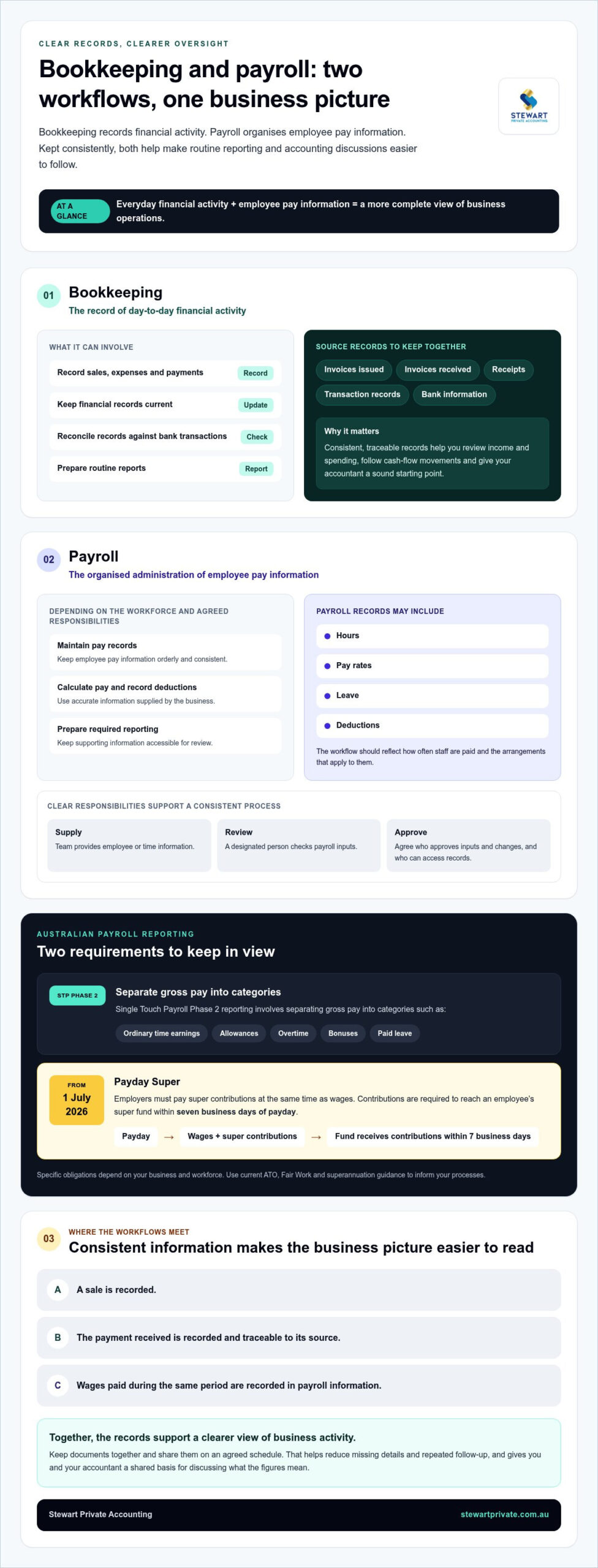
Outsourced bookkeeping and payroll support is an arrangement where an external professional helps organise a business’s financial records and administer employee pay information, with responsibilities agreed between the business and the provider. Bookkeeping records financial activity, while payroll focuses on employee pay and related records. They are separate tasks, but reliable information in both areas contributes to a more complete view of business operations.
What does small-business bookkeeping usually involve?
Bookkeeping means organising and recording everyday financial activity, including sales, expenses and payments, and keeping those records current. The work can also include reconciling records against bank transactions and preparing routine reports. Accurate source records do more than keep paperwork in order: they help you understand what has happened in the business and give your accountant a sound starting point.
For a foundational explanation, What is bookkeeping? outlines the practice and its role. In day-to-day business, consistent records help you review income and spending, follow cash-flow movements and discuss changes in trading activity. They also make it easier to look at the figures behind a decision rather than relying on memory. Learn more about bank reconciliation services and how they help verify recorded transactions against bank statements.
Where does payroll fit into business administration?
Payroll is the organised recording and administration of employee pay information. Depending on the workforce and agreed responsibilities, the process can involve maintaining pay records, calculating pay, recording deductions and preparing required reporting. Your business needs to provide accurate information and set clear approvals. The workflow should also reflect how often staff are paid and the arrangements that apply to them.
Australian payroll includes reporting and superannuation requirements. Single Touch Payroll Phase 2 reporting involves separating gross pay into categories such as ordinary time earnings, allowances, overtime, bonuses and paid leave. From 1 July 2026, Payday Super requires employers to pay super contributions at the same time as wages, with contributions required to reach an employee’s super fund within seven business days of payday. Orderly employee records and a reliable pay cycle are important parts of managing these requirements.
For a growing business, bookkeeping and payroll services Perth owners rely on can connect routine records with reporting and accounting discussions. The right workflow depends on your business and workforce. Clear records give you a firmer basis for understanding financial activity and planning what comes next.
How bookkeeping and payroll connect to clearer business records
Bookkeeping and payroll are more useful when their information can be considered together. A recorded sale, the payment received and wages paid during the same period each contribute to the picture of business activity. Consistent records make routine reporting easier to interpret and give you and your accountant a shared basis for discussing what the figures mean.
Timely bookkeeping improves visibility by keeping financial activity organised and current.
In Australia, bookkeeping can help organise information for obligations such as GST and Business Activity Statement (BAS) reporting, as well as PAYG withholding records. Payroll information also relates to Single Touch Payroll (STP) reporting and applicable Fair Work and superannuation requirements. Specific obligations depend on your business and workforce, so use current ATO, Fair Work and superannuation guidance to inform your processes.
Which records help keep bookkeeping work organised?
Common source records include invoices issued and received, receipts, transaction records and bank information. Keep documents together and share them on an agreed schedule to reduce missing details and repeated follow-up. For example, a consistent process for submitting supplier invoices makes it easier to have them available when transactions are recorded and reviewed.
Good records also let you trace a figure back to its source. That context is useful when a transaction needs clarification or your accountant is reviewing information for a BAS, tax matter or business discussion. The goal is not just to collect documents, but to make the financial story easier to follow.
What should payroll records support?
Payroll records should provide an orderly account of employee pay information and be maintained consistently. Depending on the workforce, relevant details can include hours, pay rates, leave and deductions. Keeping supporting information accessible helps the business review pay records and work through related reporting in line with applicable Fair Work, ATO and superannuation requirements.
Clear responsibilities are essential. Your team might supply employee or time information, while a designated person reviews and approves payroll inputs before processing. Agree who can access records, who approves changes and where final information is kept. These controls support continuity and help avoid uncertainty if someone is away or a pay detail needs to be checked.
Delegating routine tasks does not mean giving up oversight. As the owner, retain access to records and understand who supplies information, who approves it and who follows up on discrepancies. A defined process connects the day-to-day work to broader accounting support. Dependable records give your accountant a coherent basis for discussing reporting, tax matters and business performance.
For Perth SMEs, bookkeeping and accounting support connects routine records with accounting and advisory conversations. Keeping underlying information organised helps you retain oversight of the decisions and approvals involved in running your business.
In-house or outsourced bookkeeping and payroll: how to assess the fit
There is no single arrangement that suits every Perth SME. The right fit depends on how often tasks need attention, who has the time and capability to manage them, and how closely you want routine records connected to accounting support. Consider the recurring workload, not just busy periods. Transactions, staff changes and payroll tasks still need clear ownership when the usual person is away.
Use this comparison to weigh the trade-offs. The details vary between businesses, but responsibility, oversight and continuity matter under each model.
| Consideration | In-house | Outsourced | Blended |
|---|---|---|---|
| Responsibilities | Staff manage the agreed tasks internally. | An external professional handles agreed recurring work. | Internal staff and external support share defined tasks. |
| Owner involvement | Direct oversight, with staff time needed for coordination. | Oversight through access, approvals and agreed communication. | Owner coordinates both internal and external responsibilities. |
| Continuity | May depend on staff availability and documented processes. | Routines are agreed with the external support relationship. | Can distribute tasks, provided handovers are clear. |
| Scope | Set by internal roles and capacity. | Set by the agreed service scope. | Divided between internal work and agreed external support. |
Delegating tasks does not mean giving up control. Agree who provides records, who approves payroll information, what access each person needs and how exceptions are raised. A blended approach can suit a business that wants to retain some knowledge in-house while assigning recurring tasks elsewhere. Document handovers to avoid unclear responsibilities or duplicated effort.
When might outsourced support suit a Perth SME?
Outsourcing is worth considering when bookkeeping competes with customer service or staff management, or when records are difficult to maintain consistently. A defined working relationship establishes who handles recurring tasks and how information moves between your business and its accounting support. It also lets you set a scope around your needs instead of assuming every business requires the same assistance.
What should a service scope make clear?
Before work begins, list the tasks included, the records your business supplies, approval responsibilities and communication routines. Tailored fixed-fee arrangements make the agreed scope clear, while the work itself should reflect your business’s needs rather than assumed inclusions. For a fuller discussion of fees and scope, see this guide to choosing a fixed-fee accountant.
When comparing bookkeeping and payroll services Perth businesses can use, look for a structure that links recurring administration with accounting oversight and makes your role clear. Stewart Private Accounting provides tailored support for SMEs, connecting bookkeeping with accounting and advisory services. Explore Stewart Private Accounting’s business support to see how this fits into broader financial administration.
How to prepare your Perth business for bookkeeping and payroll support
Starting bookkeeping and payroll support is easier when you can explain how work currently gets done, even if some records are incomplete. You do not need to make everything perfect before discussing support. A clear picture of what is up to date, what is outstanding and where information is stored gives the working relationship a practical starting point.
Use this sequence to prepare:
- Identify your needs. List the recurring bookkeeping and payroll tasks you want help with, including periods when the workload becomes harder to manage.
- Gather available records. Collect financial documents, employee pay information and previous reporting relevant to the work.
- Agree responsibilities. Set out who supplies information, who reviews it and who approves changes or completed work.
- Set communication routines. Decide how records will be shared, how often you will check in and how questions or exceptions will be raised.
What should you organise before onboarding?
Bring together what is available instead of delaying the conversation until every file is complete. A short list of outstanding tasks, recurring deadlines and your current record-keeping routine helps clarify priorities. If information is missing, delayed or inconsistent, note that and explain what you know. Gaps provide useful context for planning the work.
A simple checklist can help you prepare:
- Business transaction records, invoices, receipts and bank information
- Available payroll records and employee pay information
- Previous BAS, GST, PAYG withholding or other relevant reporting records
- A list of tasks that are incomplete or need follow-up
- Known recurring deadlines and the people currently involved
- A brief description of how records are collected, stored and shared
Keep this information in its existing format for now. The aim is to provide context about your processes and available records, not to start a software migration or undertake a detailed reconciliation before support begins.
How can responsibilities and communication stay clear?
Agree who prepares and provides information, who checks it and who gives final approval. Clarify how questions will be handled, where supporting records should be sent and what to do when information arrives late or does not match. A consistent schedule for sharing records and addressing exceptions keeps expectations visible.
Identify a main contact in your business and a suitable back-up. This means routine work is less dependent on one person’s memory, and any handover has a clear point of reference. For guidance on organising financial records, explore this bank reconciliation and ledger management guide.
Preparing for bookkeeping and payroll services Perth businesses need starts with a straightforward conversation about workload, records and preferred communication. Stewart Private Accounting provides tailored support for SMEs, with the agreed service scope shaped around the business. Discuss bookkeeping support for your business to set priorities and responsibilities.
Bookkeeping and payroll support with Stewart Private Accounting
Stewart Private Accounting is a Perth-based accounting and advisory practice supporting small and medium-sized businesses. Its bookkeeping and payroll support connects day-to-day financial administration with accounting, taxation and business advice.
The practice is led by Bradley Stewart, a Chartered Tax Adviser and Registered Tax Agent with more than 15 years of public accounting and consulting experience. That background brings practical perspective to how records inform discussions about tax, reporting and your business’s financial position. Support is tailored to your business rather than delivered as a one-size-fits-all arrangement.
A connected accounting relationship for business owners
Bookkeeping records are more useful when they inform the wider financial picture. Organised transaction and payroll information, for example, can give your accountant context when discussing reporting requirements or tax planning. It can also help ground conversations about business activity and priorities. For a broader view of how strategic guidance can complement routine financial administration, explore this business advisory guide for owners.
Stewart Private Accounting brings bookkeeping together with accounting and taxation, business advisory and expert tax planning where relevant to the agreed scope. Clear information supports those discussions, while you remain involved in decisions and approvals. Organised records provide a practical basis for working through financial matters with professional support.
For Perth businesses considering bookkeeping and payroll services Perth, clarity about the working relationship matters as much as clarity about the records. Tailored fixed-fee packages make agreed services clear and avoid surprise bills. The scope is shaped around the support agreed for your business, rather than assuming every package includes the same tasks. This makes it easier to understand what work is covered and how it relates to your broader accounting needs.
What is the next step for your business?
Start by noting which routine tasks compete for your time, what records are available and where support would help. You might need help keeping bookkeeping current, organising payroll administration or connecting routine financial work with accounting and tax discussions. A clear outline makes it easier to agree on a suitable scope and responsibilities.
Stewart Private Accounting tailors fixed-fee services to agreed business needs. You do not need every record in perfect order before starting a conversation. A straightforward picture of what is working and what needs attention is a useful starting point.
Ready to discuss a suitable arrangement? Discuss bookkeeping and payroll support with Stewart Private Accounting.
Make space for the next stage of your business
As your business develops, its financial routines may need to change too. Consider which tasks should remain with you, where shared support could help and what information would make day-to-day decisions easier. Start with the pressure points affecting your time and confidence now, rather than trying to map every future need.
The right bookkeeping and payroll services Perth arrangement should make responsibilities clearer and fit how your business operates, while allowing the agreed scope to evolve with your needs. Treat the first conversation as a chance to set priorities, not a commitment to have every process perfected. Clear expectations give you a considered starting point for building reliable routines.
When you are ready, outline the tasks you would like help with and the records or processes you want to organise. Discuss a suitable support arrangement with Stewart Private Accounting and take a practical next step towards clearer financial administration.
Frequently Asked Questions
Is bookkeeping the same as payroll?
No. Bookkeeping tracks a business’s financial activity, such as sales, supplier payments and expenses. Payroll focuses on employee pay information and the records associated with paying staff. The processes can share information, but they have different purposes. For example, wages recorded in payroll should also appear in the business’s financial records, so the figures can be considered together during reporting and accounting reviews.
Can a bookkeeper help a Perth business prepare for BAS reporting?
Yes. Bookkeeping can organise transaction records and supporting documents relevant to a Business Activity Statement (BAS), including information used to work out GST and PAYG withholding figures. Keep invoices and receipts easy to trace to recorded transactions, then review unclear items before reporting. Who prepares or lodges a BAS depends on the agreed responsibilities and the credentials required for that work.
How often should a small business update its bookkeeping?
Choose a rhythm that keeps pace with your activity and reporting needs. A business with regular sales, supplier bills and staff payments may find weekly updates useful, while a quieter operation may review records monthly. Avoid leaving a long gap that makes transactions harder to identify. Set a recurring time to record activity, check for missing documents and review upcoming reporting tasks.
Can outsourced bookkeeping work if I want to keep control of my finances?
Yes. Outsourcing tasks does not require you to give up financial oversight. Agree which work is delegated, who approves payments or payroll changes, and how you will access reports and supporting records. For example, someone might organise transactions while you review a monthly summary and approve exceptions. Clear permissions and regular communication help you stay involved in decisions without handling every routine task yourself.
What records should I organise before bookkeeping support begins?
Gather what you can from the current and previous reporting periods: sales and supplier invoices, receipts, bank statements or transaction records, payroll information, and prior BAS or tax records relevant to the work. Note where documents are stored and what remains outstanding. If a document is missing, mark it as missing rather than trying to reconstruct it from memory. This helps identify what needs follow-up.
Can a bookkeeping service help if my business records are behind?
Bookkeeping support can help bring overdue records into a more organised state, depending on the agreed scope and the information available. Start by noting which periods need attention and whether key documents, such as invoices or bank records, are missing. Avoid guessing figures to make the books appear complete. A clear account of what is available and what needs investigation gives the work a sound starting point.
Does a small business need separate bookkeeping and payroll providers?
No, separate providers are not essential. A business can use one service relationship for connected tasks or divide responsibilities between internal staff and external support. The right fit depends on workload, expertise and how information will pass between everyone involved. If responsibilities are split, document who maintains pay records, who records the related costs and who reviews information for reporting, reducing the risk of gaps or duplicated work.