

What if your latest profit figure is accurate, but still doesn’t explain why cash feels tight or which part of the business needs attention? Business performance review services should connect the numbers to the decisions behind them, so you can see what’s working and where a change may help.
Financial reports show what happened, but they don’t always explain why. Choosing useful measures can be difficult, too. Even a clear finding has limited value if it doesn’t lead to a practical decision or action.
This article explains what a business performance review can examine, how to interpret results against your goals and business conditions, and how to turn findings into manageable priorities. You’ll also see how collaborative business advisory support can help you follow through, with tailored fixed-fee packages offering clarity around fees for Perth and Western Australian businesses.
Key Takeaways
- Use business performance review services to connect financial results with business goals and the decisions they inform.
- Choose a focused set of measures that answers your key business questions, then compare results with relevant goals or past periods.
- Understand how report-only, owner-led and adviser-supported reviews differ in the context and follow-through they provide.
- Prepare current reports, relevant plans and notes on recent changes to make your review more useful.
- Turn findings into a short action plan, and use accounting, bookkeeping and advisory support to help keep priorities on track.
What do business performance review services help an SME understand?
Business performance review services give you a structured way to examine results, business goals and the decisions those results inform. The aim isn’t simply to collect figures. It’s to understand what may be driving them, whether they point to progress or a concern, and what deserves attention next. For an SME owner, that context can make financial information more useful in day-to-day decisions.
A performance review interprets your business results; bookkeeping records them, while tax compliance meets reporting obligations. These activities provide an important foundation, but they don’t necessarily explain why sales have changed, whether an expense is delivering value or how current results compare with your plans.
What does a business performance review examine?
A review can consider financial results alongside operating priorities and business goals. Depending on the question, that might mean looking at revenue and expenses alongside sales activity, staffing needs, customer demand or progress on a planned investment. Focus on measures that help explain your position, rather than including figures simply because they’re easy to report.
The scope should reflect your business, the decisions you’re facing and the records available. A retailer considering a new location may want to understand how current sales and costs support that decision. A trades business may be more focused on whether a busy workload is translating into healthy cash flow. A framework such as Business Performance Management (BPM) places performance information in the context of goals and management decisions.
For example, imagine a Perth café sees sales rise but has less cash available than expected. Rather than treating higher sales as the whole story, a review could prompt practical questions: have costs also increased, are customers paying later, or has the business committed to new equipment? The figures help identify what to investigate before the owner decides how to respond.
A management review is not an audit or audit assurance. It interprets business information to support decisions; it does not provide an independent audit opinion.
When might a business owner seek a review?
You might find a review useful when considering growth, responding to a change in results, deciding where to direct staff or funds, or checking progress towards your plan. It can also help when a familiar measure shifts unexpectedly and you need to understand whether that reflects a temporary change or a pattern worth addressing.
Regular reflection can help you notice changes while there’s still time to consider your options. You don’t need to follow a fixed schedule: time the review around the decisions your business is making and the information available to support them.
If you already receive financial reports but still feel unsure about your next priority, more data may not be the answer. A focused review can bring relevant results together, clarify what they suggest and help you decide which action is practical for your SME now.
How should business performance review services assess results?
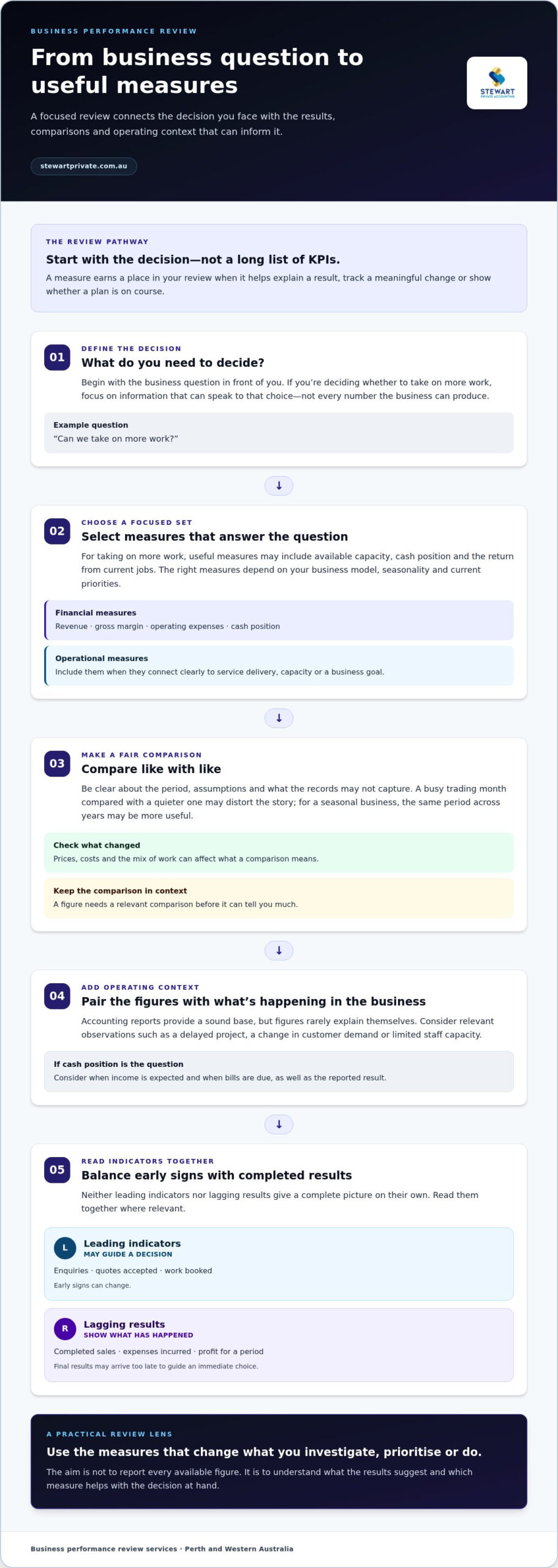
Start with the decision you need to make, then choose a small set of measures that can inform it. Business performance review services are most useful when they focus on your questions, rather than presenting a long catalogue of key performance indicators (KPIs). If you’re deciding whether to take on more work, for example, you may need to understand available capacity, cash position and the return from current jobs, not track every number the business can produce.
A KPI is useful when it helps you make a business decision. A measure that doesn’t change what you investigate, prioritise or do may not deserve space in your review. Choose measures that explain a result, track a meaningful change or show whether a plan is on course.
Depending on your business and the question at hand, useful financial measures might include revenue, gross margin, operating expenses and cash position. Include operational measures when they connect clearly to service delivery, capacity or a business goal. For a service business, that could mean comparing upcoming booked work with available staff time. For a product business, stock movement may help explain sales or cash tied up in inventory. The right measures depend on your business model, seasonality and current priorities.
It also helps to distinguish between leading indicators and lagging results. Leading indicators offer information that may guide a decision, such as enquiries, quotes accepted or work booked. Lagging results show what has already happened, such as completed sales, expenses incurred or profit for a period. Neither gives a complete picture on its own: early signs can change, while final results may arrive too late to guide an immediate choice. Read them together where relevant.
How do you turn numbers into meaningful context?
A figure needs a fair comparison before it can tell you much. Compare like with like, and be clear about the period, assumptions and anything the records may not capture. Comparing a busy trading month with a quieter one may distort the story; comparing the same period across years may be more useful for a seasonal business. Changes in prices, costs or the mix of work can also affect what a comparison means.
Accounting reports provide a sound base, but figures rarely explain themselves. Pair them with relevant operating observations, such as a delayed project, a change in customer demand or a period when staff capacity was limited. If cash position is the question, consider when income is expected and when bills are due, as well as the reported result. The Perth small business cash flow management guide offers further context for that review.
Keep the discussion practical: what changed, what might explain it, and what decision could follow? If you’d value support connecting accounting information with business priorities, Stewart Private Accounting’s business advisory support can help you interpret results and consider next steps.
Which business performance review approach gives SMEs the clearest value?
The right approach depends on the decision you need to make and how much context you need. A report-only check may suit a straightforward question, while an owner-led discussion can connect results with what’s happening in the business. An adviser-supported review can add an outside perspective and help turn the discussion into practical next steps. No single approach suits every SME.
A review can feel generic if it presents standard measures without asking what matters to your business. Start with a specific question, such as whether a proposed investment fits the current plan, then interpret relevant information against your circumstances. The comparison below shows how each approach can differ.
What is the difference between a dashboard and an adviser-led review?
A dashboard organises information so you can see selected results in one place. It may help you spot a change, but it can’t explain whether that change reflects a seasonal pattern, a one-off event or a deeper issue. In a discussion, you and an adviser can test assumptions, identify what the figures don’t explain and agree on next steps. That interpretation makes a review more than a display of metrics.
How can an SME keep the review proportionate?
Keep the scope practical. Define the decision, select a manageable set of measures and use records relevant to that question. Avoid analysis that adds effort without clarifying a choice or priority. If planned and actual results are central to the discussion, the business budgeting help practical guide can help you consider that comparison.
For example, if you’re weighing up a planned purchase, focus on the relevant budget, actual results and expected effect on available cash. You don’t need to assess every business function. A tailored scope keeps the conversation grounded in the decision at hand.
For SMEs seeking business performance review services, adviser support offers a collaborative way to interpret results and plan actions. Stewart Private Accounting’s tailored fixed-fee packages provide clarity around fees, and its business advisory support can help connect accounting information with the priorities you’re working through. Explore business advisory support from Stewart Private Accounting.
How can you prepare for a business performance review and act on findings?
A little preparation helps keep a review focused on decisions, not document gathering. Bring information that speaks to the question you want answered, add context about what has changed, then leave with actions someone can own. Business performance review services are most useful when the discussion leads to follow-through, rather than ending with observations alone.
What information should you bring to a review?
Prepare current financial reports, relevant business goals or plans, and actions agreed at a previous review. Add concise notes about changes that may affect results, such as shifts in demand, available capacity or business priorities. A short note about what changed and when can put the figures in context without requiring a lengthy explanation.
Bring your unanswered questions, too. You might want to understand why actual results differ from a budget, whether there’s room to take on more work, or what a change in costs means for a planned decision. A useful review cycle is question, evidence, decision and follow-up. This sequence helps keep the discussion grounded and purposeful.
How do you make review actions stick?
Use the discussion to agree on a manageable number of priorities. For each action, record who’s responsible, a realistic timeframe and how you’ll recognise progress. “Improve cash flow” is too broad to track on its own. “Review outstanding invoices and check collection progress at the agreed follow-up” gives the business a clearer task and a point for discussion.
Revisit actions at a practical check-in point that suits the work. If an action is delayed, discuss what’s getting in the way and whether the plan needs adjusting. If it’s complete, note what changed and whether further action is needed. This keeps follow-through constructive rather than turning the action list into another report.
- Set the review question. Identify the decision or issue you want the discussion to clarify.
- Gather relevant evidence. Bring current reports, plans and prior actions that relate to the question.
- Add business context. Note changes in demand, capacity or priorities that may help explain the results.
- Agree on priorities. Choose actions that are practical and connected to the review findings.
- Record and revisit progress. Give each action an owner, timeframe and measure of progress, then check in at the agreed point.
If an agreed action depends on planned spending, compare the budget with actual results before committing resources. The small business budgeting help practical guide can support that planning. For collaborative help interpreting results and turning them into a clear action plan, discuss business advisory support with Stewart Private Accounting.
How can Perth SMEs get practical business performance review support?
For a small or medium-sized business, useful review support starts with reliable information and a clear understanding of how the business operates. Bookkeeping helps organise transaction records, while accounting reports bring financial results into view. Business advisory adds a collaborative discussion about what those results may mean for your plans, priorities and decisions.
This connection matters because financial figures rarely explain every change on their own. A shift in cash position, for instance, may need to be considered alongside customer payment timing, upcoming commitments or a change in workload. Bringing accounting and bookkeeping information into an advisory conversation can help you explore those factors and decide what needs attention, without treating a report as the whole story.
What does collaborative review support look like?
Collaborative support is shaped around your business question. You explain what you’re working towards or what has changed; your adviser helps interpret the available information, explore relevant context and agree practical next steps with you. It’s a hands-on process, not a generic checklist imposed on every business. The focus stays on the decisions you need to make and the information that can help inform them.
Stewart Private Accounting is a Perth-based practice supporting SMEs across Western Australia with accounting, bookkeeping and business advisory. The practice is led by Bradley Stewart, a Chartered Tax Adviser and Registered Tax Agent with over 15 years of public accounting and consulting experience. That background brings accounting knowledge into a broader conversation about business priorities and planning.
Tailored fixed-fee packages are designed to provide clarity and avoid surprise bills. They offer a predictable way to understand fees for support, while recognising that each business has different requirements. For a wider view of how advisory support can fit into business decisions, explore the Business Advisory Perth guide.
What is a sensible next step for your business?
Start by identifying the business question you’d like clearer information to answer. You may be weighing up a planned investment, looking at a change in results or deciding where to direct available resources. A useful discussion can then be shaped around your business, the records available and the priorities that matter now. Business performance review services should help you understand the information and consider suitable next steps, rather than simply add another report to your workload.
You don’t need to arrive with every answer. Bring your main question and relevant business information to give the conversation a practical starting point. If you’d like to discuss business advisory support with Stewart Private Accounting, get in touch to talk through your business priorities.
Make your next business decision with greater clarity
Your next step doesn’t need to be a large-scale review. Start with one decision that’s occupying your attention, then consider what information would help you approach it with confidence. A focused conversation can help you separate the immediate question from background noise and decide what deserves attention first.
For Perth and Western Australian SMEs, business performance review services can provide a structured way to connect business information with practical choices. The value lies not in producing more analysis for its own sake, but in creating a clearer basis for decisions that fit your business and its priorities.
Stewart Private Accounting offers a collaborative approach to business advisory, with support shaped around your circumstances. Discuss practical business advisory support with Stewart Private Accounting and take a considered first step towards the decisions ahead.
Frequently Asked Questions
How often should a small business conduct a performance review?
Review key results often enough to keep them useful, then arrange a fuller discussion when a decision or change calls for it. There’s no single schedule for every business. For example, a change in demand may prompt you to look at sales and workload sooner than planned. Choose a rhythm that suits the way you manage the business, and adjust it as priorities or operating conditions change.
Can a business performance review help identify cash flow issues?
Yes, a review can help you examine cash position alongside income, expenses and planned commitments. For example, compare expected customer receipts with supplier payments due over the same period to see where timing could become tight. This doesn’t replace day-to-day cash flow management. It puts the available information into context so you can decide what to check or address next.
What is the difference between a business performance review and an audit?
A business performance review helps you understand results and inform management decisions; an audit is a separate assurance engagement with its own scope and requirements. A review shouldn’t be treated as an audit, an audit opinion or independent assurance. If your business needs assurance, the engagement and requirements are separate from a performance review. Keeping the distinction clear helps you understand what a review can and can’t tell you.
Can a sole trader benefit from business performance review services?
Yes. A sole trader can use a focused review to understand how income, expenses and workload relate to business goals. For instance, looking at income by type of work alongside the time required may help you consider which activities deserve attention. The review can stay proportionate to the operation, without adopting a corporate reporting structure or creating extra measures that don’t support a useful decision.
How much do business performance review services cost?
The fee depends on the scope, information involved and level of advisory support required, so there isn’t one figure that applies to every business. Stewart Private Accounting offers tailored fixed-fee service packages designed to provide clarity and avoid surprise bills. Start with the decision you’re facing and the support needed to define a suitable scope for your business.
Do I need accounting software for a business performance review?
No. Software can help organise records, but it doesn’t interpret results or decide what they mean for your business. A review can use relevant accounting information alongside your goals and operating context. What matters is having information that’s understandable and suitable for the question at hand. If records come from different sources, note where each figure comes from so the discussion can use them consistently.
Should employees be involved in a business performance review?
Relevant employees can contribute useful detail when a review concerns workflow, service delivery or customer experience. For example, a team member who handles bookings may explain why demand is taking longer to fulfil. The owner can choose who has helpful context and what information is appropriate to share. Keep the conversation centred on understanding business performance and improving how work is done, not assessing individuals.