ClickCease

$2.5bn JobTrainer Package: What you need to know

by | Jul 21, 2020

The Government has announced the $2.5bn JobTrainer package to retrain, upskill and open new job opportunities.

JobTrainer for job seekers and school leavers

An additional 340,700 training places will be created to provide no or low cost courses into sectors with job opportunities. The Government is working with the States and Territories to develop a list of qualifications and skill sets to be covered by the program.

JobTrainer for employers

The JobTrainer package has expanded the number of businesses that can access the 50% apprentice wage subsidy and extends the subsidy until 31 March 2021 (from 30 September 2020).

Originally, only businesses with less than 20 employees or larger employers employing apprentices/trainees let go by a small business were able to access the subsidy (for wages paid to apprentices employed by them as at 1 March 2020).

Now, businesses with under 200 employees can access the subsidy for apprentices employed from 1 July 2020.

Employers will be reimbursed 50% of an eligible apprentice’s wage up to a maximum of $7,000 per quarter per apprentice.

Employers will be able to access the subsidy after an assessment by the Australian Apprenticeship Support Network.

Eligibility

For small business:

Employ fewer than 20 people, or
A small business with fewer than 20 people, using a Group Training Organisation, and
the apprentice or trainee was undertaking an Australian Apprenticeship with you on 1 July 2020 for claims after this date. Claims prior to 1 July 2020, will continue to be based on the 1 March 2020 eligibility date.

Claims are open now for small business.

For medium sized businesses:

Employ 199 people or fewer, or
A medium sized business with 199 people or fewer, using a Group Training Organisation, and
the apprentice or trainee was undertaking an Australian Apprenticeship with you on 1 July 2020.

Claims open 1 October 2020 for medium sized businesses.

You will need to provide evidence of wages paid to the apprentice. If the business subsequently is unable to retain the apprentice, another business can access the incentive if they then employ and pay wages to the apprentice.

Final claims for payment must be lodged by 30 June 2021.

How does the apprenticeship subsidy and JobKeeper work together?

They don’t. It is one or the other.

An employer will not be eligible to claim the apprentice wage subsidy for any period where

they choose to claim the JobKeeper payment for the same apprentice.

An employer or Group Training Organisation will not be eligible for the JobKeeper payment where the employer is in receipt of an Australian Government wage subsidy for the same Australian Apprentice (for example Supporting Apprentices and Trainees and the Australian Apprentice Wage

Subsidy).

  • Financial Anxiety Help for WA Entrepreneurs: A Guide Financial Anxiety Help for WA Entrepreneurs: A Guide - What if financial anxiety eases not by solving every business problem at once, but by making the next decision clearer?…

    What if financial anxiety eases not by solving every business problem at once, but by making the next decision clearer? When available cash and upcoming obligations feel uncertain, planning can become difficult and financial administration may seem harder to manage. Seeking financial anxiety help for entrepreneurs WA can start with understanding what’s creating that uncertainty, not blaming yourself for feeling under pressure.

    If you’re carrying these concerns while running a business, you’re not alone in finding the numbers difficult to face. This guide will help you identify the practical pressures behind the anxiety, take manageable steps towards clearer finances and understand where to find support in Western Australia.

    We’ll cover ways to organise your records, review cash flow and prepare for upcoming obligations, along with WA support options that may suit your circumstances. Accurate bookkeeping and regular financial reviews can give you a steadier picture of your business and help you make decisions with greater confidence.

    Key Takeaways

    • Uneven income, overdue invoices, bills, tax obligations and unclear cash flow can all contribute to financial anxiety. They don’t make it a personal failing.
    • Bring bank balances, invoices, bills, payroll and tax records together to see what’s due and choose one manageable next step.
    • Bookkeeping, accounting, business advisory and financial counselling serve different needs. Knowing the difference can help you identify the right kind of support.
    • Use a simple four-week plan to organise records, clarify an obligation and review your progress without trying to solve everything at once.
    • Financial anxiety help for entrepreneurs WA can include clearer bookkeeping, considered tax planning and practical business advice.

    Financial anxiety for entrepreneurs in WA: what may be driving it?

    Financial anxiety is the worry and tension that can arise when you’re unsure whether business income will cover upcoming costs and commitments. It describes an experience, not a diagnosis or a judgement about your ability to run a business. The broader idea of economic anxiety also recognises how uncertainty about financial security can affect people’s wellbeing.

    For a WA business owner, the pressure may come from uneven income, overdue invoices, regular bills, tax obligations or records that don’t show a clear cash flow picture. The causes can shift as the business changes. A start-up may be waiting for reliable income; a growing business may be managing higher costs and new commitments; seasonal trading can make quieter periods harder to predict. When several figures are uncertain at once, each unknown can feel more pressing.

    These pressures don’t mean your business has failed. They may be a signal that you need a clearer picture of what’s happening and suitable support. Seeking financial anxiety help for entrepreneurs WA can begin with identifying which parts of the financial picture are unclear, rather than treating the worry as a personal failing.

    How financial uncertainty shows up in business decisions

    When the numbers feel unclear, you might put off opening accounts, delay a decision about spending or repeatedly check how much money is available. Others may focus on urgent payments while postponing planning. There’s no single response.

    Unclear or outdated records can make it harder to see which invoices are unpaid, what bills are due and how much is available for upcoming commitments. That uncertainty can narrow your focus to the next immediate concern. You don’t need to solve everything at once. Start by noticing which decision feels difficult and what information would help you make it.

    Business pressure and personal wellbeing are connected

    Business concerns can follow you home. Worry about cash flow or obligations may make it harder to sleep, concentrate on daily tasks or be present with family and friends. The effect varies from person to person, but distress that continues or interferes with daily functioning deserves attention.

    Business finance support and mental health support have different roles. Bookkeeping, accounting and business advice can help clarify financial information and inform business decisions. They aren’t treatment for anxiety or a substitute for qualified wellbeing care. If distress is affecting your day-to-day life, consider speaking with a qualified health professional. You can seek that support alongside practical help to understand your business finances.

    How to regain financial clarity when business money feels overwhelming

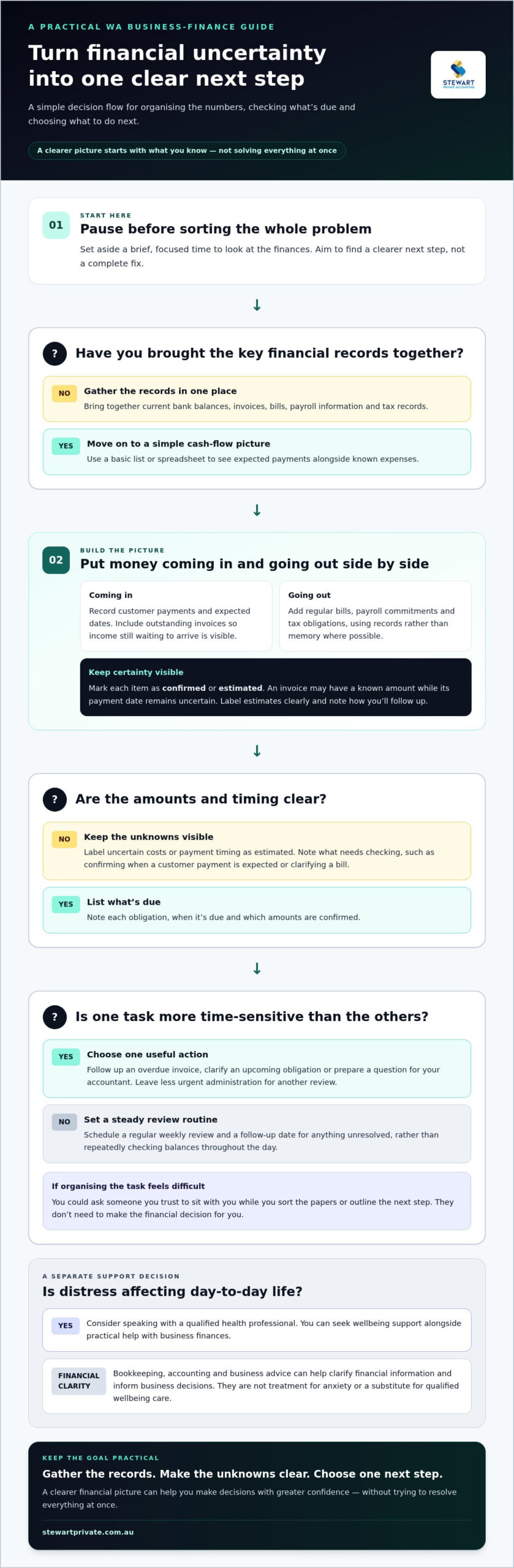
    When business finances feel like too much to sort through, aim for a clearer next step rather than a complete fix. A short, orderly review can help separate what you know from what still needs checking.

    • Pause: Set aside a brief, focused time to look at the finances without trying to solve every issue at once.
    • Gather records: Bring current bank balances, invoices, bills, payroll information and tax records together.
    • List obligations: Note what’s due, when it’s due and which amounts are confirmed.
    • Choose one next action: Follow up an overdue invoice, clarify a bill or prepare a question for your accountant.

    This process makes financial anxiety help for entrepreneurs WA more practical: it turns a general sense of uncertainty into specific items that can be checked, discussed or acted on.

    Build a simple picture of cash coming in and going out

    Use a basic list or spreadsheet to bring expected payments and known expenses into one view. Record customer payments alongside their expected dates, and include outstanding invoices so you can see which income is still waiting to arrive. Add regular bills, payroll commitments and tax obligations, using records rather than memory wherever possible.

    Mark each item as confirmed or estimated. An issued invoice, for example, is a known amount, but its payment date may still be uncertain. If you’re estimating a cost or waiting for a customer to confirm timing, label it clearly and note how you’ll follow up. This keeps estimates visible without presenting them as settled facts.

    Choose one useful action for the next few days

    Once the list is together, identify the most time-sensitive task. That might be confirming when a payment is expected, clarifying an upcoming obligation or raising a payroll question. Leave less urgent administration for another review. Completing one action can give you useful information for the next decision.

    If you plan to speak with an accountant, bookkeeper or support service, prepare the relevant records and write down your questions first. If stress makes organising the task difficult, ask someone you trust to sit with you while you sort the papers or outline the next step. They don’t need to make the financial decision for you.

    Rather than checking balances throughout the day, set a regular weekly review and a follow-up date for anything unresolved. A steady routine makes it easier to notice changes without repeatedly revisiting the same uncertainty. If you’d value help turning records into a clearer financial picture, bookkeeping and accounting support can provide a practical starting point.

    Which financial anxiety support is right for a WA entrepreneur?

    The right support depends on what’s causing the pressure. Trouble keeping records current calls for a different response from debt concerns or distress affecting your wellbeing. These forms of help can work alongside one another, but each has a distinct purpose.

    SupportWhat it can help withConsider it when
    BookkeepingOrganising transaction records and keeping accounts up to date.Records are behind, transactions are hard to track or you need a clearer view of business activity.
    Accounting and tax adviceUnderstanding financial information, tax obligations and planning questions.You need help interpreting accounts or preparing for tax-related decisions.
    Business advisoryReviewing financial information and considering practical business decisions.You want to assess options using a clearer view of how the business is performing.
    Financial counsellingSupport with personal financial difficulty and debt-related concerns.Debt pressure is affecting your personal finances or feels difficult to manage.

    When accounting, bookkeeping or business advice may help

    Bookkeeping can help organise business transactions and keep records current, so you’re not relying on memory to understand what has come in or gone out. Accounting and tax advice can help clarify obligations and planning questions using your financial records. Business advisory can help you consider what the information means for decisions such as managing costs or planning ahead. These services address business finances; they don’t replace personal financial counselling or mental health care.

    WA support for debt pressure and financial wellbeing

    The Small Business Debt Helpline is a resource for business owners facing debt concerns. The Financial Wellbeing Collective is a WA resource for financial wellbeing support. These services offer a different kind of support from accounting, bookkeeping and business advisory.

    SBDC WA, Curtin Tax Clinic and ECU Tax Clinic are other names associated with support in WA. Their services may address different needs, so identify whether your main concern is overdue records, a tax question, a business decision, debt pressure or personal distress. That first distinction can make financial anxiety help for entrepreneurs WA more focused and help you find the type of support that fits the concern.

    Financial Anxiety Help for WA Entrepreneurs: A Guide

    A practical plan for managing financial anxiety over the next month

    A month-long plan can turn financial uncertainty into a series of manageable tasks. Keep the scope modest: organise one set of records, clarify one obligation and decide when you’ll follow up. The aim is to build a useful routine, not to make every business or personal concern disappear through budgeting alone.

    • Week 1: Gather one set of records. Choose a practical starting point, such as unpaid invoices or upcoming bills. Bring together the relevant documents and mark any missing information.
    • Week 2: Clarify one obligation. Check the amount, due date and next step for a priority payment or tax matter. If you’re concerned about a payment, record the issue and include it in the questions you raise with your accountant.
    • Week 3: Assign follow-up actions. Note who will handle each task and when it needs to happen. If a record is incomplete or difficult to interpret, consider whether bookkeeping or accounting support would help.
    • Week 4: Review progress. Look at what’s clearer, what remains unresolved and which support would be useful next. Set a date for the next review.

    Set a repeatable weekly money check-in

    Choose a consistent time each week to review current balances, upcoming payments and outstanding invoices. Keep the check-in brief and use a small dashboard of figures that matter to your decisions, rather than monitoring every transaction throughout the day. Record decisions, the person responsible and the follow-up date so important tasks don’t rely on memory alone.

    Use the review to update what has changed, not to judge yourself for what hasn’t been done. If a payment date or amount is still uncertain, label it as unresolved and record how you’ll seek clarification. A regular routine can help you notice issues earlier, while leaving room to adjust the plan as the business changes.

    Know when to bring in additional support

    If records remain incomplete or hard to interpret, a bookkeeper or accountant can help bring the information into order. For debt concerns, financial counselling may be relevant. If worry persists or affects everyday life, seek support from a qualified health professional. Financial advice and wellbeing care address different needs, and you can seek both.

    For financial anxiety help for entrepreneurs WA, steady follow-through matters more than trying to fix everything in one sitting. If you’d like support keeping business records clear and using them to inform decisions, discuss bookkeeping and business advisory support.

    How Stewart Private Accounting can help bring order to business finances

    Once you’ve started gathering the numbers, the next challenge is making them useful. Current bookkeeping can give you a more organised view of business activity, including income received, expenses recorded and obligations coming up. With clearer records, you have a steadier base for planning and can spend less effort piecing together what has happened.

    Turn business records into clearer decisions

    Organised financial information can make cash flow discussions more grounded. You can consider what’s coming in, which costs need attention and what questions remain unanswered, rather than relying on guesswork. Regular financial reviews also give you a chance to raise questions as they arise, before they build into a longer list of concerns.

    Accounting and tax planning can help clarify financial information and obligations, while business advisory can support you to consider practical decisions in light of that information. These services can improve visibility and support informed choices, but they can’t resolve every business challenge or replace qualified support for personal distress. They’re a practical part of managing the business, not a promise that uncertainty will disappear.

    A steady, tailored relationship with a Perth accounting practice

    Stewart Private Accounting is a Perth-based practice led by Bradley Stewart, a Chartered Tax Adviser and Registered Tax Agent with more than 15 years of public accounting and consulting experience. The practice provides accounting and taxation, bookkeeping, tax planning and business advisory to help owners make sense of their financial information and consider their next steps.

    Support is tailored to your business needs. Fixed-fee packages cover accounting, tax and advisory services with predetermined fees, providing clarity about costs and avoiding surprise bills. The right support requirements will differ from one business to another.

    If you’re looking for financial anxiety help for entrepreneurs WA, structured accounting support can make business information clearer and decisions more considered. It won’t replace mental health or financial counselling support where that’s needed, but it can provide a more orderly foundation for managing business finances. Discuss accounting support for your business and explore an approach tailored to your circumstances.

    Build a clearer way forward for your business

    Financial uncertainty can make it harder to plan, but it doesn’t mean you’ve failed. Start by identifying what’s unclear, bringing your records together and choosing one practical next step. A regular review can help you keep track of business activity and upcoming obligations, while the right support can help you make better-informed decisions.

    For financial anxiety help for entrepreneurs WA, remember that business finance support and personal wellbeing care serve different needs. Bookkeeping, accounting, tax planning and business advisory can bring structure to your business finances, while persistent distress may call for qualified health support.

    Stewart Private Accounting is led by Bradley Stewart, a Chartered Tax Adviser and Registered Tax Agent with more than 15 years of public accounting and consulting experience. Tailored fixed-fee packages are designed to provide clarity and avoid surprise bills, with support shaped around your business requirements.

    Discuss a clearer approach to your business finances and consider how structured accounting support can fit your needs. Take the next step towards a clearer view of your business finances with Stewart Private Accounting.

    Frequently Asked Questions

    Can financial anxiety affect how I run my business?

    Yes, financial anxiety can affect business decisions and daily focus. You might put off reviewing accounts, delay a purchase decision or keep checking available funds because upcoming payments feel uncertain. These responses differ from person to person, and they don’t prove your business is failing. Start by identifying what information is missing or unclear. If worry is affecting your everyday functioning, consider seeking support from a qualified health professional as well as practical business finance advice.

    What should I do first if business finances feel overwhelming?

    Start by pausing and gathering one set of relevant records, such as current bank balances, invoices, bills, payroll information and tax records. List immediate obligations, their due dates and which figures are confirmed or estimated. Then choose one useful next action, such as following up an overdue invoice or clarifying a payment date. Financial anxiety help for entrepreneurs WA can begin with this manageable process, rather than trying to resolve every concern at once.

    Is financial counselling available to small business owners in WA?

    Financial counselling resources are available in Western Australia, but the support provided can vary. The Small Business Debt Helpline and the Financial Wellbeing Collective are examples of resources for people seeking financial support. Financial counselling may help with debt concerns, while bookkeeping or accounting support addresses business records and financial information.

    What is the difference between a financial counsellor and an accountant?

    A financial counsellor can support people experiencing financial difficulty, including debt-related concerns and options for managing them. An accountant helps with business financial information, accounting and taxation matters, and tax planning. The roles are different and may complement each other. For example, a business owner dealing with debt pressure might seek counselling for that concern and accounting advice to understand records or tax obligations. Accounting support isn’t mental health treatment or a replacement for financial counselling.

    How can a bookkeeper help when I feel anxious about business finances?

    A bookkeeper can help organise transaction records and keep business accounts current, making it easier to see recorded income and expenses. Clearer records can help you prepare for a review, spot missing information and understand what questions to raise about upcoming obligations. Bookkeeping won’t remove every business challenge or treat anxiety, but it can reduce the work involved in piecing together financial activity. If distress is affecting daily life, consider qualified wellbeing support too.

    What happens if my business cannot meet an upcoming payment?

    If you’re concerned about meeting a payment, review the amount, due date and available records, then note the issue and the questions you need answered. Keep a record of any steps you take and the follow-up required. An accountant can help clarify the business figures or tax information involved. If debt concerns are broader or affecting personal finances, financial counselling may be relevant.

    Can an accountant help me understand cash flow and tax obligations?

    Yes, an accountant can help you interpret financial records, discuss cash flow and clarify tax planning questions relevant to your business. Current, organised bookkeeping gives those discussions a stronger foundation, while regular reviews can help you identify upcoming obligations and decisions that need attention. This support is practical, not a guarantee that cash flow problems will disappear. For financial anxiety help for entrepreneurs WA, clearer financial information can be one part of a broader support plan.

  • Chartered Tax Adviser Perth: What to Expect from Expert Tax Support Chartered Tax Adviser Perth: What to Expect from Expert Tax Support - What if a tax adviser’s professional qualification and their registration to provide tax agent services describe two different things? A…

    What if a tax adviser’s professional qualification and their registration to provide tax agent services describe two different things? A search for “chartered tax adviser Perth” support often starts with that question, alongside a practical concern: how can you meet your obligations and make financial decisions with confidence?

    It’s worth looking beyond a title. The right support should pair recognised tax expertise with guidance that’s relevant to your personal or business circumstances. This article explains what the Chartered Tax Adviser designation means, how it differs from Registered Tax Agent status, and what to consider when choosing tax and accounting support in Perth.

    It also looks at how tax planning, bookkeeping and business advice can work together, and why clear service arrangements matter when you’re setting a budget. At Stewart Private Accounting, Bradley Stewart is a Chartered Tax Adviser and Registered Tax Agent with over 15 years of public accounting and consulting experience. This guide will help you understand your options and take a considered next step.

    Key Takeaways

    • Understand how the Chartered Tax Adviser designation differs from Registered Tax Agent status, and why each may matter when seeking tax support.
    • A chartered tax adviser Perth clients work with can connect tax compliance with practical support such as bookkeeping, business advice and tax planning.
    • Assess whether support fits by considering your circumstances, the adviser’s relevant experience, their communication style and fee clarity.
    • Be ready to discuss your business structure, record-keeping and reporting responsibilities so advice can reflect your situation.
    • Bradley Stewart brings over 15 years of public accounting and consulting experience to his work as a Chartered Tax Adviser and Registered Tax Agent.

    What does a Chartered Tax Adviser in Perth do?

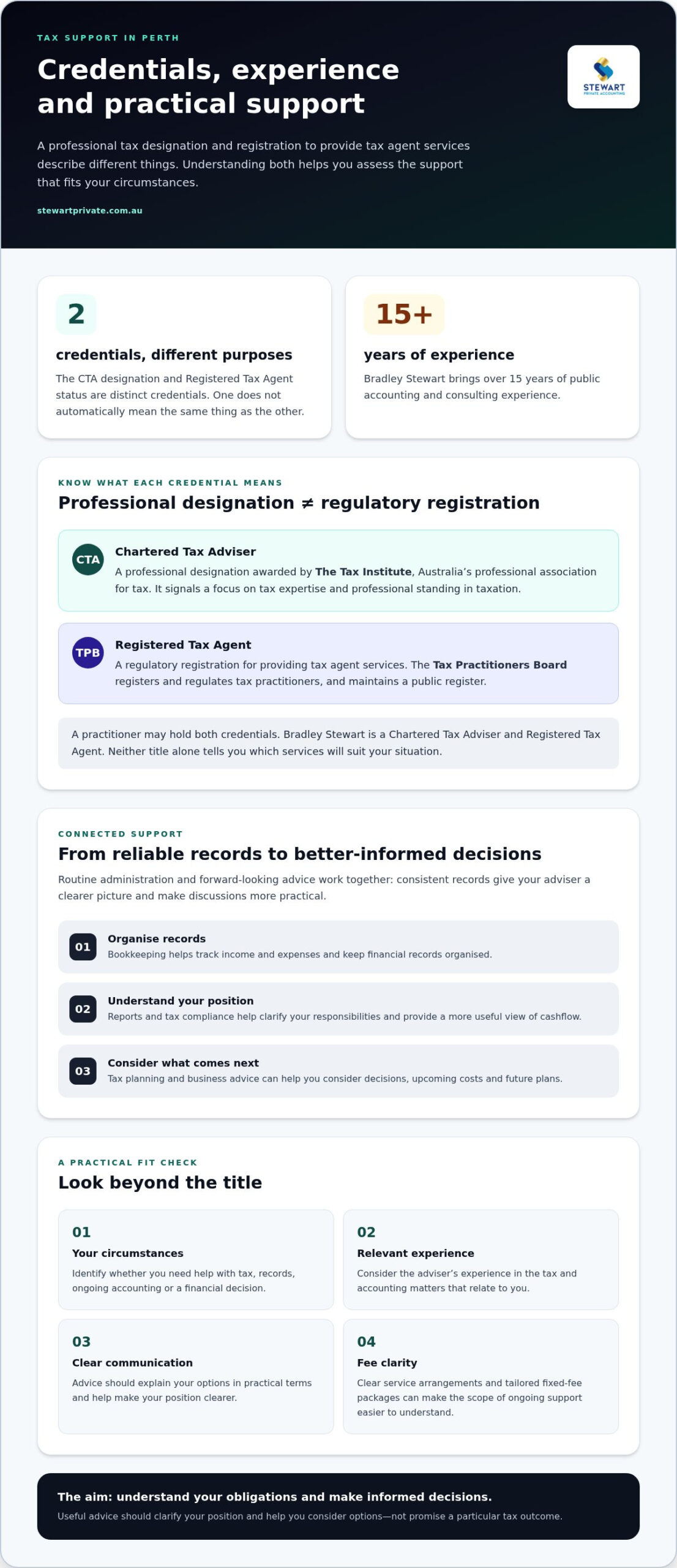
    A Chartered Tax Adviser (CTA) is a tax professional who holds a designation awarded by The Tax Institute, Australia’s professional association for tax. In practical terms, a chartered tax adviser Perth clients work with can explain how tax rules relate to their circumstances, support tax compliance and help them consider options for future decisions.

    That support may include clarifying reporting responsibilities, organising tax records or assessing the tax implications of a business or personal decision. Useful advice should make your position clearer, rather than promise a particular tax outcome. For broader context, Taxation in Australia covers the federal and state systems in which this advice sits.

    What does the CTA designation represent?

    The CTA designation is a professional credential associated with The Tax Institute. It signals a focus on tax expertise, but it doesn’t guarantee a particular result or describe every service a practitioner provides. Your needs may extend beyond technical tax advice, so consider the adviser’s relevant experience and whether they explain your options in clear, practical terms.

    For example, a small business owner planning a change may need to understand its tax implications while keeping day-to-day records organised. Clear advice can help them weigh options and plan next steps with a better understanding of their responsibilities.

    How is a Chartered Tax Adviser different from a Registered Tax Agent?

    The distinction is between a professional designation and a regulatory registration. The Tax Institute awards the CTA designation, while the Tax Practitioners Board (TPB) registers and regulates tax practitioners, including registered tax agents. These credentials serve different purposes, and one doesn’t automatically mean the same thing as the other.

    Registered Tax Agent status relates to providing tax agent services under Australia’s regulatory framework. Registration requirements are set by the TPB, which maintains a public register. The CTA designation, by contrast, recognises a person’s professional standing in taxation through The Tax Institute. A practitioner may hold both, as Bradley Stewart does, but neither title alone tells you which services will suit your situation.

    When comparing credentials, consider the whole picture: what you need help with, the adviser’s experience in relevant tax and accounting matters, and how clearly they communicate. A strong working relationship should leave you better equipped to understand your obligations and make informed decisions.

    How a Perth tax adviser can support your business and personal tax needs

    Tax support is most useful when it links the regular work of keeping records and meeting obligations with decisions about what comes next. A chartered tax adviser Perth clients work with can coordinate accounting and taxation support so you can understand your current position and consider the choices ahead.

    Routine administration includes organising financial records, preparing reports and managing tax compliance. Forward-looking advice uses that information to help you consider business decisions, cashflow and tax planning. The two are connected: accurate, consistent records give your adviser a clearer picture and make discussions more practical.

    Support for Perth small and medium-sized businesses

    For a business, support can bring together accounting, tax obligations, bookkeeping and business advice. Well-maintained books help you track income and expenses, while clear reporting gives you a more useful view of cashflow. That visibility can help you plan for upcoming costs and consider how a decision may affect the business.

    Your needs may change as your business develops. A newer business may need reliable bookkeeping and help understanding its reporting responsibilities. An established SME may benefit from advice that takes its current operations and future plans into account. Tax planning can form part of that wider picture, rather than sitting apart from everyday financial management.

    Clear service arrangements matter, too. Tailored fixed-fee packages make the scope of ongoing support easier to understand. For more on this approach, read the guide to fixed-fee accounting support.

    Support for individuals and business owners

    Your personal tax position may connect with your business income, investments or longer-term financial decisions. If you own a business, considering personal and business matters together can help you see how one decision may affect the other. Superannuation strategies may also form part of a broader discussion, depending on your circumstances. They shouldn’t be treated as a promise of a particular result.

    Bradley Stewart’s work brings tax expertise together with practical accounting, bookkeeping and business advice. The Tax Institute is the professional body associated with the Chartered Tax Adviser designation, while day-to-day support still needs to fit each client’s situation. Explore Stewart Private Accounting’s tax and accounting support to see how these services can work together.

    How to assess whether a Chartered Tax Adviser is right for you

    Choosing tax support is about fit, not just credentials. Start by identifying what you need help with: a tax return, ongoing business accounting, clearer records or advice before a financial decision. Then consider whether the adviser has relevant experience, explains matters in plain language and sets out the work and fees clearly.

    The right level of guidance depends on your circumstances. If your needs are straightforward, you may only need focused help with a specific tax matter. If you run a business or have connected personal and business decisions, coordinated accounting, tax and advisory support may be more useful. The aim is to identify the help that’s relevant, not to take on services you don’t need.

    Look beyond the designation

    Consider how an adviser’s experience relates to your situation and whether their explanations help you make informed choices. A clear scope of work should set out the services included and what you can expect, so you share an understanding from the outset. Bradley Stewart brings over 15 years of public accounting and consulting experience. That’s useful context, not a universal benchmark for every client.

    Notice how the adviser responds to your questions. You should be able to understand the advice, the practical steps involved and where a decision may affect your tax position. A strong working relationship depends on clear communication as well as technical knowledge.

    Consider how fees are structured

    A tailored fixed-fee package can make the agreed work and fee easier to understand before you proceed. It can also support more predictable budgeting when the scope reflects your needs. No fee model is automatically right for everyone, and a fixed fee doesn’t mean the same services are included by every practice.

    Compare what’s covered, how additional work is handled and whether the arrangement suits the support you need. For more context, see this guide to accountant costs in Perth. You can also explore the differences between fixed-fee and hourly arrangements as you consider which structure feels clearest for your business.

    For a chartered tax adviser Perth clients can work with confidently, look for relevant expertise, practical communication and a clear agreement that fits your circumstances. Explore Stewart Private Accounting’s tax and accounting support to see how tailored assistance can bring these elements together.

    Chartered Tax Adviser Perth: What to Expect from Expert Tax Support

    What Perth and Western Australian clients should discuss with a tax adviser

    A useful tax discussion starts with your circumstances, not a generic checklist. Your business structure, income sources, record-keeping processes and reporting responsibilities can all affect what needs attention. A chartered tax adviser Perth clients consult can help clarify which matters apply to them and what to prioritise.

    Deadlines and obligations can depend on your circumstances and the type of reporting involved. Before acting on a due date or compliance requirement, make sure the information reflects current Australian Taxation Office (ATO) guidance and your situation. This keeps planning grounded in what applies to you, rather than assumptions based on another business or taxpayer.

    Which records and questions help make an initial discussion useful?

    Bring relevant, current financial records and a short summary of what you want to resolve. The useful information will vary, but you might cover:

    • how your business is structured and how you currently organise financial records
    • which reporting tasks or tax matters you find difficult to manage
    • cashflow concerns or upcoming business and personal decisions
    • questions about your existing bookkeeping and reporting processes

    You don’t need to have every document perfectly organised before seeking guidance. A clear picture of what’s working, what’s unclear and which decisions are approaching gives the conversation a practical starting point. From there, an adviser can help identify relevant priorities and support that fits.

    How can ongoing advice reduce administrative uncertainty?

    Agreed, regular communication can help keep responsibilities visible and address questions as they arise, rather than leaving everything until reporting time. Bookkeeping support can help maintain organised financial records, while accounting and taxation services can help you understand reporting needs and tax matters. If your business has employees, discuss how payroll-related records fit into your overall record-keeping and responsibilities.

    Current, organised records make tax discussions clearer because they give your adviser a more reliable picture of your financial position. That clarity can help focus conversations on what needs attention, whether you’re reviewing reporting processes or considering a business change.

    For practical support with accounting, taxation and bookkeeping, discuss your tax and accounting needs with Stewart Private Accounting.

    Meet Stewart Private Accounting: qualified tax advice with practical support

    For individuals and small to medium-sized businesses, tax advice is most useful when it connects technical knowledge with the practical work of managing finances. Stewart Private Accounting is a Perth-based practice led by Bradley Stewart, a Chartered Tax Adviser and Registered Tax Agent with over 15 years of public accounting and consulting experience.

    That experience sits alongside accounting and taxation services, bookkeeping, business advice and expert tax planning. Bringing these areas together can help you consider routine financial responsibilities alongside the decisions you’re working towards. Support is shaped around your circumstances and the agreed scope, rather than assuming every client needs the same arrangement.

    A tailored approach for Perth businesses and individuals

    Your priorities might include keeping records organised, understanding your tax position or getting a clearer view of your business finances. Stewart Private Accounting tailors support to those needs, with clear communication about the work involved. Tailored fixed-fee packages make the service scope and fees clearer, helping you plan for the agreed support.

    The Trusted Concierge service offers a hands-on approach for clients. The right arrangement depends on your circumstances and priorities. Whether you need a specific accounting or tax service or support across several areas, practical guidance should help you understand your next steps without promising a particular outcome.

    What happens when you start a conversation?

    An initial discussion can focus on your current arrangements, what’s working well and where you’d value support. Explain your business or personal priorities and raise questions about your accounting, tax or bookkeeping needs. This gives the conversation a clear starting point.

    Proposed support should set out the scope of work, responsibilities and fees in a way you can understand. That clarity helps you decide whether the arrangement fits before moving forward. You don’t need to have every question resolved in advance. A considered conversation can help bring the relevant issues into focus.

    If you’re looking for a chartered tax adviser Perth individuals and businesses can turn to for qualified advice and practical accounting support, discuss your accounting and tax needs with Stewart Private Accounting.

    Take the next step with clear, practical tax support

    Choosing a chartered tax adviser Perth clients can work with confidently means looking beyond a professional title. Consider how the adviser’s experience fits your circumstances, whether they explain your responsibilities clearly, and how their services and fees are scoped. A Chartered Tax Adviser designation and Registered Tax Agent status have distinct roles, so understanding both can help you make a more informed choice.

    Good support connects day-to-day accounting and tax compliance with the decisions ahead. Clear, current records help make advice more useful, while tailored fixed-fee packages can make the agreed accounting, tax and advisory support easier to understand and plan for.

    At Stewart Private Accounting, Bradley Stewart is a Chartered Tax Adviser and Registered Tax Agent with over 15 years of public accounting and consulting experience. To discuss support that reflects your priorities, discuss your tax and accounting needs with Stewart Private Accounting.

    A clear conversation can help you identify a practical next step and move forward with greater confidence.

    Frequently Asked Questions

    Is a Chartered Tax Adviser the same as a Registered Tax Agent?

    No. A Chartered Tax Adviser designation is a professional credential associated with The Tax Institute, while Registered Tax Agent status is a registration under Australia’s tax practitioner framework, overseen by the Tax Practitioners Board (TPB). The credentials have different purposes, and neither guarantees a particular result. One person may hold both. Bradley Stewart is a Chartered Tax Adviser and Registered Tax Agent, combining professional tax expertise with registration to provide tax agent services.

    What does a Chartered Tax Adviser do for a small business?

    A Chartered Tax Adviser may help your small business understand tax responsibilities, organise relevant records and consider tax decisions or upcoming obligations. The right support depends on your business and the services agreed. At Stewart Private Accounting, accounting and taxation, bookkeeping and business advisory support can be tailored to client needs. Clear records and relevant advice can help you understand your position, but no particular tax saving or outcome should be assumed without considering your circumstances.

    How do I find a Chartered Tax Adviser in Perth?

    Start by identifying what you need, such as tax compliance, business accounting or ongoing advice. Then consider relevant qualifications and experience, communication style, service scope and fee clarity. You can check tax agent registration through the TPB’s official register and learn about the CTA designation through The Tax Institute. Stewart Private Accounting is a Perth-based practice led by Bradley Stewart, a Chartered Tax Adviser and Registered Tax Agent.

    Can a Chartered Tax Adviser help with tax planning?

    Yes. A Chartered Tax Adviser can provide tax guidance and planning that reflects your circumstances and the services agreed. Useful planning considers current rules, your business or personal objectives and the information available, rather than relying on generic promises of savings. An adviser should explain options and their possible implications in plain language. Check tax requirements and dates against current Australian Taxation Office guidance, as details can depend on your situation.

    Is a Chartered Tax Adviser worth it for a small business?

    It depends on your finances, the decisions you face and how much support you need. An adviser may help bring structure to tax compliance and provide clearer guidance for business decisions, while a smaller or simpler operation may only need focused assistance. Consider relevant experience, communication, responsibilities and fee clarity. A professional designation alone doesn’t determine whether a particular service is right for your business or guarantee a specific outcome.

    What should I prepare before meeting a tax adviser?

    Gather the financial records and recent tax or business documents you have, along with a short list of questions or decisions you’d like to discuss. It can help to outline your business activities, current reporting processes and any upcoming dates you know about. You don’t need to have everything perfectly organised before the conversation. Your adviser can explain what other information would be useful for your circumstances and the support you’re considering.

    How are fixed-fee accounting services different from hourly advice?

    Fixed-fee services set an agreed fee for a defined scope of work, while an hourly arrangement charges according to time spent. Which approach suits you depends on the work required and how clearly it can be scoped. Ask for a plain explanation of what’s included and how additional work is handled. Stewart Private Accounting offers tailored fixed-fee packages for accounting, tax and advisory support, designed to clarify the agreed services and fees.


  • 7 Signs You Need a New Accountant - and How to Decide What Comes Next 7 Signs You Need a New Accountant – and How to Decide What Comes Next - One frustrating interaction rarely tells you it’s time to change accountants. The more useful question is whether the problem keeps…

    One frustrating interaction rarely tells you it’s time to change accountants. The more useful question is whether the problem keeps recurring and whether your accountant takes practical steps to resolve it. The signs you need a new accountant often show up as a pattern: slow or unclear communication, missed follow-through, advice that arrives only when a deadline is close, or support that no longer fits the way your business operates.

    It’s understandable to feel uncertain about what to do next. You may want clearer answers and more help planning for tax and cash flow, without making a major change over one frustrating mistake. This article will help you recognise persistent service problems, raise your concerns and assess whether the response leads to real improvement. You’ll also learn what to look for in accounting support that suits your current needs, and how to decide on a practical next step with a clear head, whether you’re an individual or run a business in Western Australia.

    Key Takeaways

    • Look for recurring service issues rather than deciding based on one late reply or mistake.
    • The signs you need a new accountant may include unclear answers, repeated errors or support that no longer matches your needs.
    • Record what happened and how it affected your obligations or decisions before raising concerns.
    • Use a clear conversation about expectations and responsibilities to assess whether the relationship can improve.
    • When considering a better fit, weigh communication, scope, relevant expertise and planning support; you can check a Registered Tax Agent through the Tax Practitioners Board.

    Signs You Need a New Accountant: When Does a Concern Become a Pattern?

    Reviewing whether your accountant still suits you is a normal part of running a business or managing your finances. Your needs can change over time, and a relationship that once worked well may need to adapt. One late reply or corrected error on its own may not be a reason to leave a long-standing accountant. The more useful question is whether problems repeat, affect your decisions or obligations, and remain unresolved after you raise them.

    Accountants help make sense of financial information and support decisions about what comes next. For a general overview of the profession, Wikipedia explains that Practitioners of accounting are known as accountants. In practice, the value of that support depends on whether it helps with your circumstances and decisions. This checklist is relevant to Australian individuals and small-to-medium businesses, including Perth businesses balancing day-to-day operations with financial planning.

    How to tell a one-off problem from a recurring warning sign

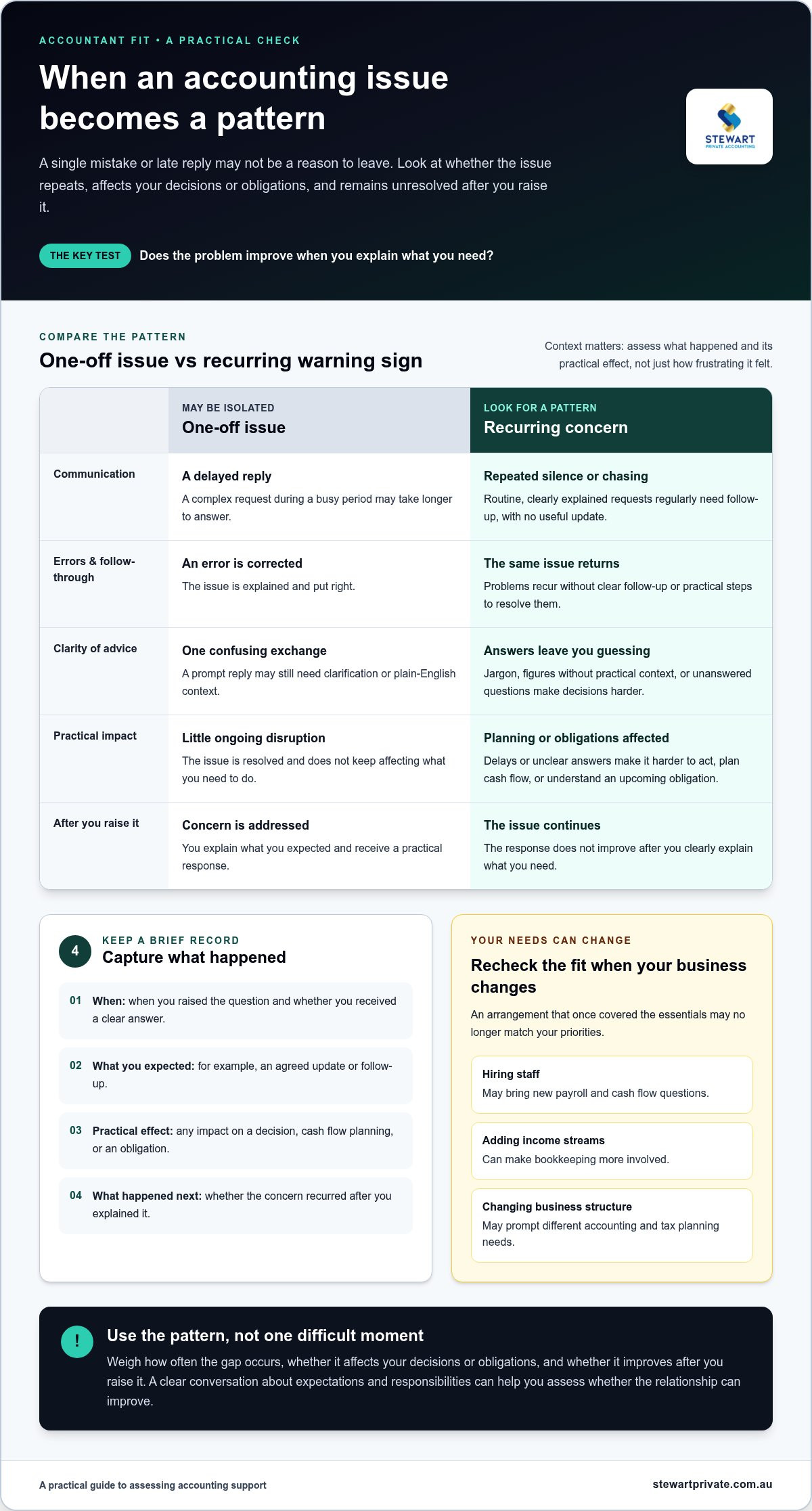
    Context matters. A delayed response to a complex request during a busy period may be different from repeated silence on straightforward questions, especially when you need an answer to make a time-sensitive decision. An isolated error that is explained and corrected is also different from the same issue recurring without clear follow-up.

    Keep a brief record so you can assess what’s happening rather than relying on a general feeling of frustration. Note:

    • When you raised the question and whether you received a clear answer.
    • What you expected, such as an agreed update or follow-up.
    • Any effect on a decision, cash flow planning or an obligation.
    • Whether the concern happened again after you explained it.

    This record isn’t about assuming intent or assigning blame. It helps you distinguish a one-off from a pattern and describe the practical impact calmly. If the issue continues after you’ve raised it clearly, the response is useful information about the relationship.

    Why changing business needs can affect accountant fit

    A business can outgrow an arrangement that once covered the essentials. Hiring staff may bring new payroll and cash flow questions. Adding income streams can make bookkeeping more involved, while a change in business structure may prompt different accounting and tax planning needs. Your priorities may also shift from completing compliance tasks to getting useful guidance for upcoming decisions.

    “Accountant fit means matching your changing needs with consistent, useful support.” If your current service still handles basic bookkeeping or compliance but leaves your newer priorities unanswered, the mismatch may call for a conversation about scope and expectations. Looking at the signs you need a new accountant means weighing the gap, how often it occurs and whether it improves when addressed, rather than reacting to one difficult moment.

    Signs Your Accountant Is Hard to Reach or Leaves You Guessing

    Communication problems matter when they make it harder to manage your finances, not simply because a reply took longer than you hoped. Accountants may have busy periods, and a general query won’t always need the same attention as a deadline-sensitive issue. Consider what you agreed about communication, how often you need to follow up, and whether delays leave you unable to act.

    When slow responses become a meaningful concern

    Ask whether you regularly have to chase routine requests that were clearly explained. One delayed response may have a reasonable explanation; repeated follow-ups with no useful update can become a service concern, particularly if you’re waiting to make a time-sensitive decision or understand an upcoming obligation.

    Consider the effect, too. If you can’t confirm what information is needed, when a task is expected to be completed, or how a financial commitment may affect cash flow, planning becomes harder. Note the date, what you asked, any follow-up and the practical consequence. This helps you describe the pattern accurately without treating every delay as a warning sign.

    When accounting explanations are not helping you decide

    A reply can arrive promptly and still leave you guessing. Repeated jargon, figures without practical context or explanations that don’t answer your question may make it difficult to understand your financial position. You might know a figure has changed, for example, but not what that means for a planned purchase or business decision.

    Ask for the answer in plain English and explain what you’re trying to decide. Then assess whether the response makes the options and relevant figures clearer. Useful accounting advice explains financial choices in terms you can use to make a decision. If the same questions remain unanswered after you’ve clarified what you need, that’s more telling than a single confusing exchange.

    To assess whether communication is a genuine concern, review the pattern against the expectations you and your accountant agreed. Consider whether:

    • Routine, clearly explained requests often require repeated follow-ups.
    • You receive a useful update when a response or task is delayed.
    • Answers address your question and explain what the information means for your next step.
    • Communication improves after you raise the concern directly.

    These are practical signs you need a new accountant to weigh, not an automatic verdict. If the response doesn’t improve, consider what clearer, more hands-on accounting support might look like. For Perth businesses seeking a personal approach, explore accounting and advisory support.

    Signs Your Accountant Is Reactive, Inaccurate or No Longer Suits Your Needs

    Repeated corrections, support that arrives only as a deadline approaches, or advice that no longer fits your business can point to a deeper mismatch. One error that is promptly explained and corrected doesn’t necessarily define the relationship. The concern grows when the same issues return, create extra work or leave you uncertain about what needs attention next.

    Repeated errors and last-minute compliance pressure

    Keep a record of corrections and their practical effects. Note what needed changing, when you raised it, how it was resolved and whether it led to rework, delayed decisions or uncertainty about responsibilities. This creates a fair picture without assuming why an error occurred or drawing conclusions about intent or negligence.

    Also consider whether you receive support only when information is due, rather than enough guidance to prepare in a steady, organised way. Last-minute requests for records, unclear ownership of tasks or recurring gaps in bookkeeping may leave you rushing to assemble information. A single correction or busy period is different from a pattern that repeatedly creates pressure.

    Compliance work focuses on meeting relevant reporting and record-keeping needs. Forward-looking advice uses financial information to help you plan for choices such as managing cash flow or considering a business decision. If you’re unsure about a tax obligation or requirement, check current information from the Australian Taxation Office rather than relying on assumptions.

    When your accountant’s support no longer matches your business

    Your business may have changed since you first agreed on the support you needed. Hiring staff can bring payroll questions; new income streams may make bookkeeping more involved; growth can prompt more frequent cash flow planning. An arrangement focused on routine records or compliance may no longer address the questions you need help with now.

    As business complexity changes, review whether your accounting support still matches the decisions you need to make. Start with a clear conversation about what’s changed and what support would be useful. If the current arrangement doesn’t cover your priorities, the issue may be a mismatch in scope rather than poor service in every area.

    These may be signs you need a new accountant, but assess frequency and impact before deciding. Ask yourself:

    • Are corrections recurring, and do they create repeated rework or uncertainty?
    • Does support arrive early enough for you to prepare, or mainly at the last minute?
    • Have your staffing, income streams or planning needs changed beyond the current support?

    Your answers can help you identify whether a concern calls for clearer responsibilities, a broader conversation about support or a change in accounting relationship.

    7 Signs You Need a New Accountant - and How to Decide What Comes Next

    How to Use This Accountant Checklist Before You Make a Decision

    A checklist is most useful when it helps you make a measured decision, not when it turns every frustration into a verdict. Before deciding whether the signs you need a new accountant are adding up, work through the concerns in order: record what’s happening, assess its impact, raise it clearly, then review the response and any follow-through.

    A practical review process for your accountant relationship

    Start with specific examples rather than a broad conclusion such as “I’m not getting enough support”. Note dates, what you asked or expected, what happened, and how it affected a business or personal decision. Then compare the support you currently receive with your actual needs, including tax, bookkeeping and advisory questions.

    Before speaking with your accountant, decide what a satisfactory resolution would look like. You might want clearer responsibility for providing records, more useful explanations of your financial position or a better understanding of which tasks are included in your arrangement. If fee clarity or scope is part of the concern, this fixed-fee accountant guide for Perth businesses can help you consider what to clarify.

    What a constructive response should help clarify

    Raise your concerns respectfully and focus on what needs to change. A useful discussion should help clarify responsibilities, expectations and next steps. A reassuring promise matters less than a practical plan you can both understand and revisit.

    After the conversation, choose a reasonable review point that suits the issue and any relevant deadlines. There’s no universal timeframe for every concern. Check whether communication, work quality or the agreed support has improved by then. Keep your notes factual, whether the matter is resolved or remains outstanding. That gives you a fair basis for deciding what to do next without assuming one conversation will settle everything.

    If the discussion reveals that your needs have changed, revisit the scope of support you require, such as bookkeeping, tax planning or advice on business decisions. Clear expectations can help you judge whether the relationship is improving or whether a different arrangement may fit better. For accounting and advisory support tailored to your needs, explore support for your business.

    What to Look for in an Accountant Who Fits Your Next Chapter

    A good fit is about more than completing tax and bookkeeping tasks. Look for accounting support that matches the way you operate now, explains financial information clearly and helps you plan appropriately. Accessible communication, a clear scope of work and relevant experience can make it easier to manage routine responsibilities and emerging business questions.

    In Australia, you can check a practitioner’s Registered Tax Agent status through the Tax Practitioners Board. Verify current registration details directly, and consider whether the accountant’s experience and approach align with your needs. The signs you need a new accountant can help you define what isn’t working, but your next choice should be based on the practical support you need going forward.

    Questions that help assess a potential accounting relationship

    Use an initial conversation to understand how the working relationship would operate. Ask how responsibilities are divided, what work is included and how communication is handled. Discuss whether the support can address your current bookkeeping, tax planning or business advice needs.

    Compare how clearly each area is explained, not just how confidently someone describes their service. A useful discussion should leave you with a better understanding of the scope, the way questions are handled and whether the support suits your priorities. Avoid basing the decision on a single promise. Look for a clear, considered fit.

    How steady, personalised accounting support can bring clarity

    For individuals and businesses in Western Australia, Stewart Private Accounting provides tailored fixed-fee accounting, tax and advisory support. Its fixed-fee service packages set predetermined fees for agreed services, helping clarify what the arrangement covers and avoid surprise bills. Services span compliance and bookkeeping to strategic business advice. The practice is led by Bradley Stewart, a Chartered Tax Adviser and Registered Tax Agent, with over 15 years of experience in public accounting and consulting.

    Support that connects compliance with practical questions about cash flow, payroll or business decisions can help you see how accounting work relates to the choices ahead. The right scope depends on your circumstances, so focus on whether the proposed support addresses your current needs and whether the communication feels clear and collaborative.

    If you’re reviewing your accounting relationship and would like to discuss what support could suit your needs, Discuss accounting support for your needs.

    Choose Accounting Support That Moves With You

    The signs you need a new accountant are more meaningful when they form a pattern, affect your decisions and continue after you’ve raised your concerns. Keep the conversation factual, agree on what better support looks like, and review whether communication and follow-through improve. Your needs may change as your business grows, so the right accounting relationship should keep pace.

    For individuals and businesses in Western Australia considering a different approach, Stewart Private Accounting offers tailored fixed-fee accounting, taxation and advisory packages. The practice is led by Bradley Stewart, a Chartered Tax Adviser and Registered Tax Agent with over 15 years of public accounting and consulting experience.

    If you’d like to discuss accounting support that fits your current needs, Discuss accounting support for your needs. A considered next step can bring greater clarity as you plan ahead.

    Frequently Asked Questions

    What are the most common signs you need a new accountant?

    Common signs you need a new accountant include repeated communication delays, answers that don’t address your questions, recurring errors and support that arrives only when a deadline is close. A mismatch can also emerge when your business grows but your accounting support stays the same. Consider how often the problems occur, their effect on your decisions or obligations, and whether they improve after you raise them.

    Should I change accountants if they make a mistake?

    Not necessarily. A single mistake that’s acknowledged, corrected and followed up may not justify ending a long-standing relationship. Look for a pattern instead: repeated corrections, unclear explanations or similar issues continuing after you’ve discussed them. Record what was changed and any practical impact, such as extra work or uncertainty about a decision. This gives you a factual basis for discussing the issue and deciding what to do next.

    How do I know if my accountant is being proactive enough?

    Proactive support helps you understand relevant financial information before a decision or deadline becomes urgent. It might include discussing cash flow, payroll or tax planning in the context of your business, rather than only requesting records when work is due. Consider whether the advice helps you prepare and plan, and whether you know what actions to take. The support should suit your circumstances, not just cover routine tasks.

    Can I talk to my accountant before deciding to leave?

    Yes. A direct, respectful conversation can clarify whether a concern is understood and what can change. Bring specific examples, explain how they affected your work or decisions, and state what support you need. Agree on responsibilities and practical next steps, then review whether the response leads to improvement. You don’t have to decide during that discussion. A considered follow-up can help you assess the relationship more fairly.

    How can I check whether an Australian tax agent is registered?

    You can use the Tax Practitioners Board’s online register to check whether a practitioner is registered as a tax agent. Search using their name or other identifying details, and review the current registration information shown in the register. Checking registration is one part of assessing an accountant’s fit. Also consider whether their experience, communication and agreed services suit your needs as an individual or business in Western Australia.

    Is it a problem if my business has outgrown its accountant?

    Not automatically, but it’s a reason to review whether your current support still fits. Hiring staff, adding income streams or facing new cash flow and payroll questions can change what you need from accounting support. A service that once covered bookkeeping and compliance may not address your current priorities. Discuss the gap and whether the scope can adapt. If it can’t, consider what support would better suit your business now.

    What should I look for in a new accountant?

    Look for clear communication, an understandable scope of work, relevant expertise and support that suits your planning needs. Ask how responsibilities are divided and whether the work can address your bookkeeping, tax planning or business advice requirements. In Western Australia, you can also check a tax agent’s current registration through the Tax Practitioners Board. Stewart Private Accounting offers tailored fixed-fee accounting, taxation and advisory support, led by Bradley Stewart, a Chartered Tax Adviser and Registered Tax Agent with over 15 years of public accounting and consulting experience.